 Everett
 If you're replacing siding in Everett or anywhere else in Snohomish County, you've probably run into two products competing for the same job: James Hardie fiber cement and LP SmartSide engineered wood. Both are marketed as durable, low-maintenance upgrades over vinyl or aging cedar. Both look good in a showroom. But they are built from fundamentally different materials, and those differences matter a lot more here than they would in a dry climate. This guide walks through how each product is made, how it holds up to our weather, and why our crews install only James Hardie.
Two Different Materials, One Job
James Hardie siding is fiber cement — a mix of Portland cement, sand, and cellulose fiber, cured into a dense, rigid board. LP SmartSide is engineered wood — strand-based wood fiber (similar in concept to OSB) bonded with resins and coated with a wax-based moisture treatment called SmartGuard, then finished on the outside.
Both products are sold as siding that outperforms plain wood or vinyl. Where they diverge is in what happens when water gets involved, which is the question that actually decides how a siding job ages on the west side of the Cascades.
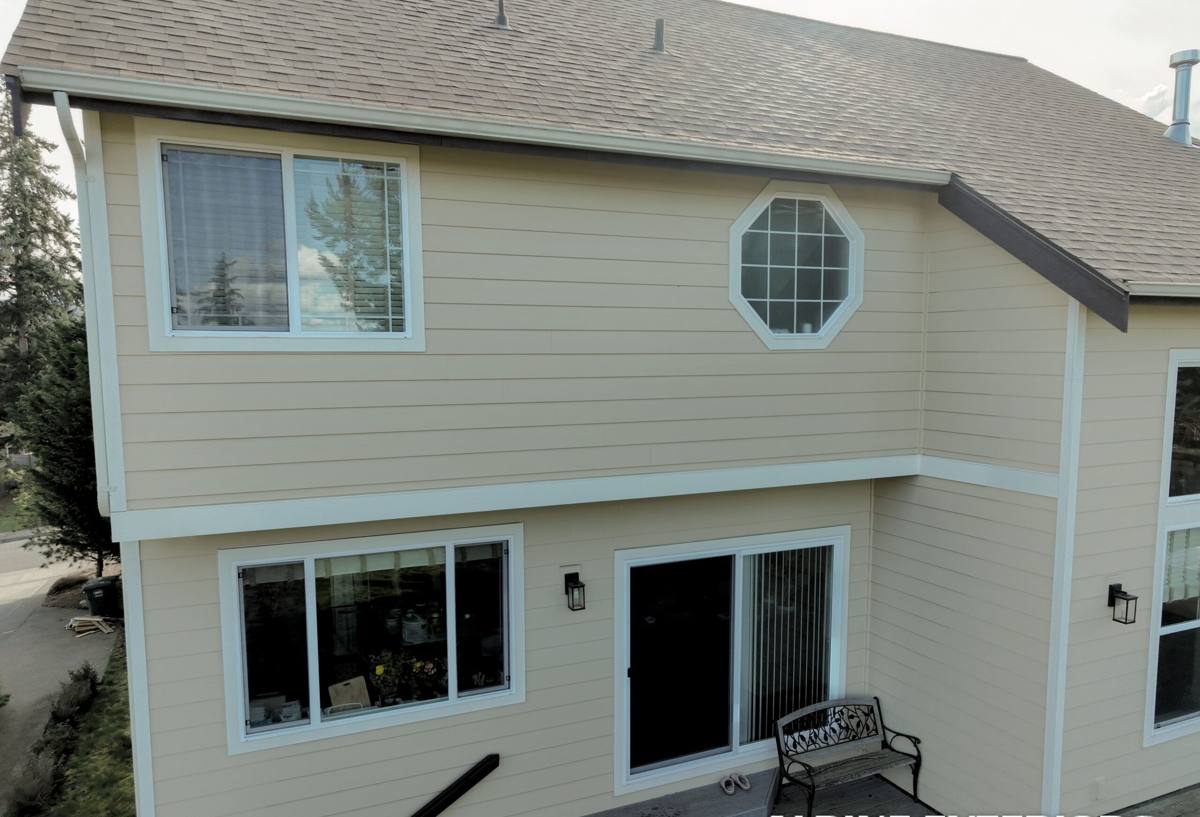
How Each Product Is Built
Fiber cement is inorganic. Cement and sand don't rot, don't feed fungus, and don't swell when they get wet the way wood does. James Hardie's HZ5 product line is specifically engineered for the Pacific Northwest's wet-freeze climate zone, with a formulation tuned for our rainfall and humidity patterns rather than a one-size-fits-all national spec.
LP SmartSide is still, at its core, wood fiber. The SmartGuard treatment — a zinc borate additive plus a resin-saturated overlay — is a real engineering improvement over untreated OSB, and it does slow moisture absorption at the face of the board. But the raw material underneath is organic. If water finds a way past the treated surface, through a cut edge, a fastener hole, a seam, or a failed caulk joint, it's wood fiber on the other side, not cement.
Why This Comparison Matters in Everett and Snohomish County
This isn't a hypothetical concern for homes here. Everett sits on Puget Sound, which means salt-laden air reaches siding on a regular basis, especially on west- and south-facing walls. Add driving rain off the Sound, a moss season that can run from October through May on shaded and north-facing elevations, and long stretches where siding simply doesn't fully dry out between storms, and you have a climate that stress-tests every seam, cut edge, and joint on a house.
None of that is a problem for the field of a properly installed fiber cement wall. It's a bigger problem for any wood-based product, because the failure mode for wood siding is almost always moisture that got past the factory treatment at a cut, a fastener, or a seam — and Snohomish County gives water a lot more opportunities to find those weak points than a drier region would.
Moisture Behavior: The Core Difference
This is the section that actually decides the comparison. Here's what happens to each product when moisture gets past the surface:
| Scenario | James Hardie Fiber Cement | LP SmartSide |
|---|---|---|
| Water reaches a cut edge | No swelling; cement doesn't absorb and expand | Exposed wood fiber unless the cut edge is field-treated with sealer, per LP's own install spec |
| Water sits at a poorly caulked joint | No structural effect on the board itself | Risk of edge swelling and eventual delamination over time |
| Prolonged damp conditions (moss, shade, north wall) | Cement resists fungal growth by nature of the material | SmartGuard resists rot better than untreated wood, but treatment is a surface defense, not immunity |
| Impact or fastener damage | Localized; doesn't compromise surrounding boards | Can create an entry point for moisture into the wood core |
LP is upfront in its own installation instructions that cut edges, top and bottom of the board, must be field-sealed. That's a correct and necessary step — but it also means the product's moisture performance depends entirely on every installer, on every cut, doing that step every time, for the life of the house. Fiber cement doesn't carry that dependency, because there's no wood fiber to protect in the first place.
Fire Resistance
James Hardie fiber cement is noncombustible — it's cement and sand, and it does not contribute fuel to a fire. That's an advantage some Everett homeowners weigh heavily, particularly on homes near dry brush lines or with wood decking and fencing nearby, and it's reflected in some insurance underwriting.
LP SmartSide is a wood-based product. It carries a Class A fire rating as tested per code, which is a real and meaningful standard — but a Class A rating for an engineered wood product and true noncombustibility are not the same thing, and it's worth understanding that distinction before you decide it doesn't matter to you.
Finish, Color, and Long-Term Maintenance
James Hardie's ColorPlus finish is baked on at the factory under controlled conditions, backed by its own separate finish warranty, and is engineered to resist the fading that raw painted surfaces get from UV exposure and salt air. Touch-up is rarely needed for years, and when it is, ColorPlus touch-up product is formulated to match.
LP SmartSide is typically sold primed, requiring a field-applied topcoat after installation, or prefinished through certain dealer programs. Either way, the painted surface is exposed to the same UV and salt-air conditions as any painted wood product, and will need repainting on a normal exterior-paint cycle — call it every 7 to 10 years depending on exposure — to keep the SmartGuard treatment protected underneath. Skipping that repaint cycle is where a lot of engineered wood siding problems start.
Installation Sensitivity
Both products are what installers call "install-sensitive" — meaning the manufacturer's spec has to be followed closely for the warranty to mean anything and for the siding to perform as designed. Correct fastener placement, proper clearances off grade and roof lines, flashing details, and joint treatment matter for both.
Where they differ is the cost of a missed detail. A fastener driven wrong or a joint left unsealed on fiber cement is a cosmetic or localized issue. The same mistake on engineered wood siding gives water a direct path into the wood fiber core, and that kind of damage is often not visible until it's already spread.
- Ask any contractor bidding your siding job whether they're a manufacturer-certified installer for the specific product they're proposing.
- Ask to see how they handle cut edges, seams, and fastener patterns on their own job sites — not just what the spec sheet says.
- Ask what their warranty covers if the siding is installed wrong, versus what's covered if the material itself fails.
- Ask how the product performs specifically in a wet-freeze, salt-air climate like Snohomish County's — not just in general marketing language.
- Get the manufacturer warranty in writing, not a verbal summary, before you sign anything.
Warranty and Cost Comparison
Warranty Structure
| James Hardie | LP SmartSide | |
|---|---|---|
| Material warranty | Non-prorated limited warranty, transferable to a new owner | Limited warranty, terms vary by product line and installation compliance |
| Finish warranty | Separate ColorPlus finish warranty covering fade and chip performance | Coverage depends on whether primed-and-field-painted or factory-prefinished |
| Installer dependency | Coverage tied to installation per Hardie spec | Coverage tied to installation and edge-sealing per LP spec |
Cost Factors
Upfront material and labor cost for LP SmartSide typically runs lower than James Hardie fiber cement — that's real, and it's the main reason it gets specified on cost-driven projects. What that comparison leaves out is the maintenance side of the ledger: a repaint cycle on wood-based siding every 7 to 10 years, versus a ColorPlus finish that's engineered to go much longer between touch-ups. Over the life of a house, especially in a climate that's hard on painted exterior surfaces, that gap narrows the upfront price difference more than most homeowners expect going in.
Our Standard: Why We Install Only James Hardie
We don't install LP SmartSide, vinyl, or any of the other engineered-wood and composite siding products on the market. That's not because those products have no legitimate use — LP SmartSide is a genuine engineering improvement over plain OSB siding, and homeowners in drier parts of the country get good service out of it. It's because we've made a professional decision, based on what actually holds up long-term in Everett's specific combination of salt air, driving rain, and extended damp seasons, and fiber cement is the material that best fits that climate without asking every future owner to stay on top of a repaint schedule to protect what's underneath.
James Hardie's HZ5 line was engineered for exactly this climate zone, the ColorPlus finish removes the repaint dependency that engineered wood carries, and the material itself doesn't have wood fiber to protect from moisture in the first place. When we stand behind a siding installation, we want the material doing the heavy lifting, not just the field treatment applied at time of install.
If you're weighing your options for a siding replacement in Everett or elsewhere in Snohomish County, we're happy to walk your home, look at your specific exposure — sun, wind, shade, proximity to the Sound — and give you a straight answer on what it needs. Reach out for a free, no-pressure estimate using the form below.