 Everett
 Siding That Has to Work Year-Round in West Everett
West Everett sits close to Puget Sound, which means the homes here deal with a specific combination of weather stresses that inland Snohomish County neighborhoods don't see quite as intensely. Salt-tinged marine air off the water, long stretches of driving rain through fall and winter, and a shoulder season where moss and algae get a real foothold on anything that stays damp too long. None of that is dramatic on its own, but stacked together year after year, it's exactly the kind of slow, cumulative exposure that separates siding that holds up for decades from siding that starts failing at year twelve or fifteen.
We install James Hardie fiber cement siding exclusively, and we don't say that lightly. It's a deliberate standard we hold to because of what we've seen happen to other materials in exactly this kind of climate. This page walks through what West Everett homes are up against, how our services address it, and why the material choice matters as much as the installation itself.
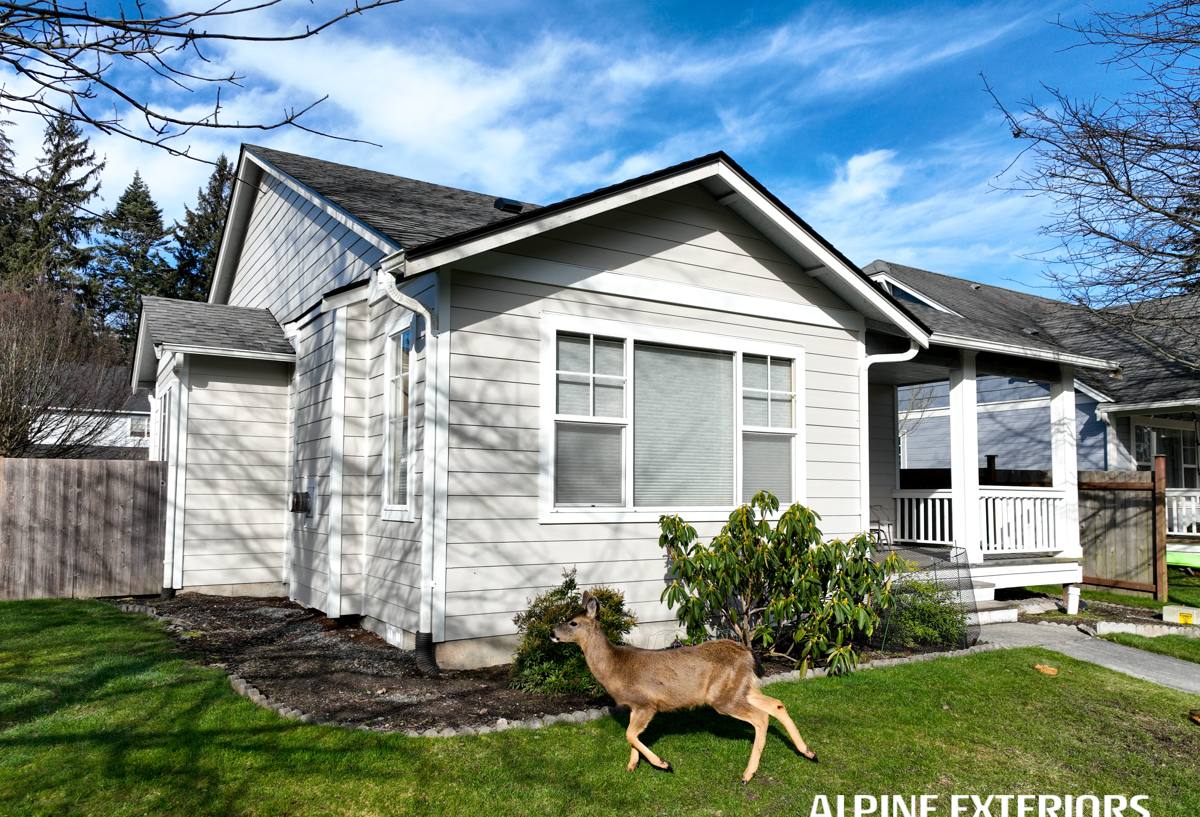
What the Puget Sound Climate Does to a House
Salt Air and Moisture
Homes closer to the water pick up airborne salt that settles on exterior surfaces. Combined with the region's humidity, that salt film can accelerate corrosion on fasteners and hardware, and it contributes to the breakdown of paint films and some composite sidings over time. It's not a dramatic effect in any single season, but it's persistent, and persistent low-grade exposure is what wins over the long run.
Driving Rain
Everett gets wind-driven rain, especially during fall and winter storm systems moving in off the Sound. That means water isn't just falling straight down onto a roofline and running off — it's getting pushed sideways into seams, laps, and trim joints. Any siding system with weak water-shedding details, or any installation with sloppy flashing and caulking, will eventually let moisture in behind the cladding. Once water gets behind siding and can't dry out, you're looking at rot, mold, and sheathing damage that's expensive to fix.
Moss and Algae Season
Between the tree cover common in this part of Snohomish County, the shaded north and west faces of most lots, and months of damp, mild weather, moss and algae growth on exterior surfaces is just a fact of life here. Some siding materials resist this better than others. Surface texture, paint chemistry, and how well a material sheds water all play into how fast green growth takes hold and how hard it is to keep clean.
Why We Only Install James Hardie
James Hardie fiber cement is engineered specifically to handle moisture-heavy climates. It's non-combustible, dimensionally stable (it doesn't expand and contract with humidity swings the way wood-based products can), and it comes with a factory-applied ColorPlus finish that's baked on under controlled conditions rather than painted on-site in variable weather. For a house sitting a few miles from Puget Sound, that combination matters more than it would somewhere dry and inland.
We've made a standard of only installing this one product line rather than offering a menu of options, because we've seen what happens with the alternatives in this exact climate:
- Vinyl siding can warp, fade, and become brittle with UV and temperature cycling, and it doesn't offer the same fire resistance.
- LP SmartSide and other engineered wood products rely on the integrity of a resin-treated wood core — if water gets past the surface at a cut edge or fastener point, the core can swell and degrade.
- Cedar and primed spruce are beautiful but need consistent maintenance — repainting, caulking, moisture monitoring — to survive a wet marine climate, and that upkeep burden falls on the homeowner indefinitely.
- Other fiber cement brands (Cemplank, Allura) are reasonable products, but we've standardized on Hardie's specific HZ5 formulation and warranty structure and would rather do one product exceptionally well than several products adequately.
None of this is a knock on any of those products in the abstract — they all have applications where they perform fine. It's a statement about what we're willing to put our name behind and warranty on a home three miles from tidewater.
James Hardie's Climate-Engineered Product Lines
James Hardie makes region-specific formulations under its "HZ" (HardieZone) system, and the Pacific Northwest falls into the zone engineered for damp, temperate climates. That means the product installed on a West Everett home is formulated for exactly the moisture exposure it will face — not a generic national blend. Combined with the ColorPlus factory finish (which resists fading and chipping better than field-applied paint), it's a system built around the reality of a place like this rather than around a lowest-common-denominator national spec.
Comparing Siding Materials for a Marine Climate
| Material | Moisture Resistance | Maintenance Burden | Fire Rating | Typical Lifespan |
|---|---|---|---|---|
| James Hardie Fiber Cement | Excellent | Low | Non-combustible | 30-50+ years |
| Vinyl | Good (can warp/crack) | Low | Combustible, can melt | 20-30 years |
| Engineered Wood (LP SmartSide) | Fair (core vulnerable if breached) | Moderate | Combustible | 20-30 years |
| Cedar | Fair (needs sealing/repainting) | High | Combustible | 20-40 years with upkeep |
Correct Installation Matters as Much as the Product
Even the best siding material fails if it's installed wrong, and in a climate with this much wind-driven rain, installation details are not optional extras. The things that actually keep water out of a wall assembly:
- Proper weather-resistant barrier and flashing integration behind the siding, not just around windows and doors
- Correct panel gaps, caulking joints, and fastener placement per Hardie's published installation specifications
- Rainscreen or drainage gap detailing where appropriate, so any moisture that does get behind the cladding can dry out and drain
- Proper flashing and kick-out details at rooflines, decks, and other siding-to-structure transitions
A manufacturer's warranty on the material itself doesn't cover a bad installation. That's part of why we treat installation quality, not just product selection, as the actual deliverable.
Beyond Siding: Roofing, Windows, and Decks
Siding doesn't work in isolation — it's one piece of a house's overall weather envelope. We also handle roofing, window replacement, and decks, because a siding project often surfaces related issues: a roofline that's letting water track down behind the wall, aging windows with failed seals contributing to moisture problems at the trim, or a deck ledger board that needs proper flashing where it meets the house. Addressing these together, rather than as disconnected projects, is how you actually solve a moisture problem instead of just moving it around the building.
Signs Your West Everett Home May Need an Exterior Assessment
- Visible moss or dark streaking building up faster than it used to, especially on north- and west-facing walls
- Soft spots, bubbling, or peeling paint on wood trim or siding
- Caulking that's cracked, shrunk, or pulled away from joints and seams
- Rising utility bills that might point to compromised insulation behind aging siding
- Visible warping, cupping, or gaps in existing siding panels
- Water staining on interior walls near exterior corners, which can indicate a wall assembly that isn't shedding water correctly
Why a Local Crew Matters Here
A crew that works Snohomish County regularly knows how West Everett's exposure to marine weather differs from a house a few miles inland in a more sheltered spot. That shows up in small decisions — where to prioritize flashing detail, which faces of the house need the most attention for moss and moisture, how to sequence a project around the region's rainy stretches. It also means someone local stands behind the work if a question comes up years down the road, not a crew that worked the area once and moved on.
What a Project Typically Involves
Every home is different, but a siding project generally follows a similar arc: an on-site assessment of the existing exterior and any moisture or structural issues, a review of Hardie product lines and colors that fit the home, removal of old siding and inspection/repair of the sheathing underneath, installation of proper weather barriers and flashing, and then the Hardie panel or lap siding installation itself with correct fastening and joint detailing. Depending on scope, timelines run from about a week for a straightforward re-side to several weeks for larger homes or projects that include structural repairs.
Cost Factors to Expect
| Factor | Why It Matters |
|---|---|
| Home size and complexity | More linear footage, corners, and trim detail means more labor and material |
| Existing wall condition | Sheathing rot or structural repairs found during tear-off add cost but are essential to fix before re-siding |
| Hardie product line selected | Lap siding, panel systems, and shingle-style products vary in material cost |
| Trim and accent work | Detailed trim, fascia, and accent bands add labor time |
| Access and site conditions | Multi-story homes, tight lots, or landscaping obstacles can affect labor time |
We don't post fixed pricing because every home's condition and scope is different, but we'll walk through the real cost drivers with you during an on-site estimate so there are no surprises.
If you're noticing moss buildup, aging siding, or just want an honest read on how your West Everett home's exterior is holding up against the marine climate, we're happy to take a look. Reach out for a free, no-pressure estimate — use the form below to get started.