 Everett
 Deck Replacement on the Bluff Above Port Gardner Bay
Port Gardner sits on the bluff overlooking Port Gardner Bay, one of the older parts of Everett with a mix of long-established homes and newer construction stacked on the hillside above the water. Decks up here don't just sit in a backyard sheltered by fences and neighboring houses the way they might further inland — a lot of them are elevated, oriented toward the view, and exposed to whatever comes off the bay with nothing much to slow it down. That combination of elevation, exposure, and age is exactly why so many decks in this neighborhood reach a point where patching a board or two stops making sense and full replacement is the honest answer.
This page is about deck replacement specifically for Port Gardner — what the bluff and bay exposure actually do to a deck over time, how to tell when repair has stopped being the right call, what a correct replacement involves, and how our process works for a project in this part of Snohomish County.
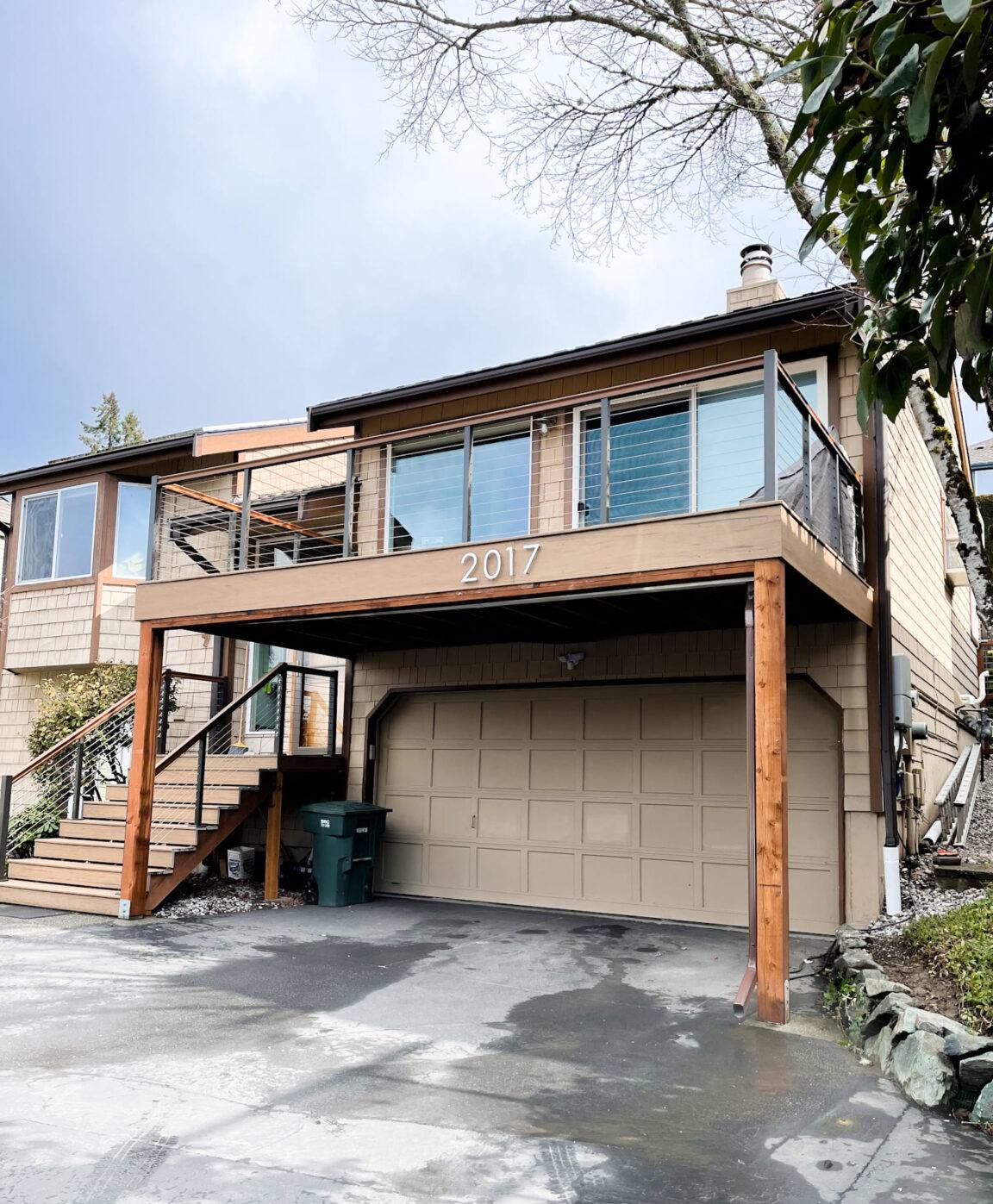
Repair or Replace: Reading the Signs
Not every tired-looking deck needs to come out entirely. A single soft board, a loose railing baluster, or surface graying on an otherwise sound structure can often be addressed without touching the substructure. The harder call is knowing when those small issues are actually symptoms of something bigger underneath, and on an older Port Gardner deck, they usually are.
Signs That Point to Replacement
- Soft or spongy decking in multiple areas, not just one isolated board
- A ledger board pulling away from the house, or visible gaps and staining where the deck meets the wall
- Posts or footings that have shifted, settled unevenly, or show rot at the base
- Railings that flex or feel loose when pushed, especially on an elevated deck where a railing failure is a real fall hazard
- Rust streaking or fastener heads that have corroded and lost their grip
- A deck built decades ago to older code, with framing, spacing, or railing heights that wouldn't pass inspection today
If what you're seeing is limited to the surface — fading, minor splintering, a board or two — repair is often the right and more affordable move. If the problems are in the framing, the ledger connection, or the footings, repair usually just delays the same conversation for a year or two while the underlying damage keeps spreading. On a bluff lot with real elevation involved, that's not a gamble worth taking with a structure people stand on.
What Port Gardner's Climate Does to an Aging Deck
Salt Air Off Port Gardner Bay
Homes on the bluff take in a steady flow of salt-tinged air moving up off the water, and a deck has no siding, no roof overhang, and no wall cavity to shield it — it's fully exposed on every side. Salt air accelerates corrosion in exposed metal: fasteners, joist hangers, post brackets, and railing hardware all lose holding strength as corrosion sets in, often well before the rust is obvious to the eye. On an older deck built with standard hardware instead of corrosion-resistant fasteners, this is frequently the real reason a structure that still looks decent from a distance is actually failing underneath.
Driving Rain and Wind on the Bluff
Elevation that gives Port Gardner homes their view also gives storms coming off the bay less to slow them down before they hit the house. Wind-driven rain doesn't fall straight down here — it gets pushed sideways, up under railings, and into ledger connections and fastener holes that were never designed to shed water from that angle. A deck that looks fine on a calm, dry day can still be taking on moisture every time a storm rolls through with wind behind it, and that moisture works into framing joints long before it shows up as a visible problem on the surface.
A Long Moss Season
Snohomish County's mild, wet stretch of the year gives moss and algae a long growing season, and a horizontal deck surface is one of the first places it takes hold — it holds standing water longer than a vertical wall and stays damp between storms. Shaded decks and north-facing surfaces on hillside lots are usually first to show it, and any decking material with surface porosity gives moss something to grip onto. Left alone, moss growth doesn't just look bad; it holds moisture against the board surface and accelerates the same decay that's already working from the framing side.
Choosing Decking Material for a Replacement
A full replacement is the moment to get the material decision right, since you're not just patching what's already there — you're choosing what the deck will be built from for the next couple of decades. The gap in performance between a well-suited material and a poorly-suited one shows up faster in a bluff, bay-exposed environment like Port Gardner than it would on a sheltered lot further inland.
| Material | Salt Air & Moisture | Moss Resistance | Upkeep |
|---|---|---|---|
| Cellular PVC | Excellent — no wood fiber to absorb moisture | Strong, non-porous surface | Occasional washing |
| Capped composite | Strong — cap layer resists moisture and staining | Good on most product lines | Occasional washing |
| Uncapped composite | Moderate — some absorption at exposed fiber edges | Fair; more prone to buildup over time | Periodic cleaning |
| Cedar | Moderate — natural resistance, needs sealing | Fair when sealed and maintained | Regular oiling or sealing |
| Pressure-treated wood | Weak against sustained salt exposure over time | Poor without regular treatment | Regular sealing or staining |
Composite and PVC decking cost more up front than wood, but on a bluff lot with real bay exposure, the maintenance gap between wood and a capped or PVC product is wide enough that a lot of Port Gardner homeowners decide the difference is worth it over the life of the deck. That said, wood is still a legitimate choice for homeowners who want the traditional look or a lower upfront cost — the honest trade-off is that it needs more consistent sealing and inspection to hold up here, not that it's a bad material.
What a Correct Deck Replacement Involves
A replacement is a full tear-out, not a resurfacing job, and that's exactly what makes it a chance to fix what a repair never could. On an older Port Gardner deck, the substructure is usually where the real work needs to happen:
- Complete removal of the old decking, railing, and any framing that's compromised, with an honest structural assessment of what's underneath before anything gets rebuilt
- Framing sized and spaced to current code and to the specific decking product's span rating, not just matched to whatever was there before
- Stainless steel or coastal-grade corrosion-resistant fasteners and hardware throughout — standard hardware corrodes faster than most homeowners expect in this air
- Proper ledger board flashing where the deck ties into the house, since that connection is one of the most common failure points on an older build
- Footings inspected and, where needed, replaced or reinforced to match the loads and soil conditions on a hillside lot
- Correct board gapping for drainage and material movement, so wind-driven rain can actually drain and dry rather than pooling between boards
- Railing and post attachment sized for real wind exposure, particularly on an elevated deck where a railing carries more consequence if it fails
- Grading and airflow underneath the deck so moisture doesn't sit against the new framing between storms
Skip any one of those steps and a new deck can still look right on day one. The shortcuts show up later, as a soft joist, a loosening post, or corrosion staining bleeding through the new boards a few winters in.
Permits and Code for a Replacement Deck
Replacing a deck in Everett generally requires a permit, and that's worth treating as part of the job rather than an afterthought, especially on a hillside lot where grade, setback, and structural requirements get more scrutiny than they would on flat ground. Older decks in Port Gardner were often built to code that's since changed — railing height, guard spacing, and footing depth requirements have all been updated over the years — so a full replacement is also the point where a deck actually gets brought up to current code rather than being rebuilt to match an outdated original. We handle permitting as part of the project rather than leaving it for the homeowner to navigate separately.
How Our Deck Replacement Process Works
We start with a site visit to assess what's actually there: the condition of the existing structure, ledger and footing condition, sun and wind exposure through the day, and how directly the site faces the bay. That assessment is what tells us whether we're looking at a straightforward replacement or one with added structural work because of settling, rot, or an outdated original build.
From there we walk through decking material options against your budget and how the space actually gets used — a smaller deck off a kitchen door gets used differently than a larger one built around the view. Once the plan and permit are in place, the tear-out and rebuild follow the sequence above: substructure and framing first, sized and fastened for what this site actually sees, then decking, railing, and any stairs. We close out with a walkthrough covering what the specific material you chose needs going forward, which for most modern decking is minimal but not nothing.
Why It Matters That We Already Work Port Gardner
A crew that mostly works flatter, more sheltered parts of Everett can still build a competent deck, but a Port Gardner replacement has variables that come up more often here than elsewhere in the city — footing and structural questions tied to hillside grading, corrosion-grade fastener needs from sustained bay exposure, and wind loads on elevated decks with an open view toward the water. Working this neighborhood regularly means we're not guessing at those requirements on your project. We've seen which decking materials and fastener grades actually hold up against Port Gardner's specific combination of salt air, driving rain, and moss, and which older decks in this area tend to be hiding structural problems that don't show from the surface.
That familiarity also shows up in smaller judgment calls — how to orient a rebuilt deck for the wind a particular bluff lot actually takes, or being straightforward with a homeowner about what their deck genuinely needs to last versus what's just an upsell.
Get a Straight Answer About Your Deck
Whether you're already sure your deck needs to come out or just want an honest read on whether repair is still realistic, we're happy to walk the site with you and lay out the options plainly. Reach out below for a free, no-pressure estimate.