 Everett
 Why Mukilteo Roofs Wear Differently Than Roofs Inland
Mukilteo sits right on Puget Sound, and that waterfront location changes what an asphalt shingle roof has to deal with compared to a home a few miles inland in Everett or unincorporated Snohomish County. Salt-laden air moves off the water and settles on exposed surfaces, wind-driven rain gets pushed sideways into edges and penetrations instead of just falling straight down, and the shade from mature evergreens combined with our long wet season gives moss and moss-friendly algae months at a time to take hold. None of that is dramatic on its own, but stacked together over years, it's exactly the combination that shortens the life of a roof that wasn't detailed correctly the first time.
We're not describing a different roofing system for Mukilteo — asphalt shingles are still one of the most practical, cost-effective roofing materials for this climate. What changes is attention to the details that matter most here: ventilation, flashing, underlayment, and the granule and algae-resistance qualities of the shingle itself. Get those right and a shingle roof will do its job for decades in this environment. Skip them, and you'll see problems years before a shingle roof "should" fail.
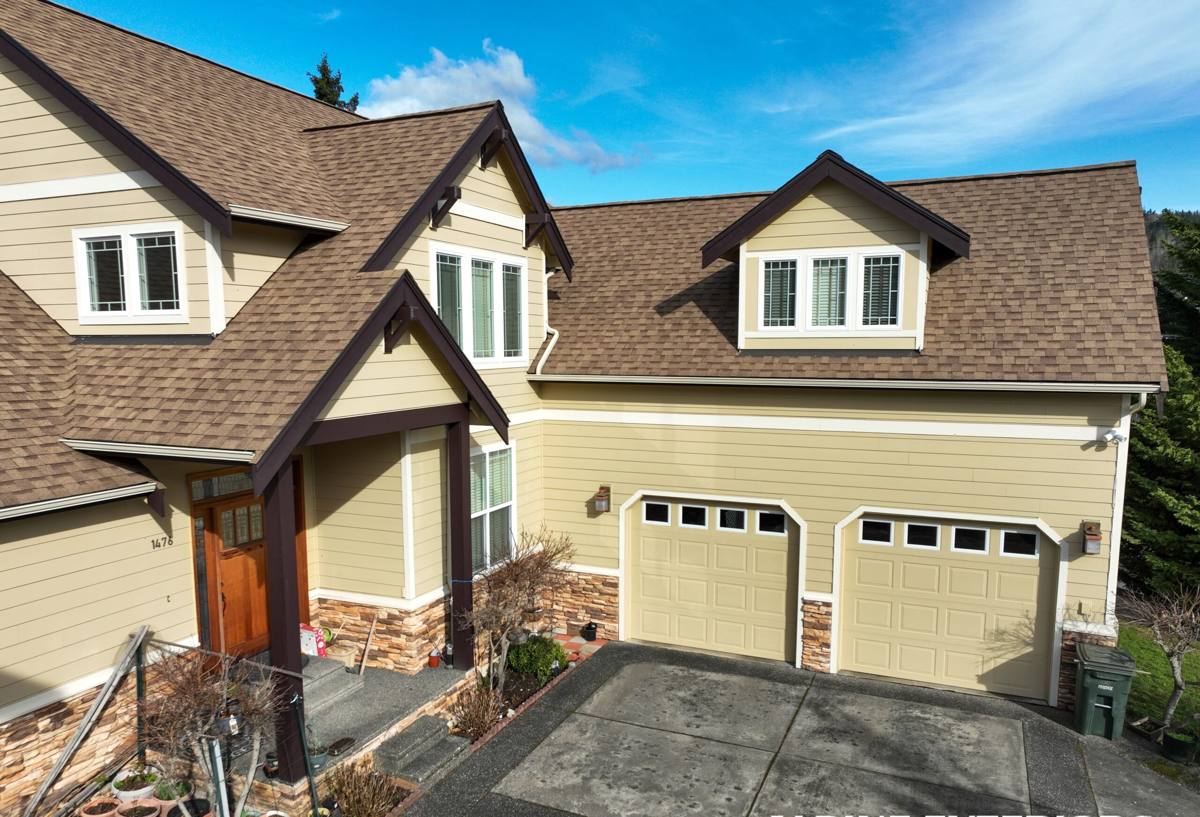
What Salt Air, Rain, and Moss Actually Do to a Shingle Roof
Salt Air
Airborne salt doesn't rot shingles the way it corrodes bare metal, but it does accelerate corrosion on the metal components every shingle roof depends on — nails, flashing, vent housings, and gutter hardware. When those fail early, water finds its way underneath a perfectly good shingle field. This is why fastener and flashing material choice matters more here than it does 20 miles east.
Driving Rain
Straight-down rain is easy for any roof to shed. Wind-driven rain off the Sound gets forced up and under shingle edges, around chimneys, and into valleys and roof-to-wall transitions. A roof that relies only on the shingles themselves to keep water out — without proper underlayment and flashing behind them — is vulnerable exactly in these spots.
Moss and Algae
Shade, moisture, and mild temperatures are a perfect combination for moss growth on north-facing slopes and anywhere debris collects. Moss holds moisture against the shingle surface, lifts shingle edges as it grows, and over time creates channels for water to travel backward under the roof covering instead of off of it. Left unchecked long enough, it can shorten the effective life of an otherwise sound roof.
What a Correct Asphalt Shingle Roof Involves
A shingle roof is a system, not just a layer of shingles nailed to plywood. In our climate, every layer of that system earns its place:
- Ice and water barrier at eaves, valleys, and roof penetrations — the spots most exposed to wind-driven rain and ice damming during cold snaps
- Synthetic underlayment across the full roof deck as a secondary water barrier beneath the shingles
- Proper flashing at chimneys, skylights, sidewalls, and any roof-to-wall transition, using corrosion-resistant metal suited to a coastal environment
- Balanced ventilation — intake at the eaves and exhaust at the ridge — so moisture from inside the home doesn't condense on the underside of the deck
- Correct nailing pattern per the manufacturer's specification, since under-nailing is one of the most common causes of early wind and rain damage
- Algae-resistant shingles on any home with shade exposure or a history of moss and staining
Any one of these done wrong can undercut the whole roof, no matter how good the shingles themselves are. This is where a lot of roof problems in this area actually start — not with the shingle brand, but with a shortcut taken somewhere in the underlayment or flashing.
Choosing the Right Shingle for This Climate
Asphalt shingles come in a range of tiers, and the right choice depends on your roof's exposure, budget, and how long you plan to be in the home. For Mukilteo specifically, we steer most homeowners toward mid-to-upper tier architectural shingles with algae-resistant granules, especially on roofs with any shaded or north-facing area.
| Shingle Tier | Typical Lifespan | Best Fit For |
|---|---|---|
| 3-Tab (economy) | 15–20 years | Budget-driven projects, low-slope simple roofs, sun-exposed sides with little shade |
| Architectural / Dimensional | 25–30 years | Most Mukilteo homes — better wind resistance and a heavier profile that holds up to driving rain |
| Premium / Designer | 30+ years | Homes prioritizing appearance and maximum algae/moss resistance, or steep, highly visible roofs |
Algae-resistant (AR) granules, which use a copper or zinc component to slow moss and algae growth, are worth the modest upgrade cost on almost any Mukilteo roof with shade. They don't make a roof moss-proof, but they meaningfully slow regrowth after cleaning, which matters when you're dealing with a wet season that runs several months long.
Our Installation Process
Every re-roof or new install follows the same sequence, whether it's a straightforward single-story home or a steeper, more complex roofline:
- Inspection and estimate — we look at the existing roof, deck condition, ventilation, and any problem areas before quoting, not after
- Tear-off — full removal of the old roofing down to the deck, with the deck inspected and any damaged sheathing replaced
- Underlayment and ice/water barrier installation — across the full deck, with extra coverage at eaves, valleys, and penetrations
- Flashing — new flashing at chimneys, skylights, walls, and vents rather than reusing old, corroded pieces
- Shingle installation — set to manufacturer nailing specs, with attention to proper overlap and sealing along edges and ridges
- Ventilation check — confirming intake and exhaust are balanced for the attic or roof assembly
- Cleanup and final walkthrough — magnetic sweep for debris and a walk-through so you know exactly what was done
Repair, Restore, or Replace: A Cost-Factor Comparison
Not every roof problem in Mukilteo means a full replacement. The right call depends on the roof's age, how widespread the damage is, and what's driving the issue in the first place.
| Situation | Likely Approach | What Drives Cost |
|---|---|---|
| Isolated leak, flashing failure, or storm damage on a roof under 15 years old | Targeted repair | Access, extent of hidden water damage, matching existing shingle color |
| Heavy moss coverage, granule loss, or widespread minor leaks on an older roof | Full tear-off and replacement | Roof size, pitch, number of penetrations, tear-off complexity, shingle tier chosen |
| Sound shingles but poor ventilation or flashing details | Repair the specific defect, not the whole roof | Scope of flashing/ventilation work needed |
We'll always tell you honestly which category your roof falls into rather than defaulting to the most expensive option. A well-installed shingle roof shouldn't need full replacement just because it has moss on it — but if the underlayment or deck has been compromised, patching over that isn't a real fix.
Living With a Shingle Roof in a Moss-Prone Climate
A correctly installed roof still benefits from some basic upkeep in this environment. This isn't about constant maintenance — it's a short list, done on a reasonable schedule:
- Keep gutters and valleys clear of needles and leaf debris, which trap moisture and give moss a place to start
- Have moss gently removed before it spreads across a slope — soft-washing rather than aggressive scraping protects the granule layer
- Trim back overhanging branches to reduce shade and debris on north-facing slopes
- Have flashing and penetrations checked periodically, since these fail before the shingle field usually does
- Address small leaks quickly — in this climate, a small entry point has months of wet weather to do damage before it dries out on its own
Why Hiring Local Experience in Mukilteo Matters
Roofing crews that mostly work drier, more inland areas don't always default to coastal-grade flashing, full ice-and-water coverage, or algae-resistant shingles unless a homeowner specifically asks for them. A crew that regularly works Mukilteo and the rest of Snohomish County's waterfront communities builds those details in as standard practice, because we see what happens when they're skipped. We know which parts of a roof take the worst of the wind-driven rain off the Sound, which slopes hold moss the longest, and where corrosion shows up first on flashing and fasteners that weren't upgraded for the environment.
That local familiarity also means a straightforward, honest estimate — we're not guessing at what a coastal Snohomish County roof needs, because it's the roof type we work on regularly.
Get a Straightforward Estimate
Whether you're dealing with moss buildup, a leak that's been nagging you, or a shingle roof that's simply reaching the end of its service life, we're happy to take a look and give you an honest read on what it actually needs. Reach out for a free, no-pressure estimate using the form below.