 Everett
 Fiber Cement Siding for Riverside Homes in Everett
Riverside sits along the Snohomish River on the east side of Everett, a neighborhood where older homes on modest lots mix with newer infill construction, and where river-bottom lowland sits close enough to the water and the surrounding wetlands that moisture management on a home's exterior isn't optional — it's the whole game. Add in Everett's usual dose of Port Gardner Bay salt air moving through the wider area and Snohomish County's long, wet fall-through-spring stretch, and Riverside homes end up dealing with a heavier, more sustained moisture load than a lot of the drier, more elevated neighborhoods across the city.
We install James Hardie fiber cement siding exclusively, and in Riverside specifically, that choice is less about brand preference and more about which material actually holds up when a wall spends a good part of the year sitting in damp air with limited drying time between storms. This page covers what Riverside's setting asks of a siding system, what a correct fiber cement install actually involves, and how we approach the work on homes in this neighborhood.
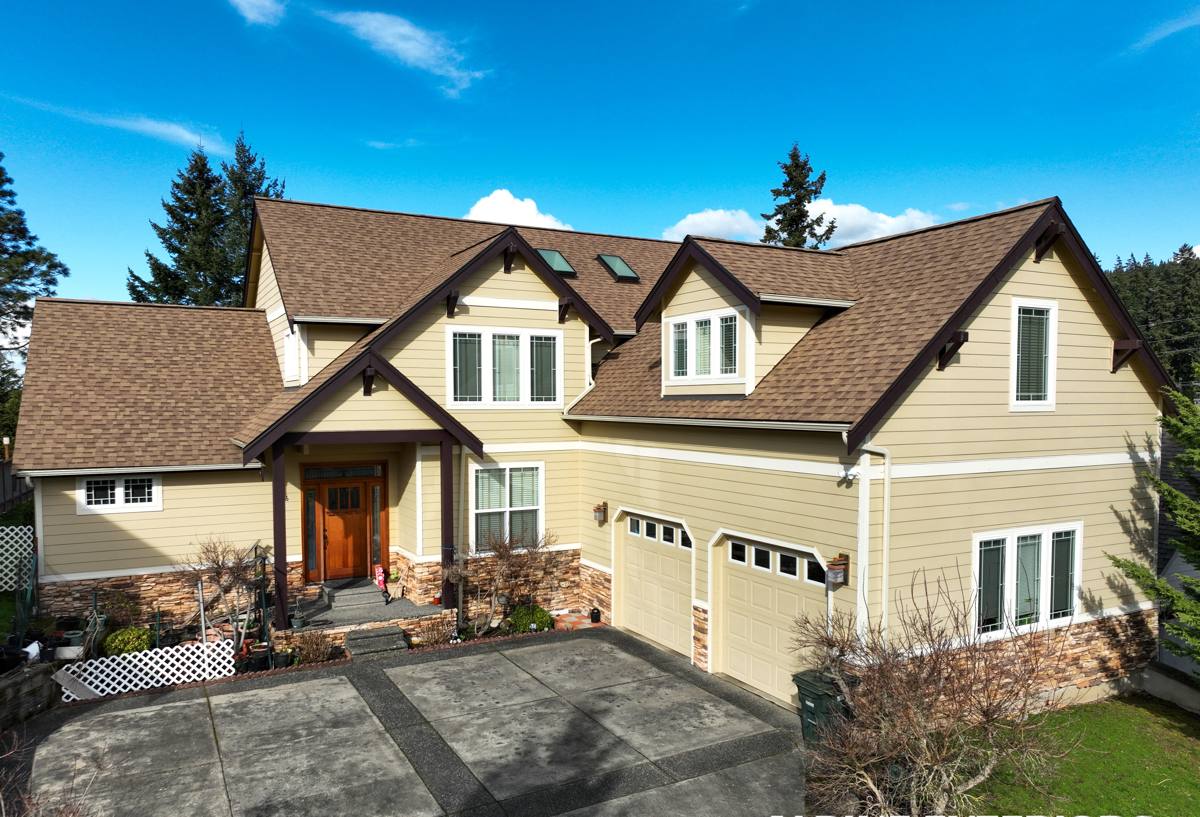
What Riverside's Setting Does to Siding
Low-Lying Ground and Slow-Drying Air
River-adjacent, lower-elevation ground tends to hold humidity longer than higher ground a mile or two away, since cool, damp air settles into low spots and doesn't clear out as quickly once the sun goes down or a marine layer rolls in. For a home's exterior, that translates into more hours per week where the siding surface stays damp rather than drying out, which matters most for any material that absorbs moisture at the surface instead of shedding it.
Driving Rain and Wind Off the River Corridor
Open ground along a river corridor gives wind less to break against than a tightly built, tree-lined block does, and that means rain can arrive at a Riverside wall with more direct force than the same storm delivers to a sheltered lot elsewhere in Everett. Walls facing the open river side of a property typically take the brunt of it, while a shaded or fenced-in side of the same house may stay comparatively dry — which is exactly why flashing and drainage details need to be built for the wettest exposure a house has, not an average across all four walls.
A Long Moss and Mildew Window
Between low-lying humidity, regular Pacific Northwest rainfall, and mature trees on a lot of Riverside properties, exterior surfaces here often don't get a long, uninterrupted dry stretch for much of the year. That's the exact window moss and mildew need to get established, and it shows up first on north-facing walls and anywhere shaded by trees or a neighboring structure. Siding that holds moisture at the surface rather than shedding it stays in that damp window longer and gives moss more time to take hold before the next real dry spell.
Why James Hardie Fiber Cement Is What We Install
We used to work with a wider range of siding products. We narrowed that down after watching, repeatedly, which materials held up on damp, lower-lying properties like the ones common in Riverside — and which ones developed problems within just a handful of years.
- Non-combustible core: Fiber cement doesn't feed a fire the way wood-based siding can, which matters for safety and often for insurance considerations too.
- Factory-applied ColorPlus finish: The color is baked on under controlled conditions rather than brushed on in the field, which holds up far better against sustained dampness and repeated wet-dry cycling than site-applied paint or stain.
- Climate-engineered HZ5 product line: The formulation we install for this region is built for heavy moisture exposure and freeze-thaw swings, a close match for a low-lying, river-adjacent setting like Riverside.
- Dimensional stability: Fiber cement doesn't swell, cup, or warp the way engineered wood products can after repeated wetting.
- Strong transferable warranty: Correctly installed Hardie siding carries one of the more substantial warranty structures in the industry, and it transfers if the home changes hands.
We don't install LP SmartSide, vinyl siding, Cemplank, Allura, primed spruce, or cedar. Those products all have a place in the broader market, and plenty of homeowners elsewhere are satisfied with them. But on ground this consistently damp, we made a professional call to stand fully behind one system rather than offer a lower-cost option that quietly shifts long-term moisture and maintenance risk back onto the homeowner.
What a Correct Fiber Cement Install Involves
Fiber cement only performs the way it's engineered to when it's installed to James Hardie's published specifications. On a Riverside home, that means:
- House wrap or a weather-resistive barrier installed and lapped correctly before any siding goes up
- A drainage gap or rainscreen behind the siding so moisture that does get past the surface has somewhere to go instead of sitting against the wall sheathing
- Correct clearance from grade, decks, and patios — a common miss on riverside lots where finished grade and hardscaping sit closer to the wall than they should
- Corrosion-resistant fasteners at the manufacturer's specified spacing, not just enough to hold the board up
- Properly lapped and sealed joints, with cut edges primed on site since the factory finish only covers the original board face
- Flashing integrated correctly at every window, door, corner, and roof-to-wall transition, since those are the spots water actually finds its way in
Skip any one of these steps and a wall can still look fine on installation day. The problems that show up when they're skipped — soft spots near the base, staining at seams, moisture behind the cladding — take a few wet seasons to surface, which is exactly why they're easy for a rushed install to get away with until the homeowner is the one dealing with it years later.
Our Process for a Riverside Siding Project
Walkthrough and Assessment
We start with an on-site walk of the home, paying close attention to which walls face the river corridor's open exposure directly and which are sheltered by trees, fencing, or neighboring structures. We also check grade and drainage around the foundation, since a low-lying lot with poor site drainage can undermine even a well-installed siding job if water isn't moving away from the house.
Written Scope Before Work Begins
We put together a clear, written scope of work and timeline before any material is ordered or any old siding comes off, so there's no ambiguity about what's included.
Installation to Manufacturer Spec
Every fastener, gap, and flashing detail follows James Hardie's published installation requirements for this climate zone. That's what keeps the manufacturer's warranty intact and what actually determines whether the wall performs for decades rather than years.
Final Walkthrough
We walk the finished job with you, cover what little ongoing maintenance fiber cement actually needs, and make sure you know what a healthy wall looks like if you ever want to check it yourself.
Comparing Siding Materials for a Riverside Lot
| Material | Moisture Behavior | Maintenance on Low-Lying Ground | Typical Longevity Here |
|---|---|---|---|
| James Hardie fiber cement | Dimensionally stable; resists swelling and warping | Low; factory finish resists moss growth and fading | 30+ years with correct installation |
| Vinyl siding | Can trap moisture behind panels in damp, poorly ventilated walls | Low upfront cost, but hidden moisture problems are hard to spot | Variable; shorter on directly exposed walls |
| LP SmartSide / engineered wood | Wood-based core is sensitive at cut edges and fastener holes | Moderate to high; edge sealing needs regular upkeep in sustained damp | Depends heavily on installation quality and upkeep |
| Cedar / primed wood | Absorbs and releases moisture readily | High; needs regular refinishing, especially on shaded walls | Shorter without disciplined, consistent maintenance |
Cost Factors for Riverside Homes
Every siding project prices out differently based on the home itself, but a few factors move the number most often on Riverside properties specifically:
| Factor | Why It Matters |
|---|---|
| Existing wall condition | Rot or moisture damage found during tear-off, more common on lower-lying, damp lots, needs repair before new siding goes up |
| Grade and drainage around the foundation | Poor site drainage may need correcting alongside the siding work to protect the new install |
| Wall height and complexity | More corners, dormers, and transitions mean more cuts and flashing details |
| Trim and window count | More openings mean more flashing and finish work around each one |
| Access and site conditions | Fenced yards, mature landscaping, or limited access near the river can add labor time |
We'll walk your specific home and give you real numbers based on what we actually find, rather than a rough estimate off square footage alone — two Riverside homes with similar footprints can have very different scopes depending on what's behind the existing siding.
A Simple Checklist Before Hiring for Siding Work in Riverside
- Ask what siding material they install and why, and whether it comes with a written, transferable warranty
- Confirm current Washington contractor licensing and active liability insurance
- Ask how they handle grade and drainage on low-lying, river-adjacent lots, not just the siding itself
- Ask about their experience with damp, moisture-heavy properties specifically, not just general remodeling
- Get a clear, written scope of work and timeline before signing anything
Why a Local Crew Matters in Riverside
Riverside is a neighborhood where two homes a few blocks apart can have genuinely different exposure and drainage conditions depending on how close they sit to the river's lower ground and how much tree cover shades the lot. A crew that regularly works this part of Everett already accounts for that variation — adjusting drainage detailing, flashing laps, and fastener choices wall by wall instead of applying one generic spec to every house. That local judgment is what separates a siding job that looks fine for a season from one that's still performing decades later.
If you're weighing fiber cement siding for a home in Riverside, we're happy to walk the property, talk through what your specific walls and site conditions need, and give you a straightforward, no-pressure estimate. There's a form below — reach out and we'll set up a time to take a look.