 Everett
 Siding Repair in Silver Lake: What This Corner of Everett Is Up Against
Silver Lake sits in south Everett, and like the rest of Snohomish County it lives under a Puget Sound maritime climate: long stretches of low, driving rain from fall through spring, humid air off the Sound that never fully lets siding dry out, and short winter days that keep north- and shade-facing walls damp for weeks at a time. Add in the salt-laden air that moves inland off Port Gardner Bay and Possession Sound on windy days, and you have a climate that is genuinely hard on exterior building materials — not dramatic, just relentless.
That combination shows up on siding as slow, cumulative damage rather than sudden failure. Moisture works into seams and fastener holes a little at a time. Moss and algae get a running start every fall and don't fully dry out until late spring. Salt-bearing moisture accelerates corrosion on fasteners and trim metal. None of this means Silver Lake homes are falling apart — it means siding repair here has to account for a climate that is actively working against a quick patch job.
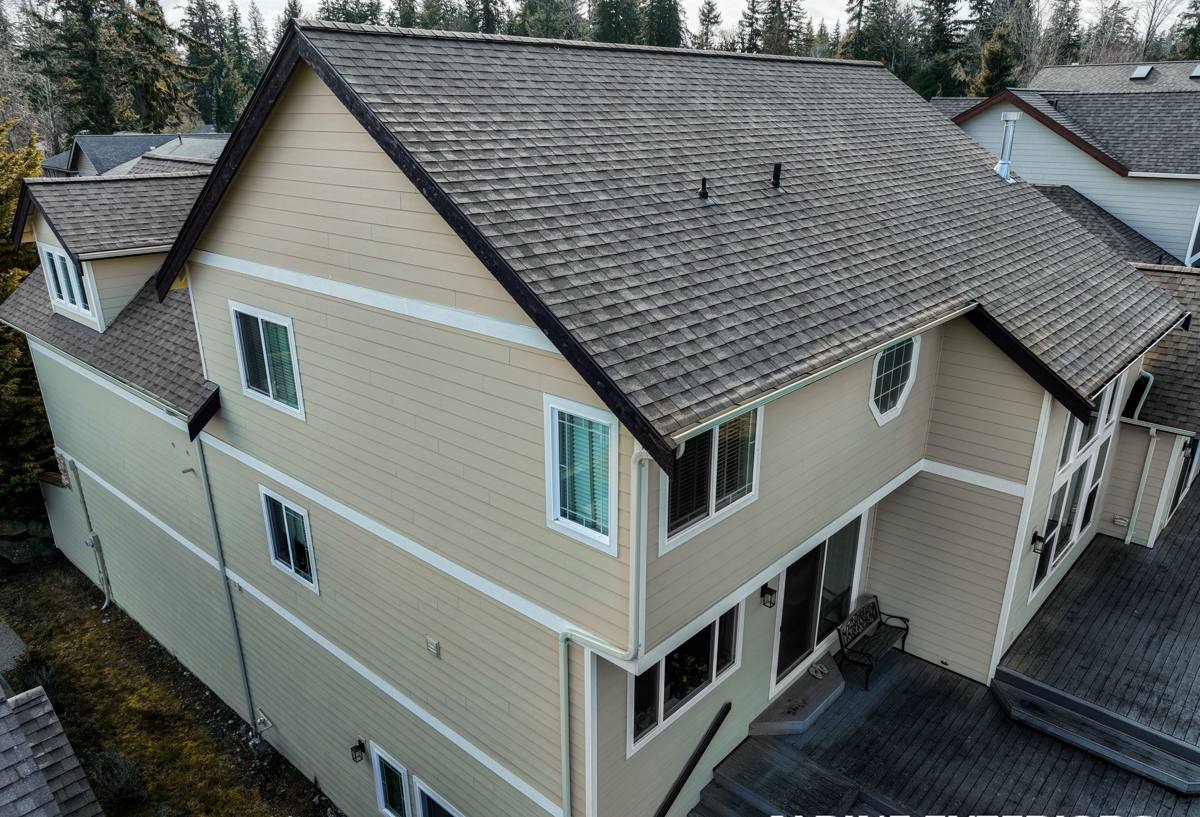
Signs Your Silver Lake Home Needs a Siding Repair
Most siding problems don't announce themselves. They show up as small visual cues long before there's a hole in the wall. Homeowners in this neighborhood should walk their home's exterior at least twice a year and look for:
- Cracked, split, or buckled siding panels or boards, especially near corners and window trim
- Soft or spongy spots when you press on siding near the bottom of walls or under windows
- Paint that's peeling, bubbling, or failing in one specific area rather than evenly across the wall
- Persistent moss, algae, or black streaking that comes back within weeks of cleaning
- Gaps opening up around window and door trim, or at panel seams
- Visible water staining on interior walls or ceilings near exterior corners
- Rust streaks running down from fasteners or metal trim
- A musty smell in a room that backs up to an exterior wall
Any one of these on its own might be minor. Two or three in the same area, especially on a wall that faces prevailing weather, usually means moisture has already gotten past the surface and into the wall assembly.
What a Correct Siding Repair Actually Involves
A siding repair that's done right is not just cutting out a damaged board and nailing in a new one. The visible siding is the last layer of a system, and a repair that ignores the layers behind it just buys a homeowner a few more years before the same problem resurfaces, often worse.
Diagnosis before demolition
Before anything gets removed, the damaged section needs to be understood, not just replaced. That means figuring out how water is getting in — a failed caulk joint, a missing kick-out flashing, a fastener driven at the wrong angle, siding installed too close to grade or a deck surface — because if that entry point isn't corrected, the new siding will fail the same way the old siding did.
Checking what's behind the siding
Once siding is opened up, the water-resistive barrier and sheathing underneath need to be inspected. If moisture has reached the sheathing, that has to be addressed — dried out, and in some cases the sheathing itself replaced — before new siding goes back on. Covering damaged sheathing with new siding is a shortcut that hides a problem instead of fixing it.
Matching material and installation detail
The replacement piece needs to match the existing siding's profile, reveal, and fastening pattern, and it needs to be installed with the same flashing and clearance details the rest of the wall should have — proper gaps at grade, at decks, and at trim, correct fastener placement, and joints that are sealed or designed to shed water rather than trap it.
The Most Common Repair Calls We See Around Silver Lake
The specific repair issues we get called out for in this neighborhood tend to cluster around a handful of patterns, driven directly by the local climate:
Moisture entry at penetrations and trim
Window and door trim, hose bibs, light fixtures, and vents are where siding gets cut and pieced together, and they're the most common places for water to find a way in after years of driving rain. A gap that started as hairline can, after a few wet seasons, be pulling moisture into the wall every time it rains.
Moss and algae staining that keeps returning
Shaded, north-facing, and tree-adjacent walls in this area hold moisture long enough for moss and algae to take hold, and simple surface cleaning without addressing the underlying moisture retention just means it comes right back. Repeated growth in the same spot is often a sign that a wall isn't drying properly between rain events, not just a cleaning problem.
Fastener and trim corrosion
Metal fasteners and trim exposed to salt-influenced coastal air corrode faster than the same materials would inland. Rust streaking below fasteners is common, and once corrosion starts, that fastener's grip on the siding weakens over time.
Impact and settling damage
Cracked panels from incidental impact, or gaps that open up as a house settles, show up on any siding material, but in a wet climate an open crack or gap becomes a moisture entry point far faster than it would somewhere dry.
Repair or Replace? How We Help You Decide
Not every damaged section needs a full re-side, and not every "repair" is actually worth doing. Part of an honest assessment is telling a homeowner when a targeted repair makes sense versus when patching a larger problem is just delaying an inevitable, more expensive replacement.
| Factor | Favors Repair | Favors Replacement |
|---|---|---|
| Extent of damage | Isolated to one or two sections | Spread across multiple walls or elevations |
| Sheathing condition | Dry, solid behind the damaged siding | Soft, stained, or rotted in multiple spots |
| Age of existing siding | Well within its expected service life | Near or past the end of its typical lifespan |
| Material match | Matching material or color is available | Discontinued profile, color, or product line |
| Root cause | A fixable, isolated moisture entry point | A systemic issue — grading, flashing, or original installation |
When the underlying cause is isolated and the rest of the wall is sound, a repair is the right call and the honest one. When damage is widespread or the existing product can't be reasonably matched, we say so plainly rather than stringing together patches that won't hold up through another Snohomish County winter.
Our Siding Repair Process, Start to Finish
- On-site inspection: We walk the exterior, identify every area of concern, and probe suspect spots to check for hidden moisture damage, not just what's visible from the ground.
- Root-cause diagnosis: We determine why the damage happened — flashing, clearance, a failed seal, or something upstream like gutter overflow — so the fix addresses the cause, not just the symptom.
- Written scope and pricing: You get a clear explanation of what needs to happen, what it costs, and why, before any work starts.
- Careful removal: Damaged siding and trim come off without unnecessary disturbance to sound surrounding material.
- Sheathing and barrier check: Anything behind the siding gets inspected and corrected as needed before new material goes on.
- Proper reinstallation: New siding goes in matched to the existing reveal and profile, with correct flashing, clearances, and fastening.
- Final walk-through: We review the completed repair with you and point out anything worth keeping an eye on going forward.
Why We Repair With James Hardie Fiber Cement — Even on Repairs
We install and repair James Hardie fiber cement siding exclusively. That's a deliberate standard, not a limitation, and it matters just as much on a repair as it does on a full install. Hardie's HZ5 product line is engineered for the kind of wet, humid Pacific Northwest exposure Silver Lake sees every winter, and it's non-combustible, dimensionally stable, and holds its ColorPlus factory finish without the recurring repainting that wood and some engineered wood products require.
When we're called to repair siding on a home where the existing material is vinyl, LP SmartSide, cedar, or another engineered wood product, we're straightforward about the trade-offs. Vinyl colors and profiles are frequently discontinued, which makes a seamless patch difficult or impossible. Engineered wood siding is sensitive to moisture at cut edges and seams — precisely the failure points that generate repair calls in the first place — and cedar requires ongoing staining or sealing to keep performing. In those cases we'll give you an honest read on whether a like-for-like patch is realistic, or whether replacing the affected section (or the wall) with Hardie is the more durable long-term fix. We won't talk you into replacing sound siding, but we also won't pretend a patch will hold up if the underlying material makes that unlikely.
Why It Matters to Hire a Crew That Already Works This Neighborhood
Siding repair is detail work, and a crew that's already spent time on homes in and around Silver Lake has a real advantage: they've seen how this specific stretch of Everett's climate — the shade patterns, the moisture load, the salt-influenced air off the Sound — actually plays out on real walls, not just in general Pacific Northwest terms. That translates into faster, more accurate diagnosis of why a repair is needed in the first place, rather than guessing.
It also matters for accountability. A contractor who's established in Everett and Snohomish County, carries proper licensing and insurance, and stands behind their work with a real warranty is a very different proposition than an out-of-area crew that won't be easy to reach if a repair needs a follow-up visit. Ask any siding contractor for proof of licensing, insurance, and manufacturer certification before they touch your home — a reputable local company will hand that over without hesitation.
After the Repair: Keeping Silver Lake Siding in Good Shape
A correctly done repair should last, but a little seasonal attention keeps small issues from becoming repeat repair calls in this climate:
- Rinse siding gently once or twice a year to keep moss and algae from establishing, especially on shaded or north-facing walls
- Keep gutters clear so overflow isn't running down the wall behind the siding
- Trim back vegetation and tree limbs that keep a wall section shaded and damp
- Check caulking at trim, windows, and penetrations annually and touch up before winter rains start
- Walk the exterior after any major windstorm to catch new cracks or loosened panels early
Staying ahead of these small things is what keeps a good repair from turning into a bigger one down the road.
If you're seeing any of these signs on your Silver Lake home, we're happy to take a look and give you a straight answer on what's going on and what it will take to fix it properly. Request a free, no-pressure estimate using the form below.