 Everett
 Why Snohomish Decks Take More Abuse Than the Brochure Admits
Snohomish sits close enough to Puget Sound and the Snohomish River basin that decks here deal with a specific combination of stressors most decking products were never really tested for: salt-laden air moving in off the water, long stretches of driving rain that come in sideways under eaves and railings, and a moss season that can run from October clear through April. None of these factors are dramatic on their own. Together, over a few winters, they're what turns a nice-looking deck into a slick, stained, slowly rotting problem.
A deck built for a dry climate — or built by a crew that mostly frames houses and treats decking as an afterthought — tends to show its age fast around here. Fasteners bleed rust through the boards. Joists and ledger boards trap moisture against the house. Moss takes hold in shaded corners and never fully lets go. None of that is inevitable. It's a function of material choice and how the deck is actually built, not just what it's built with.
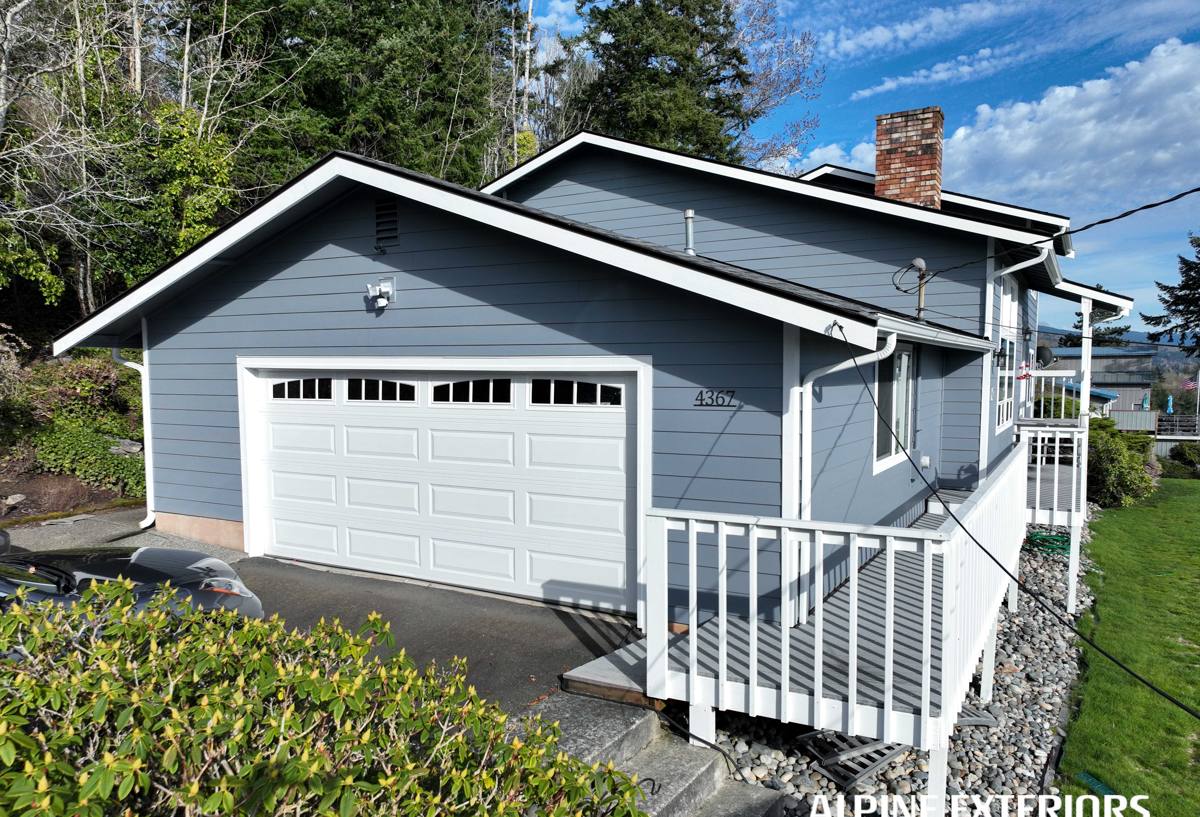
Why Composite Makes Sense for This Climate
Composite decking isn't automatically the right call everywhere, but for Snohomish's conditions it solves real, specific problems that wood decking struggles with year after year.
Moisture and Rot Resistance
Wood decking needs a dry season to recover in. Snohomish doesn't reliably give it one. When boards stay damp for weeks at a stretch, you get cupping, splintering, and eventually rot at the joints and fastener holes — usually starting on the north side or wherever shade keeps a board from drying out between rains. Composite boards don't absorb water the way wood fibers do, so that slow moisture cycle that wrecks wood decking over a decade largely isn't a factor.
Moss and Algae Growth
Moss and algae need moisture, shade, and organic material to root into. Wood grain gives them plenty to grab onto. Modern capped composite boards have a much harder, less porous surface, so growth that does form tends to sit on top rather than working into the material — which means it comes off with routine cleaning instead of requiring sanding or replacement.
Salt Air and Hardware Corrosion
Salt air accelerates corrosion on any exposed metal — fasteners, brackets, railing hardware. This isn't really a "composite versus wood" issue; it's a fastener and hardware issue that shows up on any deck near the water regardless of decking material. It matters here because it changes what "correct installation" means in Snohomish specifically, which is the next thing worth understanding before you compare products.
What a Correctly Built Composite Deck Actually Involves
The decking boards themselves get all the attention, but most of the failures we get called out to look at — soft spots, sagging, mildew smell under the deck, rust streaks — trace back to what's underneath the boards, not the boards themselves.
Substructure and Framing
Composite boards are heavier than wood and behave differently under load and temperature swings, so joist spacing and framing need to match the manufacturer's actual span tables for the specific product — not just "what we always use for wood." Ledger board attachment to the house needs proper flashing so water is directed away from the wall assembly, not into it. This is the single most common corner we see cut on decks that fail early, composite or not.
Drainage and Airflow Underneath
In a climate with this much rainfall, a deck needs somewhere for water to go and enough airflow underneath to keep the substructure from staying damp. That means grading and drainage planning at ground level, gaps and spacing that let air move, and keeping the underside of the deck from becoming a trapped, humid space where framing rot and mold can take hold even though the decking surface above looks fine.
Fastening and Board Spacing for Movement
Composite boards expand and contract with temperature more than solid wood. Hidden fastener systems and gapping have to account for that movement, or you end up with buckled boards or fasteners working loose within a couple of seasons. This is a detail that's easy to get wrong if a crew treats composite installation exactly like wood installation instead of following the product-specific requirements.
Comparing Composite Decking Options
"Composite decking" isn't one product — there's a real range in how boards are built, and it affects how they hold up in a wet, mossy, salt-air climate like Snohomish's.
| Board Type | Moisture Behavior | Maintenance | Typical Trade-off |
|---|---|---|---|
| Capped composite (wood-plastic core with a protective outer shell) | Very good — the cap resists moisture and staining | Occasional wash-down; no sealing or staining | Higher upfront cost than uncapped composite |
| Uncapped composite | More prone to surface staining and moisture absorption over time | More frequent cleaning; can fade and roughen with age | Lower cost, shorter realistic lifespan in wet climates |
| Solid PVC (cellular vinyl) | Excellent — essentially no organic material to hold moisture | Low; very resistant to mold and mildew | Higher cost; different look and feel underfoot than wood-composite blends |
| Pressure-treated wood (for comparison) | Absorbs and releases moisture continuously | Annual cleaning, periodic sealing or staining | Lowest upfront cost, highest long-term maintenance |
We install a range of these depending on budget, the deck's exposure to sun and rain, and how much maintenance a homeowner actually wants to do. For a deck with heavy shade or close proximity to the water, we're usually steering people toward a capped or solid PVC product — not because the cheaper option is bad, but because the maintenance gap between them shows up faster here than it would in a drier climate.
Our Process for a Snohomish Composite Deck
The steps themselves aren't unusual, but the sequencing and attention to a few specific items are what separate a deck that holds up from one that doesn't.
- On-site evaluation of the existing structure, grading, and drainage before we quote anything
- Confirming ledger attachment and flashing details against the house's actual wall assembly
- Framing to the decking manufacturer's span and fastener specifications, not a generic layout
- Corrosion-resistant hardware throughout, given the salt air exposure this close to the Sound
- Proper gapping for board expansion and drainage, including around posts and the house
- Site cleanup and a final walk-through before we consider the job done
Where a deck is a replacement rather than new construction, we also check what condition the ledger, posts, and footings are in before covering anything back up — no point putting new decking over framing that's already compromised.
Maintenance That Actually Matters Here
One of the real advantages of composite is how little maintenance it needs compared to wood, but "low maintenance" isn't "no maintenance," especially through a Snohomish moss season. A periodic rinse and scrub with a deck-safe cleaner keeps organic buildup from getting a foothold in shaded corners and near the house where airflow is limited. Keeping gutters and downspouts clear and directed away from the deck matters more here than in drier regions, since a steady drip onto one section of decking is exactly the kind of localized moisture that encourages moss and staining. Beyond that, an occasional check that fasteners and hardware haven't started corroding is worth doing, particularly on decks closer to open water where salt exposure is heaviest.
Permits and Local Requirements
Deck projects in and around Everett typically require a permit once you're past a certain size or height, and the requirements differ depending on whether the property is inside city limits or in unincorporated Snohomish County. Guardrail height, stair requirements, and footing depth all get checked as part of that process. We handle the permit application and inspection scheduling as part of the job rather than leaving it for the homeowner to sort out — it's a normal part of building a deck correctly, not an extra step.
Why It Matters That We Already Work in Snohomish
A lot of what makes a composite deck last here isn't in the product spec sheet — it's in decisions a crew makes on-site: how they flash the ledger against your specific siding, how they handle drainage on a lot that doesn't slope the way the plans assume, which fastener grade actually holds up given how close the property sits to the water. Crews that build decks across a lot of different climates tend to fall back on generic methods. A crew that's built and maintained decks around Snohomish specifically has already seen where those generic methods fall short in this weather, and builds around it from the start instead of learning it on your project.
If you're weighing composite decking for a home in Snohomish, we're happy to take a look at your space, talk through what the site actually needs, and give you a straightforward, no-pressure estimate — just fill out the form below.