 Everett
 Siding That Has to Work in Eastmont's Climate, Not Just Look Good on Day One
Eastmont sits close enough to Puget Sound and the Snohomish County lowlands that homes here take a steady beating from moisture almost year-round. It's not one dramatic storm that wears out a house's exterior — it's the accumulation. Salt-laden air off the Sound corrodes fasteners and finishes over time. Driving rain, pushed sideways by wind off the water, gets forced into seams and laps that would stay dry in a calmer climate. And the long stretch of gray, wet months from fall through spring gives moss, algae, and mildew months of uninterrupted growing conditions on any siding that holds moisture against its surface.
Siding for an Eastmont home isn't a cosmetic decision — it's a moisture-management decision first. The material, the way it's cut and fastened, and the water-shedding details behind it all matter more here than they would in a dry inland climate. This page covers what fiber cement siding specifically needs to do right in this neighborhood, and how we install it to hold up to it.
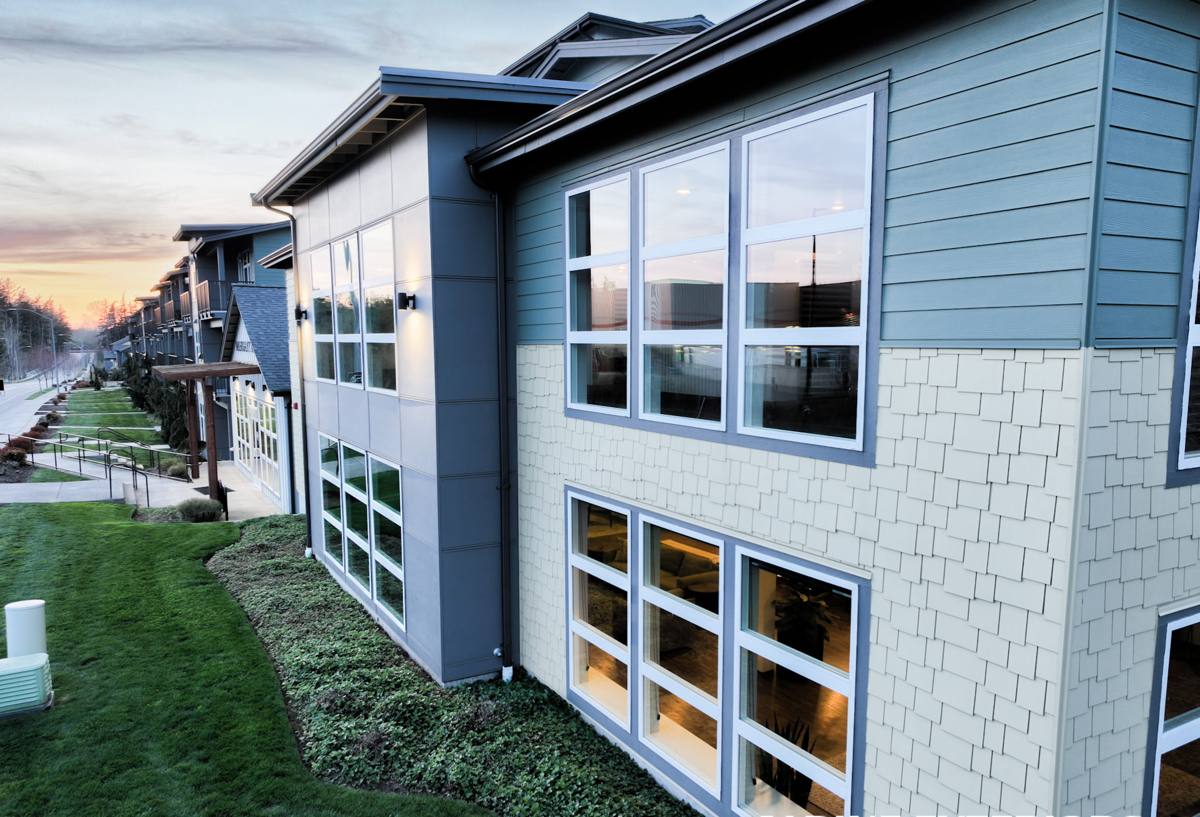
Why We Only Install James Hardie Fiber Cement
We install James Hardie fiber cement siding exclusively. We don't install vinyl, LP SmartSide, primed wood, cedar, or other fiber cement brands like Allura or Cemplank. That's a deliberate standard, not a lack of options.
Fiber cement as a category — cement, sand, and cellulose fiber pressed and cured into planks — is dimensionally stable, non-combustible, and doesn't rot the way wood-based products can. But not all fiber cement is engineered or finished the same way, and the finish is where a lot of long-term performance actually lives. James Hardie's ColorPlus factory-applied finish is baked on under controlled conditions and backed by its own finish warranty, which matters in a climate where field-applied paint takes a beating from UV, salt air, and constant damp-dry cycling. Hardie also engineers its HZ5 product line specifically for climate zones like ours, with moisture and freeze-thaw performance tuned to marine and Pacific Northwest conditions. That combination — the substrate, the finish, and the climate engineering — is why we standardized on one product line instead of installing whatever a customer happens to ask for.
What This Means for an Eastmont Homeowner
In practice, it means the siding going on your house isn't a generic product pulled from a catalog. It's specified for this region's moisture load, factory-finished so the color and coating aren't dependent on field paint quality, and backed by a transferable warranty that holds up if you sell the house before the siding's service life is up.
What Correct Fiber Cement Installation Actually Involves
Fiber cement performs well for decades when it's installed to manufacturer spec — and performs poorly, fast, when it isn't. Most of the fiber cement failures we get called out to inspect in this area trace back to installation shortcuts, not the product itself.
Water Management Behind the Siding
The siding itself is the last line of defense, not the only one. Correct installation starts with a weather-resistive barrier and properly integrated flashing at every window, door, and penetration, lapped so water is directed out and down rather than trapped behind the cladding. Given how much wind-driven rain Eastmont sees in fall and winter, gaps or reverse-lapped flashing here are where moisture gets in — long before the siding face shows any sign of a problem.
Clearances and Gaps
Hardie specifies minimum clearances from grade, roofing, decks, and other transitions, plus gaps at butt joints and trim to allow for expansion and drainage. Skipping these clearances is one of the most common shortcuts we see on older installs in this area, and it's usually what's behind moisture staining or soft trim years later.
Fastening
Fasteners have to be corrosion-resistant and driven to the correct depth — not overdriven, not underdriven — and spaced per Hardie's fastening schedule for our wind exposure. In a salt-air environment, fastener quality isn't optional; the wrong fastener corrodes and stains the face of the siding from the inside out.
Caulking and Joint Treatment
Joints, seams, and trim intersections need the right sealant, applied correctly — not as a substitute for proper flashing, but as a secondary defense. Overreliance on caulk instead of flashing is a shortcut that fails quietly for a year or two, then fails visibly.
Moss, Algae, and the Long Wet Season
Snohomish County's wet season runs long, and Eastmont's tree cover and proximity to the water keep humidity elevated even on drier days. Moss and algae need moisture and shade to establish, and they'll colonize any siding surface that holds water or sits in consistent shadow — fiber cement included, if the install details are wrong.
Two things matter most here: keeping the bottom edge of the siding properly clear of soil, mulch, and standing vegetation, and making sure the assembly behind the siding can dry out between rain events. A tight, well-flashed, properly clearanced install sheds water fast and dries fast. A sloppy one holds moisture against the back of the panel, and that's exactly the environment moss and mildew need.
Fiber Cement vs. the Alternatives, for This Climate
| Material | Behavior in Salt Air / Driving Rain | Moss Resistance | Long-Term Maintenance |
|---|---|---|---|
| James Hardie Fiber Cement | Non-combustible, dimensionally stable, factory-finished ColorPlus resists fading and coating failure | Good when installed with proper clearance and drainage; doesn't feed moss growth | Occasional wash; no repainting needed for the life of the ColorPlus finish |
| Vinyl | Can warp or become brittle with UV and temperature cycling; seams are a water-entry risk | Textured/lower-quality profiles can trap grime that supports moss | Low, but color fades and can't be repainted easily |
| Primed Wood / Cedar | Absorbs moisture; salt air accelerates finish breakdown | Higher risk — organic material, moss and algae readily colonize it | Regular repainting/staining and moisture monitoring required |
| LP SmartSide (engineered wood) | Treated to resist moisture but still wood-based; edge sealing is critical | Moderate — depends heavily on maintaining factory edge seal | Field-applied finish requires more upkeep than a factory finish |
This is a general comparison, not a claim that every alternative fails — it's a summary of the trade-offs that led us to standardize on one product for this climate rather than offer several.
Our Process for an Eastmont Fiber Cement Project
- Walk-through and assessment — we look at your existing siding, trim, flashing condition, and any moisture or moss patterns already showing on the house.
- Product and color selection — choosing the right Hardie plank or panel profile and ColorPlus color for your home.
- Tear-off and substrate check — removing old siding and inspecting sheathing for hidden rot or moisture damage before anything new goes on.
- Weather-resistive barrier and flashing — installed and lapped correctly at every window, door, and penetration.
- Siding installation — fastened, clearanced, and joined to Hardie's spec for our wind and moisture exposure.
- Final detailing — trim, caulking, and cleanup, with a walk-through so you know what to expect and how to care for it.
What to Verify Before You Hire Anyone for This Job
- Do they install to manufacturer clearance and fastening specs, or "close enough"?
- Do they carry proper flashing details for windows, doors, and roof-to-wall transitions — not just caulk?
- Are they familiar with this specific neighborhood's exposure — wind direction, tree cover, moisture patterns?
- Do they use factory-finished product, or field-paint after install?
- Will the manufacturer's warranty transfer if you sell the house?
- Can they explain why they chose the product line they're recommending for your specific exposure?
Why Local Experience in Eastmont Matters
A siding crew that already works this part of Everett has already seen how moisture behaves on homes with this specific mix of tree cover, wind exposure, and proximity to the Sound. That's not something you get from a spec sheet — it's from having flashed the same style of window trim, dealt with the same soil-and-siding clearance issues, and seen which details actually fail after a few wet seasons versus which ones hold. A crew that's only worked drier inland climates may install to code and still miss the details that matter most here.
Get a Straightforward Estimate
If you're weighing a siding replacement or repair on an Eastmont home, we're happy to walk the exterior with you, point out anything we see — moisture, moss, flashing issues, or otherwise — and give you a clear, no-pressure estimate for James Hardie fiber cement done right. Fill out the form below to get started.