 Everett
 Snohomish's Climate Is Hard on Siding — Here's Why
Snohomish sits close enough to Puget Sound and the Snohomish River basin that homes here deal with a specific combination of stresses most siding products were never designed for: salt-tinged air moving in off the Sound, wind-driven rain that hits walls sideways instead of falling straight down, and a moss season that can run from October through May in a wet year. None of these is dramatic on its own. Together, over ten or fifteen winters, they're what separates a siding job that still looks tight from one that's rippling, staining, or rotting at the butt joints.
Salt air is corrosive to fasteners and finishes over time, even this far inland from open ocean. Driving rain doesn't just wet a wall's face — it pushes moisture up under laps and into any gap that wasn't sealed or flashed correctly. And moss doesn't just grow on roofs. Given a shaded, north-facing wall and a porous surface to grip, it colonizes siding too, holding moisture against the substrate long after the rain has stopped. A siding system for a Snohomish home has to be evaluated against all three, not just against how it looks on the day it goes up.
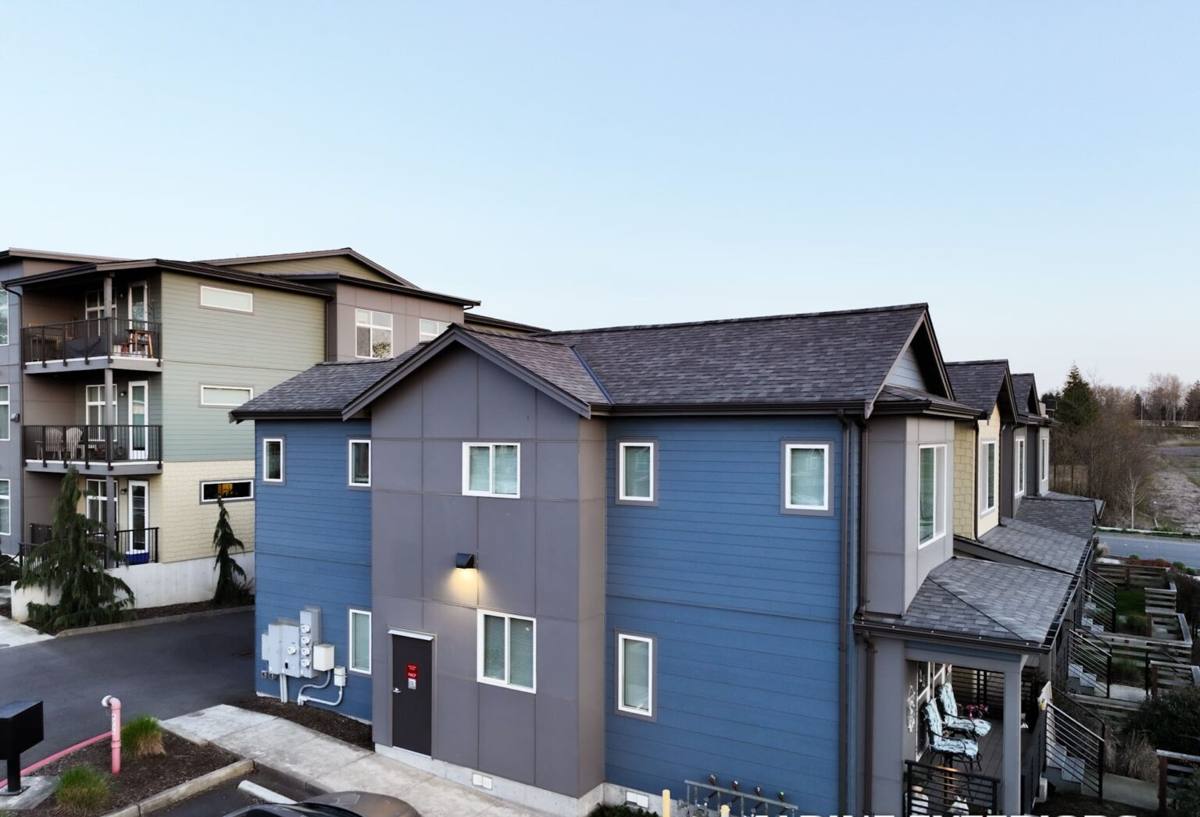
What Fiber Cement Siding Solves for This Neighborhood
Moisture Without Rot
Fiber cement is cellulose fiber, sand, and Portland cement pressed and cured into a dense, stable board. It doesn't have the wood grain structure that lets water wick along fibers, and it doesn't swell and split the way solid or engineered wood products can when they take on repeated moisture. In a climate where a wall can stay damp for days at a stretch during a fall storm cycle, that structural stability matters more than the marketing language around it suggests — it's the difference between a board that shrugs off a wet winter and one that's slowly delaminating from the inside.
A Surface Moss and Mildew Don't Take to Easily
Moss and mildew need a foothold — organic material and a porous surface help them grip and spread. A factory-cured fiber cement surface with a baked-on finish is far less hospitable to that growth than raw or field-painted wood. It doesn't stop biological growth entirely (nothing fully does in this climate), but it dramatically reduces how fast it establishes and how deep it gets, which changes how often a homeowner has to actively deal with it.
Non-Combustible by Composition
Fiber cement doesn't burn — it's a cement-based product, not a wood or wood-composite one. That's less about Snohomish's specific weather and more about long-term risk management: it's one less combustible material on the exterior of the house, permanently, with no maintenance required to keep that property true.
Why We Only Install James Hardie — Not LP SmartSide, Vinyl, Cemplank, Allura, Primed Wood, or Cedar
We get asked why we don't offer more options. The honest answer is that we looked at what each alternative asks of a homeowner living in this climate, and standardized on one product because it holds up with the least ongoing maintenance burden.
- LP SmartSide is an engineered wood-strand product with real strengths — it's lighter, easier to install, and holds paint well when new. But it depends on factory-sealed edges and correctly maintained caulk joints to keep moisture out of the strand core. In a climate with rain most of the year, that's a maintenance schedule that's easy to fall behind on, and once water gets past a compromised seal, the strand material swells in a way solid fiber cement doesn't.
- Vinyl siding is inexpensive and low-maintenance in the sense that it doesn't need painting, but it's thin, it expands and contracts with temperature swings, and it can crack or warp under impact or aggressive pressure-washing — which is exactly the kind of cleaning moss-prone siding in this area tends to need.
- Cemplank and Allura are also fiber cement, and we don't have a complaint about the base material. We standardized on one manufacturer for the same reason any contractor standardizes on one system: consistent factory finish quality, one warranty structure to stand behind, and installation specs our crews know cold rather than switching details between products.
- Primed spruce and cedar are genuinely beautiful and we understand the appeal. They're also organic wood products that need re-staining or repainting on a real schedule, and in a climate this consistently damp, gaps in that maintenance show up fast as cupping, checking, or rot at end grain and butt joints.
None of these are bad products used correctly. They're products that ask more of the homeowner, on an ongoing basis, than we think is reasonable to expect given what this climate does to an exterior wall year after year.
The Hardie Product Lines Built for This Climate Zone
James Hardie engineers its siding by climate zone (HZ5 covers the Pacific Northwest), which affects the formulation used to resist moisture and temperature cycling here specifically, rather than shipping the same board to Arizona and Washington. On top of that, ColorPlus Technology — Hardie's factory-applied finish — is baked on in a controlled environment, which produces a denser, more consistent finish than field-applied paint and comes with its own finish warranty.
| Product | Typical Use | Why It Fits Here |
|---|---|---|
| HardiePlank lap siding | Primary wall siding, most homes | Traditional lap profile sheds driving rain when installed with correct overlap and gap |
| HardiePanel vertical siding | Accent walls, gable ends, modern facades | Fewer horizontal laps means fewer seams for wind-driven rain to find |
| HardieTrim | Corners, window and door casing, fascia | Matches board density and finish so trim doesn't fail before the field siding does |
| HardieShingle | Accent gables, dormers | Staggered or straight-edge shingle look without the maintenance of cedar shakes |
What a Correct Installation Looks Like in Snohomish
Rainscreen and Drainage
Given how much wind-driven rain a Snohomish wall sees, a drainage gap behind the siding — letting any moisture that does get past the cladding drain and dry out rather than sit against the weather-resistive barrier — is not optional in our book. It's the single detail that most affects how a job performs ten years out, and it's invisible once the siding is up, which is exactly why it's worth asking a contractor about directly.
Flashing, Fastening, and Gaps
Every penetration — windows, doors, hose bibs, light fixtures — needs flashing that directs water out and away from the sheathing, not just caulk over the top. Fasteners have to land in framing at the spacing and depth Hardie specifies; both over-driven and under-driven nails compromise how a board handles seasonal movement. And boards need the manufacturer-specified gap at butt joints and trim, because fiber cement does expand and contract slightly with moisture and temperature.
Caulking Only Where It Belongs
Caulk is a finishing detail, not a waterproofing strategy. If a joint relies on caulk alone to stay dry, it's going to fail eventually — caulk is the first thing UV and repeated wetting break down. Correct flashing and lap sequencing should keep water out even before caulk is added.
Our Process From Estimate to Finished Job
- On-site assessment of the existing wall, including a check for moisture already trapped behind the current siding — this changes the scope before a number is quoted.
- Tear-off of the old siding and inspection of the sheathing underneath; any soft or rotted sheathing gets repaired before anything new goes up.
- Weather-resistive barrier and drainage gap installed correctly, with all seams lapped the right direction for how water actually runs on the wall.
- Fiber cement installed to Hardie's written fastening, gap, and clearance specifications — not shortcuts that only show up as problems years later.
- Trim, flashing, and touch-up caulking completed, then a full walkthrough and cleanup before we call the job done.
Cost Factors for a Snohomish Fiber Cement Job
| Factor | Why It Moves the Price |
|---|---|
| Home size and number of stories | More wall area and scaffolding/lift needs on taller sections |
| Condition of existing sheathing | Rot or moisture damage found at tear-off requires repair before siding can go on |
| Trim and roofline complexity | More corners, dormers, and roof intersections mean more cutting and flashing labor |
| Siding profile and lines chosen | Lap width, vertical panel accents, and shingle-style sections price differently |
| ColorPlus finish vs. field-painted | Factory finish costs more up front but removes a repaint cycle from the maintenance schedule |
| Site access | Tight lots, fencing, or landscaping close to the walls can add labor time |
Maintenance: Keeping Moss and Mildew Off Your New Siding
Fiber cement with a factory finish needs far less upkeep than wood siding, but "less" isn't "none," especially with the moss pressure this area sees.
- Rinse the siding down once a year, ideally before the wet season starts, to clear pollen, dirt, and early moss growth before it establishes
- Keep gutters clear so overflow isn't running down the wall face during heavy rain
- Trim back shrubs, trees, and vines so walls get airflow and aren't sitting in constant shade and dampness
- Check caulk lines around windows and trim once a year and have any cracked or separated caulk replaced promptly
- Avoid high-pressure washing directly at joints and edges — a garden hose and soft brush is enough for routine cleaning
Why Hiring a Crew That Already Works Snohomish Matters
A lot of what makes a siding job hold up here isn't visible in a sales brochure — it's knowing how far the drainage gap needs to be sized for how much wind-driven rain this area actually gets, which wall orientations in Snohomish tend to hold moss longest, and how Snohomish County's permitting and inspection process works so a job doesn't stall waiting on paperwork nobody planned for. A crew that installs Hardie siding across Everett and the surrounding Snohomish County area every week isn't guessing at any of that — it's routine.
If you're weighing a siding replacement in Snohomish, we're happy to walk your home, point out what your walls are actually dealing with, and put together a straightforward, no-pressure estimate — just fill out the form below.