 Everett
 Forest Park's Weather Is Harder on Siding Than Most Homeowners Realize
Forest Park sits close enough to Puget Sound and the Snohomish River delta that homes here deal with a specific combination of stresses most inland neighborhoods never see: salt-laden air moving in off the water, long stretches of driving, wind-blown rain, and a heavy tree canopy that keeps siding shaded and damp for much of the year. Any one of those on its own is manageable. Together, over a Pacific Northwest winter that can run six or seven months of on-and-off rain, they wear through weak siding systems faster than a spec sheet would suggest.
The tree cover that gives Forest Park its name is part of the appeal of living there, but it also means less direct sun and airflow reaching exterior walls. Less sun and airflow means siding stays wet longer after every storm, and damp, shaded surfaces are exactly where moss, algae, and mildew take hold. Add in the fine salt residue that settles on siding near the water and you get a slow, steady degradation process that shows up first as discoloration, then as soft spots, then as real structural rot if it's ignored long enough.
What This Means for a Siding Choice
None of this is unusual for Snohomish County, and it isn't a reason to avoid the neighborhood — it's a reason to be precise about what goes on the wall. A siding material that handles a dry summer fine but swells, delaminates, or holds moisture through a wet winter is going to show its weaknesses here faster than it would in a drier climate. That's the lens we use on every material decision for Forest Park homes.
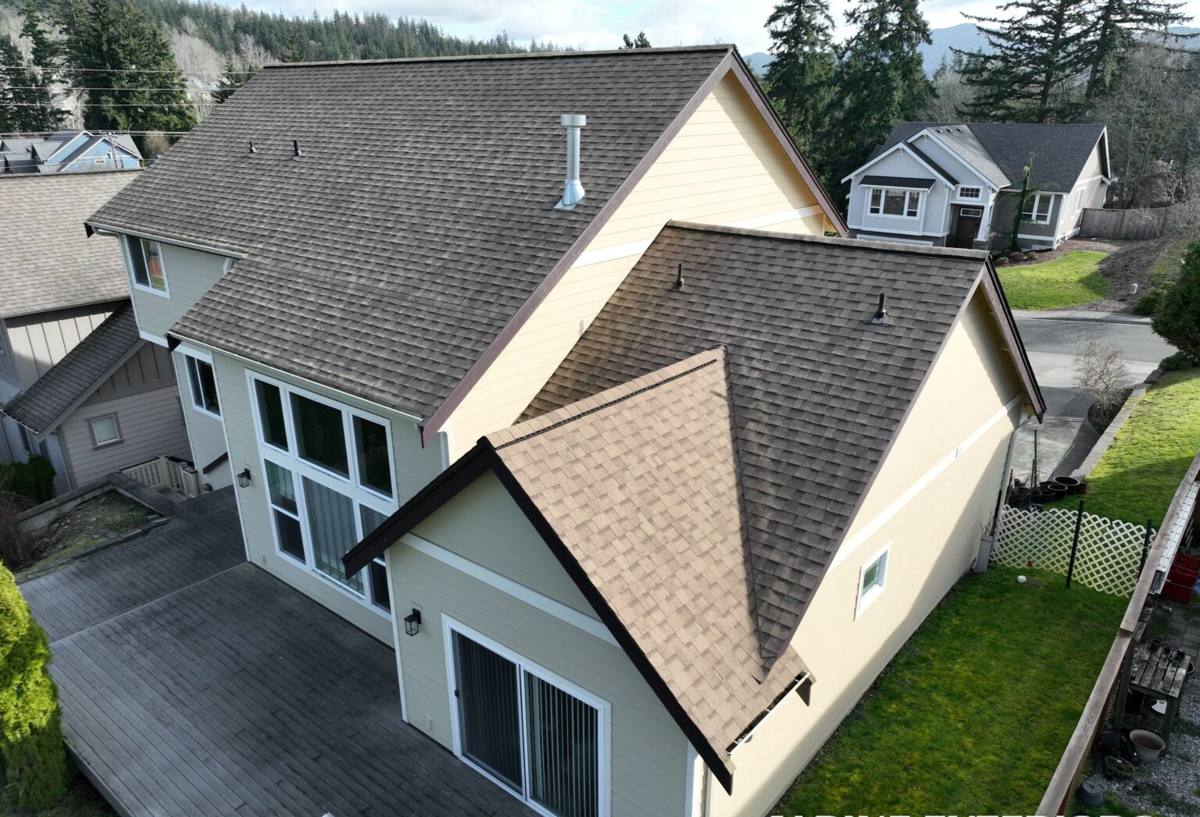
What Correctly Installed Fiber Cement Solves Here
Fiber cement siding is a mix of cement, sand, and cellulose fiber, pressed and cured into planks. It doesn't absorb water the way wood-based products do, it doesn't corrode like some metal siding, and it doesn't soften or warp when it's held wet against a wall for days at a time. For a neighborhood with real moss season and salt exposure, that moisture stability is the single biggest reason it outperforms the alternatives over a 20-30 year horizon.
- Moisture resistance: fiber cement doesn't swell, cup, or rot from repeated wet-dry cycles the way untreated or primed wood products can.
- Non-combustible: it carries a Class A fire rating, which matters to insurers and to homeowners near wooded lots.
- Dimensional stability: it expands and contracts far less than vinyl or wood with temperature swings, so seams and caulk lines hold up longer.
- Factory-cured finish: a baked-on finish resists fading and chalking better than field-applied paint, which matters when a wall gets shaded most of the year and doesn't get a lot of natural UV to help it dry and cure.
None of that means fiber cement is maintenance-free. It still needs to be installed with correct clearances, flashed properly at every penetration, and occasionally washed to keep moss and mildew from staining the surface. But the material itself gives you a much wider margin for error against the kind of weather Forest Park actually gets.
Why We Only Install James Hardie
Fiber cement is a category, not a single product, and the brand and formulation behind the boards matters more than most homeowners are told. We standardized on James Hardie for every job we do, including Forest Park, and we don't install LP SmartSide, vinyl, Cemplank, Allura, primed spruce, or cedar. That's a deliberate professional standard, not a knock on every homeowner who has one of those products on their house already.
The Honest Trade-Offs With the Alternatives
| Product | What it does well | Why it's a harder fit for this climate |
|---|---|---|
| LP SmartSide (engineered wood) | Lighter, easier to install, warmer look | Wood-strand core is more moisture-sensitive at cut edges and exposed grain; needs vigilant caulk and paint maintenance in a wet climate |
| Vinyl siding | Low upfront cost, no painting | Softens and warps in heat, becomes brittle in cold, and seams can let wind-driven rain behind the panel over time |
| Cedar (natural wood) | Authentic look, renewable material | Needs regular refinishing to resist rot and moss in shaded, damp conditions; upkeep cost compounds over the years |
| Primed spruce | Lower material cost | Primer is a base coat, not a moisture barrier; end grain and cut edges absorb water quickly if not sealed and maintained |
| James Hardie fiber cement | Moisture-stable, non-combustible, factory finish, strong transferable warranty | Higher material and labor cost than vinyl; heavier product requires correct fastening and handling |
Every one of those alternative products has a legitimate place somewhere in the market. What we've found, job after job, is that in a climate that combines salt air, sustained rain, and heavy shade, the products that depend on paint film, caulk maintenance, or a sealed factory edge to stay dry are the ones that come back to bite homeowners first. Hardie's engineered HZ product lines are formulated specifically for climates like ours, and the ColorPlus factory finish takes the maintenance burden off the paint film that other products rely on.
What a Correct Fiber Cement Installation Actually Involves
Fiber cement's reputation depends entirely on installation quality. A well-made board installed wrong will still fail early, and a lot of the siding problems we get called out to inspect in this area trace back to shortcuts taken during the original install, not the material itself.
The Non-Negotiables
- Correct starter strip and level baseline before the first course goes up
- Proper clearance from grade, roofing, and decks — Hardie's specifications call for gaps most crews skip to save time
- Rain screen or drainage plane behind the siding so any moisture that gets past the surface has somewhere to go
- Flashing at every window, door, and penetration, installed to shed water outward and downward, not trap it
- Correct fastener type, spacing, and depth — over-driven nails crack the board's fiber structure and create failure points
- Factory-cut and factory-primed edges kept intact wherever possible, with any field cuts sealed per manufacturer spec
That last point matters more here than it does in drier parts of the state. Every cut edge that isn't sealed is a place water can wick into the board over a long, wet winter. It's a small step that a rushed crew skips and a careful one doesn't.
Our Process, Start to Finish
- On-site assessment: we look at your home's exposure — how much tree cover, which walls take the worst wind-driven rain, and whether existing siding shows moisture damage that needs to be addressed before new siding goes up.
- Written estimate: a clear breakdown of material, labor, and any additional work like sheathing repair or flashing replacement uncovered during tear-off.
- Tear-off and inspection: removing old siding lets us actually see the sheathing and framing underneath, which is the only way to catch hidden rot before it's covered back up.
- Weather barrier and flashing: this layer does as much work as the siding itself and gets installed to spec, not to the minimum code will allow.
- Hardie installation: planks, panels, or trim installed with correct fastening, clearances, and joint treatment.
- Final walkthrough: we go over the finished work with you before calling the job done.
Cost Factors Homeowners Should Actually Weigh
| Factor | Why it moves the price |
|---|---|
| Existing siding removal | Tear-off, disposal, and any sheathing repair found underneath add labor beyond the new siding install |
| Home shape and trim detail | More corners, windows, and architectural detail mean more cutting, flashing, and finish work |
| Product line and profile | Lap siding, board-and-batten, and panel systems within the Hardie lineup carry different material costs |
| Access and lot conditions | Steep grades, tight side yards, or heavy tree cover close to the house slow down staging and installation |
| Color and finish | Factory ColorPlus finish costs more upfront than primed board but removes the need for a full repaint later |
We don't quote a number without seeing the house — anyone who does is guessing. But those are the honest variables that move a Forest Park estimate up or down, and we walk through each one with you before you sign anything.
Living With Fiber Cement Siding in This Climate
Correctly installed Hardie siding is low-maintenance, not maintenance-free. In a shaded, damp neighborhood like Forest Park, plan on an occasional soft wash to keep moss and mildew from staining the surface — a garden hose and a soft brush is usually enough; pressure washing directly at the surface can force water behind the boards and isn't recommended. Keep gutters clear so runoff isn't sheeting down the wall, and trim back vegetation that's holding moisture against the siding. None of that is heavy lifting, but it's the difference between siding that looks new at year fifteen and siding that looks tired at year seven.
A Quick Self-Check for Homeowners
- Do you see dark streaking or green growth concentrated on north- or shade-facing walls?
- Is caulking around windows and trim cracking or pulling away?
- Are there soft spots when you press on the siding near the ground or below windows?
- Has paint on existing siding started chalking or peeling in patches?
- Is there visible gap or daylight where trim meets siding at corners?
Any of those are worth a professional look before they turn into a bigger repair.
Why a Crew That Already Works This Neighborhood Matters
Every neighborhood in Snohomish County has its own combination of exposure, tree cover, and permitting quirks, and Forest Park's mix of mature trees and proximity to the water is its own case. A crew that has already worked jobs in the area knows what wall orientations take the worst weather, how much clearance to plan for around established trees, and what Everett's permitting and inspection process expects for exterior work — none of which is complicated, but all of which slows a job down when a crew is encountering it for the first time. That familiarity translates into fewer surprises during tear-off and a more accurate estimate up front.
If you're weighing a siding replacement in Forest Park, we'd rather walk your house with you and give you a straight answer than sell you on a material that isn't right for how your home is exposed. Reach out for a free, no-pressure estimate — there's a form below.