 Everett
 Why Siding Choice Matters More in Forest Park Than It Looks
Forest Park sits close enough to Puget Sound and the Snohomish County waterways that homes here deal with a specific combination of stressors most siding products were never engineered for: salt-tinged marine air, long stretches of driving rain off the water, and a moss season that can run from fall through spring. None of these alone is unusual for Western Washington. Together, over years, they punish siding that isn't dimensionally stable, isn't sealed correctly at the seams, or relies on a surface coating that wasn't built to shed moisture and organic growth at the same time.
That's the lens we use on every Forest Park project. The question isn't just "what does this siding look like new," it's "what does this siding look like in year twelve, after two hundred more rainy weeks and a dozen more moss cycles." That's also why we only install James Hardie fiber cement — it's the one system we're willing to put our name behind for this specific climate.
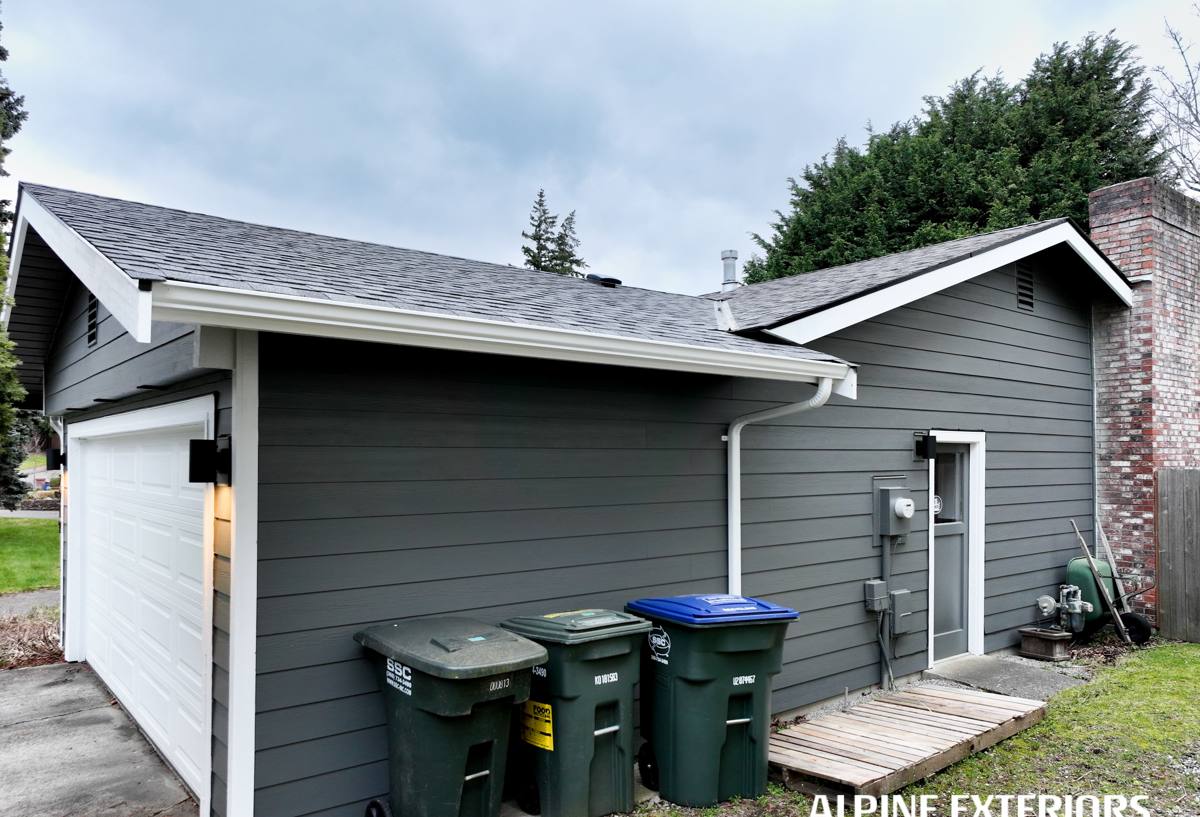
What Forest Park's Climate Actually Does to Siding
Salt Air and Coating Breakdown
Homes within a few miles of Puget Sound take on airborne salt that accelerates the breakdown of paint films and lower-grade coatings. On some siding materials this shows up as chalking, fading, or bubbling well before the manufacturer's stated service life. Fiber cement isn't immune to weathering, but it doesn't absorb moisture into its core the way wood-based products do, and a factory-baked finish holds up to salt exposure far better than a field-applied coat.
Driving Rain and Wind-Driven Moisture
Everett gets rain that doesn't just fall — it's pushed sideways into wall assemblies during storms coming off the Sound. Any siding system with weak lap joints, poor flashing, or gaps at trim and penetrations will eventually let water behind the cladding. Once moisture gets behind siding and can't dry out, you're not looking at a cosmetic problem anymore; you're looking at sheathing damage, framing rot, and mold, all hidden until it's expensive.
Moss and Organic Growth
Shaded lots, north-facing walls, and the long damp season common to this area give moss, algae, and mildew months at a time to establish themselves on siding surfaces. Porous or textured materials give organic growth more to grip onto and hold moisture against. Smoother, denser materials with a durable factory finish are simply harder for moss to colonize and easier to keep clean.
What James Hardie Brings to This Specific Set of Problems
James Hardie fiber cement is engineered from cement, sand, and cellulose fibers — not wood pulp, not vinyl resin. That composition matters here for a few concrete reasons:
- It's non-combustible, which matters for wildfire-adjacent insurance considerations and is simply a better fire performance profile than wood or vinyl.
- It doesn't swell, warp, or rot the way wood-based sidings can when they take on moisture at cut edges or joints.
- Hardie's HZ5 product engineering is built for regions with freeze-thaw cycling and sustained moisture exposure — which fits the Pacific Northwest better than a one-size-fits-all national product.
- ColorPlus finish is baked on in a factory-controlled process, not brushed or sprayed on site, which gives it stronger resistance to fading, chalking, and moisture intrusion at the coating level than field-applied paint.
None of that means Hardie siding is maintenance-free or installation-proof. It means the material itself isn't the weak link — the installation is where a job succeeds or fails, especially in a climate like this one.
Where Installation Quality Actually Determines the Outcome
Moisture Management Behind the Cladding
Correct water-resistive barrier lapping, properly flashed windows and doors, and a drainage plane that lets any incidental moisture escape are non-negotiable in a driving-rain climate. Fiber cement siding installed directly against a wall with no drainage gap, or with house wrap taped backwards, will trap water regardless of how good the siding itself is.
Fastening and Clearances to Manufacturer Spec
James Hardie publishes specific fastener patterns, minimum clearances from grade, roof lines, and decks, and gapping requirements at butt joints. Skipping these — nailing too close to panel edges, tight-butting boards with no expansion gap, or letting siding sit too close to the ground where splashback keeps it wet — is how installers void the warranty and create the exact failure points salt air and rain go looking for.
Caulking and Joint Treatment
Hardie's own installation guidance is specific about where caulk is appropriate and where it isn't. Over-caulking joints that are supposed to allow drainage or movement traps moisture instead of releasing it — a mistake that looks fine at final walkthrough and shows up as staining or soft trim two winters later.
Choosing the Right Hardie Line for a Forest Park Home
Hardie makes several distinct product lines, and the right pick depends on the home's style, exposure, and what's already on it:
| Product | Best Fit | Consideration for This Area |
|---|---|---|
| HardiePlank lap siding | Most traditional and craftsman-style homes | Widest color range in ColorPlus; handles wind-driven rain well when lapped correctly |
| HardiePanel vertical siding | Modern facades, accent walls, gables | Fewer horizontal joints to manage moisture at, good for board-and-batten looks |
| HardieShingle | Homes wanting a cedar-shake look | Textured surface needs correct exposure and fastening to resist moss buildup |
| HardieTrim | Corner boards, window and door trim | Pairs with any of the above; keeps trim from being the weak point against the siding field |
Color selection matters too. On shaded, moss-prone walls, darker ColorPlus finishes hide staining longer between cleanings, while lighter finishes show organic growth sooner but are easier to spot and address early. There's no universally "right" answer — it's a conversation about the specific lot and exposure.
Our Process on Forest Park Projects
- On-site assessment — we look at existing siding condition, sheathing access points, moisture history, sun/shade exposure, and drainage around the foundation before recommending anything.
- Tear-off and sheathing inspection — this is where hidden rot or trapped moisture from the old siding system gets found and addressed, not covered over.
- Water-resistive barrier and flashing — installed and lapped correctly at every window, door, and penetration before a single piece of siding goes up.
- Hardie installation to manufacturer spec — correct fastener pattern, clearances, and joint gapping, not shortcuts that happen to look fine on day one.
- Final walkthrough — trim, caulking lines, and touch-up review with the homeowner before we consider the job done.
Cost Factors for a Forest Park Hardie Project
| Factor | Why It Moves the Price |
|---|---|
| Tear-off scope | Removing and disposing of existing siding, especially if multiple layers exist, adds labor and disposal cost |
| Sheathing repair | Rot or moisture damage found during tear-off has to be addressed before new siding goes on — this varies a lot house to house |
| Product line and profile | HardieShingle and custom trim details generally run higher than standard lap siding |
| Color | Factory ColorPlus finishes cost more upfront than primed boards but remove the ongoing cost of repainting |
| Home shape and stories | Cut complexity, gables, and access (scaffolding vs. ladders) affect labor time |
We don't quote broad numbers without seeing the house — too much of the cost depends on what's actually happening behind the existing siding. A walkthrough gives an honest, specific range instead of a guess.
Why a Crew That Already Works in Forest Park Matters
A contractor who regularly works Snohomish County homes near the Sound has already seen how salt exposure, moss, and driving rain interact with different wall assemblies, roof lines, and lot orientations in this specific area. That's not a marketing point — it changes real decisions on the job, like where extra flashing attention is worth it, which walls need a moisture-resistant approach first, and what a realistic maintenance rhythm looks like for a given exposure. A crew installing siding in a drier, calmer climate simply hasn't had to solve for these conditions as often.
Keeping Hardie Siding Performing in This Climate
Correctly installed Hardie siding is low-maintenance, not no-maintenance. A simple seasonal routine keeps it performing the way it's designed to:
- Rinse siding down once or twice a year to keep salt residue and pollen film from building up
- Check shaded, north-facing walls for early moss growth and address it before it spreads
- Keep gutters clear so overflow isn't running down the siding face during heavy rain events
- Trim back landscaping that keeps siding damp or shaded longer than necessary
- Inspect caulking lines at trim and joints every couple of years and touch up as needed
- Walk the exterior after major storms to check for any loose or damaged boards near rooflines and grade
If you're weighing a siding replacement for a Forest Park home, we're happy to walk the property, look at what's actually going on behind your current siding, and give you a straightforward, no-pressure estimate for doing it right the first time.