 Everett
 Glenhaven is a settled residential pocket of Everett, and like most established Snohomish County neighborhoods, it's got a real mix of home ages — which means a real mix of siding that's nearing or past its useful life. We do siding replacement work throughout this part of Everett, and Glenhaven is one of the neighborhoods where the local climate — salt-tinged air moving in off the Sound, long stretches of driving rain, and a moss season that can run most of the year — plays a direct role in how long siding actually lasts and what it takes to replace it correctly.
What Glenhaven's Climate Does to Aging Siding
Western Washington's marine climate isn't gentle on the outside of a house, and Glenhaven sees the same pattern that shows up across Everett: sustained wet weather rather than short, hard storms, which gives water more time to find its way into every seam, lap joint, and fastener hole that isn't detailed correctly. Add in salt-tinged air moving inland off Puget Sound and you get accelerated corrosion on exposed fasteners and hardware, plus faster breakdown of any coating that isn't built to handle it.
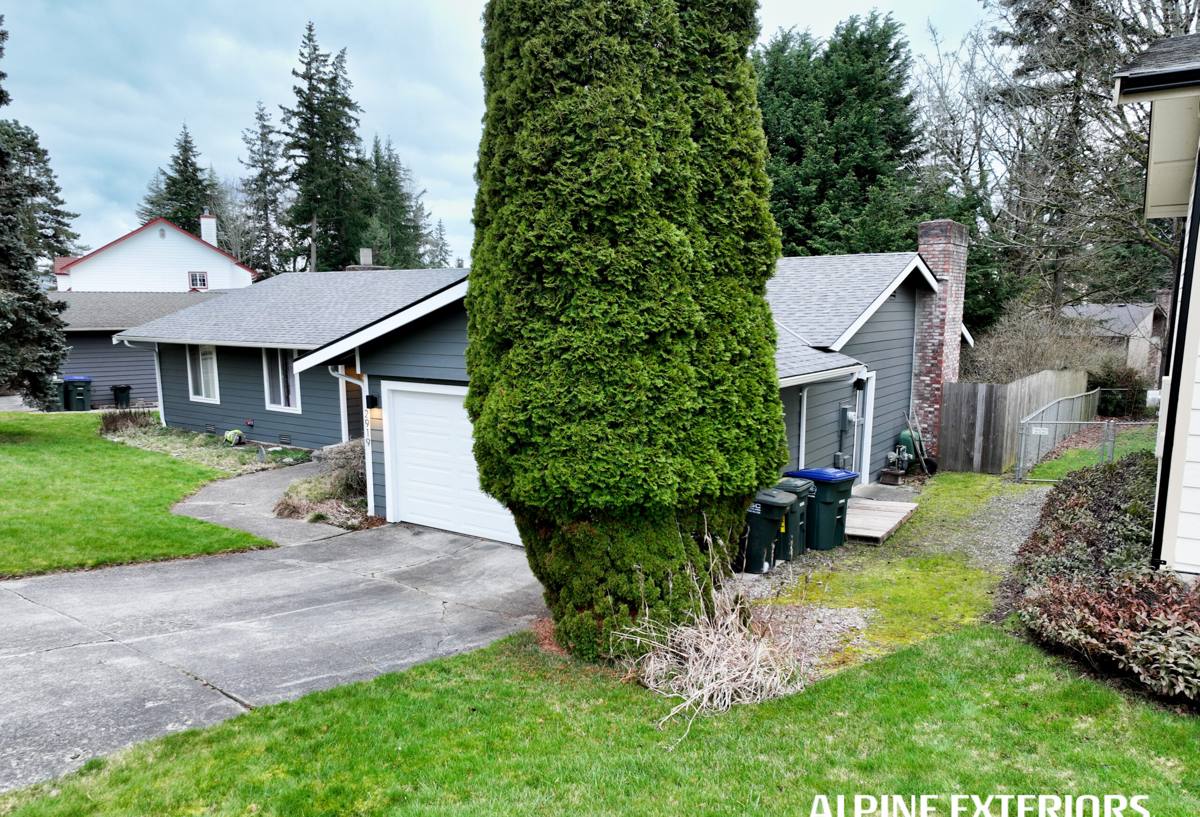
Then there's moss. Mature trees are common on Glenhaven lots, and shaded, north-facing walls under that kind of tree cover stay damp far longer than walls that get regular sun. That's exactly the condition moss and mildew need to take hold, and on older or wood-based siding, ongoing moisture exposure isn't just a cosmetic problem — it's the thing that quietly rots sheathing and framing behind the wall while the siding still looks passable from the street.
Warning Signs We See Most Often on Glenhaven Replacement Calls
- Soft, spongy siding or trim, especially near the bottom courses and around window and door openings
- Persistent moss or algae staining that comes back within weeks of being cleaned
- Paint that's chalking, peeling, or failing faster than it used to, even after a fresh coat
- Visible cracking, warping, or separation at seams and lap joints
- Rising energy bills or drafts that suggest the wall assembly behind the siding isn't sealing the way it should
Repair or Replace? Knowing Where the Line Is
Not every issue on a Glenhaven home means a full replacement. A section of damaged siding, a failed piece of trim, or isolated caulk failure can often be repaired without touching the rest of the wall. The distinction that matters is whether the damage is contained to the surface material or whether moisture has already reached the sheathing and framing underneath. Once water has been tracking behind the siding for a season or more, patching the visible symptom just buries the real problem for another few years.
Age matters too. Older wood, vinyl, or early fiber cement products that are approaching or past their expected service life are rarely worth chasing with repairs indefinitely — at some point the labor and material cost of another round of patching starts to rival a real replacement, without giving you a longer-term fix. A straightforward inspection usually tells us which side of that line a given Glenhaven home is on.
What a Correct Siding Replacement Actually Involves
Full siding replacement is a bigger project than a re-side that just covers over what's there, and that's the point — it's the only way to actually deal with what's happening behind the old siding, not just what's visible in front of it. On a proper tear-off, we're not just pulling boards; we're looking at everything the siding was hiding.
Beyond the Boards: What's Underneath Matters More
Once the old siding is off, the sheathing gets inspected for rot, soft spots, or water damage, and any compromised sections get replaced before anything new goes back up — installing new siding over damaged sheathing just repeats the same failure on a delay. A correctly installed water-resistive barrier (house wrap) goes on next, lapped and taped so water sheds outward at every seam instead of tracking behind it. Flashing at windows, doors, and any wall penetration gets integrated with that barrier, not just caulked as an afterthought, since caulk alone is a maintenance item, not a permanent water seal.
Fastening pattern, nail spacing, and clearance above grade, decks, and roof lines all matter more in a climate like ours than they do in a drier region, because any shortcut there shows up as a moisture problem within a few wet seasons rather than a few decades. This is the part of a replacement job that's invisible once the new siding is up — and it's also the part that determines whether the new siding actually lasts.
Why We Replace Glenhaven Siding With James Hardie Fiber Cement — Nothing Else
We don't install vinyl, LP SmartSide, Cemplank, Allura, primed spruce, or cedar. That's a standard, not a limitation — we've settled on one product because we've seen how materials actually perform against sustained Puget Sound moisture and moss pressure, and Hardie fiber cement holds up to that combination better than the alternatives we've chosen not to install. It's non-combustible, it doesn't swell or rot the way wood-based products can, and it's dimensionally stable enough that it isn't constantly opening and closing seams as it moves through wet and dry cycles the way vinyl and some wood products do.
Hardie's ColorPlus factory finish is baked on under controlled conditions and warrantied separately from the board itself, which matters in a region where field-applied paint has a hard time curing evenly given how much of the year is wet. Hardie also builds region-specific HZ product lines engineered for climates like ours, and the whole system is backed by a strong, transferable warranty — a real consideration if a Glenhaven home changes hands down the road.
| Hardie Product | Where It's Used on a Glenhaven Home | Why It Fits This Climate |
|---|---|---|
| HardiePlank Lap Siding | Primary field siding on most homes | Smooth or cedar-textured finish, dimensionally stable in wet-dry cycling |
| HardiePanel Vertical Siding | Gables, accent walls, modern facades | Clean lines, pairs with lap siding for style variation |
| HardieTrim Boards | Window/door surrounds, corners, fascia | Resists the swelling and rot that plague wood trim in constant moisture |
| HZ5 Climate-Engineered Line | Standard for our region | Formulated specifically for wetter, colder climate zones like western Washington |
Our Siding Replacement Process, Start to Finish
- Inspection and assessment: We walk the home, evaluate current siding condition, check for hidden moisture damage, and give an honest read on repair versus replacement.
- Scope and estimate: A written scope covering material, tear-off, sheathing repair allowances, and labor — no pressure to decide on the spot.
- Tear-off and inspection: Old siding comes off and the sheathing and framing underneath get inspected before anything new goes on.
- Repair and prep: Any damaged sheathing gets replaced, and the wall is prepped for a correctly lapped water-resistive barrier.
- Flashing and barrier installation: Windows, doors, and penetrations get properly integrated flashing before siding starts.
- Hardie installation: Siding, trim, and any accent panels go on to manufacturer spec — fastening pattern, clearances, and seams done right the first time.
- Final walkthrough: We review the finished work with the homeowner and address anything before calling the job complete.
What Siding Replacement Costs Depend On
Every Glenhaven home is different, and we don't quote a project without seeing it, but the factors that move the price are consistent from house to house:
| Factor | Why It Matters |
|---|---|
| Home size and wall complexity | More square footage and more corners, gables, and dormers mean more material and labor |
| Sheathing condition underneath | Hidden rot found during tear-off adds repair work that can't be scoped until the old siding is off |
| Product and trim selection | Lap siding versus panel accents, standard versus wider trim profiles |
| Access and site conditions | Mature trees, tight side yards, or multi-story walls affect staging and labor time |
| Window and door count | Each opening needs flashing integration, which adds labor beyond flat wall area |
An honest estimate accounts for the likelihood of finding some hidden sheathing damage rather than assuming a best-case scenario, so the number you're given up front holds up once the walls are actually open.
Why a Crew That Already Works Glenhaven Matters
A lot of what separates a siding replacement that lasts from one that needs attention again in a few years comes down to details a generic, unfamiliar crew is more likely to miss: how much rain exposure a given wall orientation gets on a Glenhaven lot, where moss pressure is worst given the tree cover common in this neighborhood, and how much clearance new siding needs above grade, decks, and hardscaping given how long the ground stays wet here. Crews who work Everett exteriors regularly see these patterns repeat house to house, and that familiarity shows up in decisions homeowners rarely see directly but absolutely feel in how the siding performs over the following decade — fastener choice, flashing sequence, where a J-channel actually belongs.
It also means fewer surprises around permitting and scheduling. A crew that already knows Everett's permitting process and has handled the tree cover, narrow access, and older-home quirks common in Snohomish County neighborhoods isn't learning those things on your project.
Before You Start: A Homeowner's Checklist
- Get a written scope that specifies tear-off, sheathing inspection, and how hidden damage will be handled if it's found
- Confirm the contractor is licensed and bonded to work in Washington state
- Ask what happens if rotted sheathing is discovered — is it a change order surprise or already accounted for in the process?
- Clarify what siding product is being installed and why, not just the per-square-foot price
- Ask about warranty coverage on both material and labor, and whether it's transferable if you sell
- Confirm who pulls the permit and manages inspections
If your Glenhaven home is showing any of the warning signs above, or you're simply planning ahead before a small problem becomes a big one, we're happy to take a look. Reach out for a free, no-pressure estimate — we'll give you a straight read on whether replacement makes sense now, and what it would actually involve.