 Everett
 Why Lake Stevens Roofs Take a Different Kind of Beating
Lake Stevens sits in the wetter, greener stretch of Snohomish County, and that setting shapes what a roof has to survive here. The lake itself keeps humidity higher than you'll find in drier inland areas, tree cover is heavy on most lots, and the broader Puget Sound climate brings long stretches of driving rain from fall through spring. Add in the salt-tinged marine air that moves inland off the Sound, and you've got a combination that's harder on roofing materials than a lot of homeowners realize until they're dealing with the results.
None of this means asphalt shingles are a poor fit for Lake Stevens — they're still one of the most practical, cost-effective roofing options for this climate when they're specified and installed correctly. What it does mean is that a roof built here needs more attention paid to moisture management, ventilation, and moss resistance than the same roof would need in a drier part of the state. That's the gap between a roof that looks fine on install day and one that's still performing well ten and fifteen years later.
The Moss Problem
Moss is the single most common issue we see on shingle roofs around Lake Stevens. Shaded, north-facing slopes under tree canopy stay damp for days after a storm, and moss spores take hold in that moisture. Left alone, moss doesn't just look bad — it holds water against the shingle surface, works its way under shingle tabs, and lifts them enough for wind-driven rain to get underneath. A roof that's fighting moss is a roof that's losing granules and years of life faster than it should.
Driving Rain and Wind-Driven Moisture
Storms coming off the Sound don't always fall straight down. Wind-driven rain pushes water sideways and upward under shingle edges, especially at eaves, valleys, and anywhere flashing has started to separate. A roof that was installed with shortcuts in the underlayment or flashing details can look completely normal from the ground while quietly letting water into the deck.
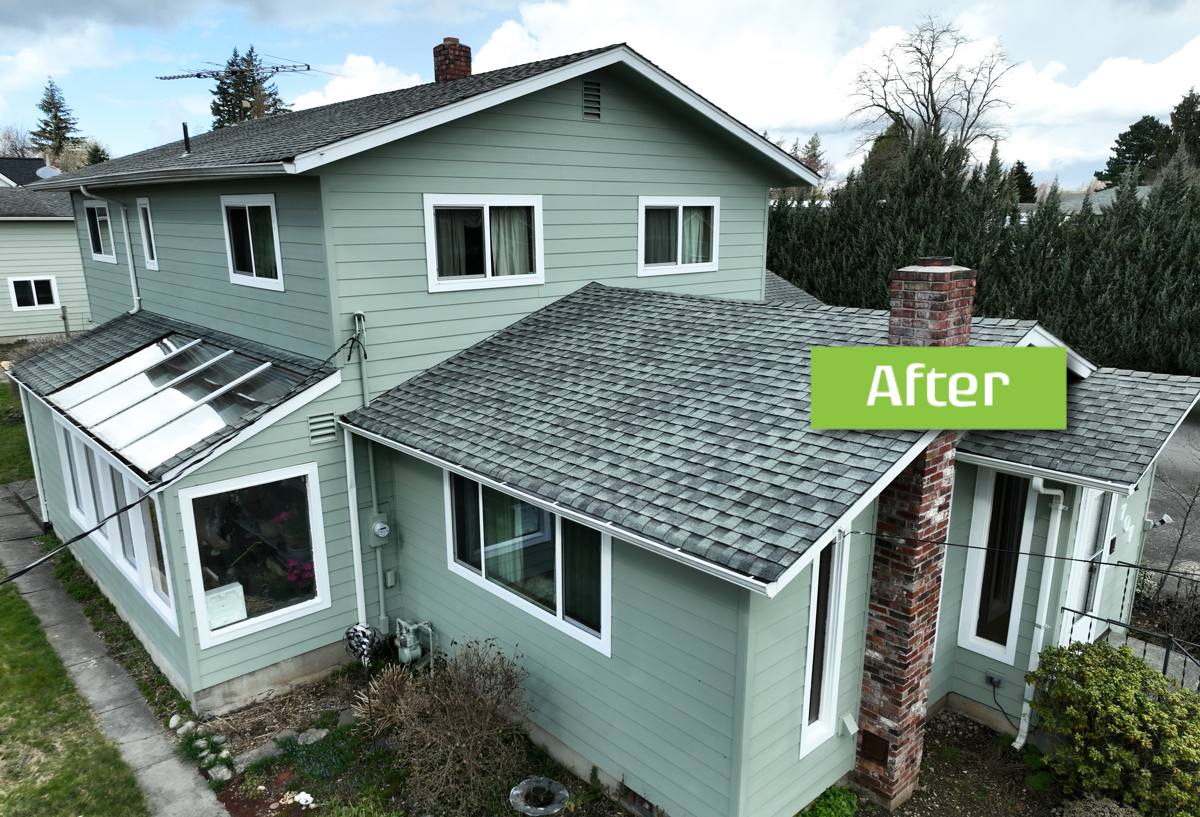
What a Correct Asphalt Shingle Roof Involves
A roof that's going to hold up in this climate isn't just shingles nailed to plywood. It's a system, and every layer matters.
- Tear-off and deck inspection: Old layers come off so the deck can actually be checked for soft spots, rot, or delamination — problems that get hidden, not fixed, when a new layer is installed over them.
- Ice-and-water shield at vulnerable points: Eaves, valleys, and roof-to-wall transitions get a self-adhering waterproof membrane, not just felt, because these are the spots wind-driven rain exploits first.
- Synthetic underlayment across the field: A durable water-resistant barrier under the shingles is the backup layer that protects the deck if any water gets past the shingles themselves.
- Proper nailing pattern: Shingles fastened per manufacturer spec, in the nailing zone, with the correct number of fasteners — this is where a lot of storm-related shingle loss actually starts.
- New flashing at penetrations: Vent pipes, chimneys, and skylights get new flashing rather than reused pieces, since old flashing is a common hidden leak source.
- Balanced ventilation: Intake at the eaves and exhaust at the ridge, sized to move air through the attic and keep the underside of the deck dry.
Ventilation: The Detail Most Roofs Get Wrong
Ventilation doesn't get much attention because it's invisible once the roof is finished, but it's often the difference between a shingle roof that lasts and one that fails early. Without enough intake and exhaust airflow, heat and moisture build up in the attic. In summer that bakes shingles from underneath; in winter, humid indoor air condenses on the cold underside of the deck. Either way, the deck and the shingles above it degrade faster — and it's a slow, hidden process that's easy to miss during a quick roof inspection because the damage happens from the inside out.
On a lot of Lake Stevens homes, especially ones with additions or older attic conversions, ventilation was never properly balanced in the first place. When we're up on a roof for an estimate, checking soffit intake against ridge or box-vent exhaust is a standard part of what we look at, because installing new shingles over an unventilated attic just repeats the same problem on a new roof.
Signs Your Lake Stevens Roof Needs Attention
- Dark streaking or green-black patches, especially on shaded or north-facing slopes
- Granules collecting in gutters or at downspout outlets
- Shingle edges that look curled, cupped, or lifted
- Soft or spongy spots when the roof deck is walked
- Daylight visible through the attic roof boards
- Water stains on interior ceilings, especially after a windy rainstorm
- Moss or plant growth building up in valleys or along the ridge
- A roof approaching or past 18-20 years old with no major work done
Any one of these on its own isn't necessarily an emergency, but they're worth a real inspection rather than a guess from the ground. Moss and granule loss in particular are easy to underestimate because the roof can still look "fine" from the driveway.
Choosing the Right Shingle for This Climate
Not every asphalt shingle product is built the same way, and the differences matter more in a wet, moss-prone climate like this one than they would somewhere dry. We install algae-resistant shingles as a standard, not an upgrade, because standard shingles without that protection tend to develop staining and moss issues noticeably sooner around Lake Stevens.
| Shingle Type | Typical Lifespan Here | Best Fit For |
|---|---|---|
| 3-tab (standard) | 15-20 years | Budget-focused projects, simpler rooflines |
| Architectural/dimensional | 25-30 years | Most Lake Stevens homes — better wind rating, thicker profile |
| Premium/designer | 30+ years | Steeper, more visible rooflines, longer-term ownership plans |
For most homes in this area, architectural shingles are the practical middle ground: meaningfully better wind resistance and thickness than 3-tab, without the cost jump of a premium line. We'll walk through the actual options and trade-offs for your roof rather than pushing one product across the board — the right choice depends on roof pitch, sun exposure, and how long you plan to stay in the home.
What Drives the Cost of a Lake Stevens Roof
| Factor | Why It Matters |
|---|---|
| Roof size and pitch | Steeper roofs take longer to work and require more safety setup |
| Number of layers to remove | Tear-off of multiple old layers adds labor and disposal cost |
| Deck condition | Rotted or soft plywood found during tear-off needs replacement before shingles go on |
| Roof complexity | Valleys, dormers, and multiple penetrations mean more flashing and cut work |
| Shingle grade chosen | 3-tab, architectural, and premium products carry different material costs |
| Ventilation upgrades | Adding or correcting intake/exhaust vents affects both material and labor |
We'd rather walk your specific roof and give you real numbers than quote a broad range that doesn't mean much until we've seen the deck. What we can say honestly: the roofs that end up costing homeowners the most are the ones where a cheap install skipped ventilation or flashing details and the damage wasn't visible until years later.
How We Work
1. On-Site Inspection and Estimate
We get on the roof, not just in the yard. That means checking the deck where accessible, looking at existing ventilation, and identifying trouble spots like valleys and flashing before we ever write a number down.
2. Clear Scope and Materials
You'll know exactly what shingle, underlayment, and flashing package you're getting, and why, before work starts — no vague "shingle roof" line item.
3. Tear-Off and Deck Repair
Old roofing comes off, the deck gets inspected, and any soft or damaged sheathing is replaced before anything new goes down.
4. Installation
Ice-and-water shield at vulnerable areas, synthetic underlayment, new flashing, and shingles installed to manufacturer nailing specs, with ventilation corrected or upgraded as needed.
5. Cleanup and Walkthrough
Job site cleared of debris and nails, with a walkthrough so you know what was done and what to watch for going forward.
Why Hiring a Crew That Already Works Lake Stevens Matters
A roofing crew that's spent time on homes around Lake Stevens already knows which slopes tend to hold moss, how local tree cover affects drying time after a storm, and where wind-driven rain typically finds its way into a poorly detailed roof. That's not something you get from a general roofing checklist — it comes from seeing the same climate conditions repeat across dozens of local roofs.
It also means someone who understands that a roof here isn't judged by how it looks in September — it's judged by how it holds up through a wet Snohomish County winter. We build and repair roofs with that standard in mind, not just a pass-or-fail inspection on install day.
Get a Straight Answer on Your Roof
Whether you're dealing with moss, a suspected leak, an aging roof, or you're just planning ahead, we're happy to take a look and give you an honest read on where things stand. There's no pressure and no obligation — just a clear estimate based on what we actually find on your roof. Use the form below to request your free estimate.