 Everett
 Why Pinehurst Roofs Age the Way They Do
Pinehurst sits close enough to Puget Sound and the Snohomish County lowlands that its roofs deal with a specific combination of stresses: salt-tinged air moving in off the water, long stretches of driving rain from fall through spring, and a moss season that can run eight months or more in a wet year. None of these are dramatic events on their own — no hailstorms, no wildfire embers — but the steady, grinding exposure is what wears out a roof before its rated lifespan is up. We see it in the same patterns block after block: shingles that granule-shed early on the north-facing slopes that never fully dry out, moss colonies working into the shingle mat at the eaves, and fastener corrosion on older roofs that used builder-grade flashing and nails not meant for a marine-influenced climate.
A roof replacement done right for this neighborhood isn't just "put new shingles on." It's a system decision — deck condition, underlayment type, ventilation, flashing metal, and moss strategy all have to work together, because in Everett's climate any one weak link shortens the life of the whole roof.
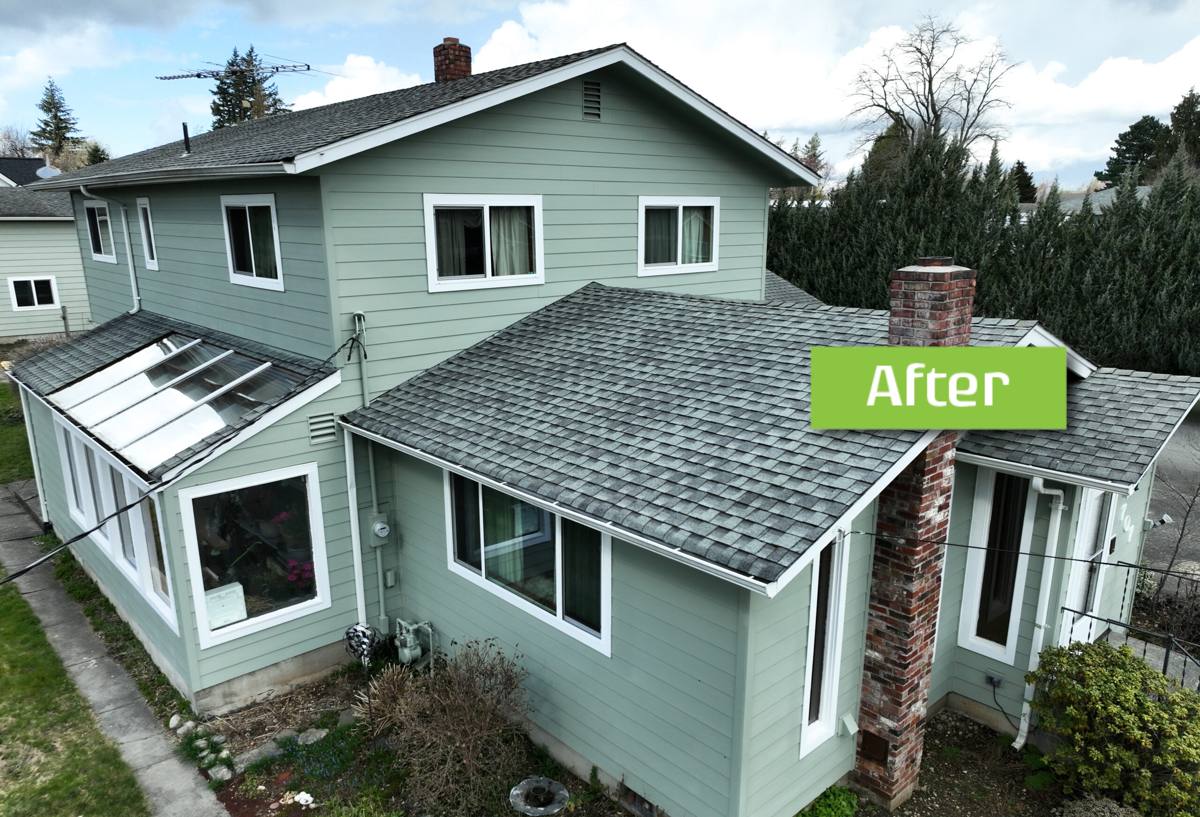
Repair, or Full Replacement?
Not every roof in Pinehurst needs full replacement, and we'll tell you honestly when a repair is the smarter move. The decision usually comes down to how much of the roof's water-shedding system is still intact versus how much has been compromised by age and moisture.
Signs that point toward replacement
- Granule loss heavy enough that you can see bare, shiny asphalt on multiple slopes, not just one patch
- Shingles that are cupping, curling, or cracking across large sections rather than a few isolated spots
- Soft or spongy decking found during an inspection, especially near valleys or eaves
- Moss that has been established for more than a season or two and has lifted shingle tabs
- Repeated leaks in different spots each winter rather than one recurring trouble area
- A roof already past 20–25 years old on standard asphalt shingle, even if it "looks okay" from the ground
If the deck is sound, the leak is isolated, and the rest of the roof still has real service life left, a targeted repair is the honest recommendation — and we'll say so even though a replacement is the bigger job for us.
What a Correct Roof Replacement Actually Involves
A roof replacement is a system, and skipping steps is exactly how a "new roof" ends up leaking or moss-covered again in five years instead of twenty. Here's what should happen on every full tear-off and replace, regardless of which material you choose:
Tear-off and deck inspection
Every layer of old roofing comes off down to the deck. This is the only point where anyone can actually see the plywood or plank sheathing underneath — soft spots, rot, or old water staining get replaced before anything new goes down. Roofing over an existing layer hides problems instead of fixing them, and it's not something we do on a full replacement.
Underlayment built for wet climates
In a region with this much sustained rain, the underlayment matters almost as much as the shingle itself. A synthetic, high-traction underlayment paired with self-adhering ice-and-water membrane at eaves, valleys, and around penetrations gives the roof a real second line of defense if wind-driven rain ever gets under the surface layer — which, on an exposed Pinehurst slope in a February storm, it eventually will.
Flashing that won't corrode
Salt-influenced air corrodes cheap galvanized flashing and fasteners faster than most homeowners expect. We flash chimneys, valleys, skylights, and wall intersections with corrosion-resistant metal and use fasteners rated for coastal exposure, not the minimum-cost hardware that shows rust streaks within a few winters.
Ventilation, not just shingles
A roof deck that can't breathe traps moisture from inside the house against the underside of the sheathing — this accelerates rot from below at the same time rain and moss are working it from above. Balanced intake (soffit) and exhaust (ridge) ventilation is part of a correct replacement, not an upsell.
Material Choices for Everett's Climate
There's no single "best" roofing material — there's a best fit for your home's exposure, roof pitch, and budget. Here's how the common options actually perform under Pinehurst's salt air, rain, and moss conditions:
| Material | Moss/moisture behavior | Typical lifespan here | Trade-offs |
|---|---|---|---|
| Architectural (laminate) asphalt shingle | Good with proper ventilation and periodic moss treatment; algae-resistant granules help on shaded slopes | 25–30 years | Best value; needs occasional moss/algae maintenance on north-facing or tree-shaded sections |
| Standard 3-tab shingle | More prone to early granule loss and moss colonization | 15–20 years | Lowest upfront cost, but shortest service life in this climate; we don't recommend it for most Pinehurst homes anymore |
| Standing-seam metal | Sheds moisture fast, moss struggles to gain a foothold on smooth panels | 40–50+ years | Higher upfront cost; requires correct fastening and underlayment detailing to avoid condensation issues |
| Cedar shake | Attractive but holds moisture in the wood itself, needs active moss/mildew maintenance | 20–30 years with upkeep | Higher maintenance burden and fire-rating considerations; we're upfront that it's a bigger ongoing commitment in a wet climate |
For most Pinehurst homes, a mid-to-upper-tier architectural shingle with algae-resistant granules and proper ventilation gives the best balance of upfront cost, appearance, and realistic maintenance. Metal is worth a serious look on lower-pitch sections or for homeowners planning to stay long-term and wanting to largely opt out of moss maintenance.
Moss and Algae: Managing It, Not Just Reacting to It
Moss isn't cosmetic — once it establishes itself under shingle tabs, it holds moisture against the roofing material and lifts edges, which is exactly where wind-driven rain gets in. In a climate with Everett's rainfall pattern, moss control is an ongoing part of roof ownership, not a one-time fix.
What actually helps over the life of a new roof:
- Algae-resistant shingles with embedded copper or zinc granules on shaded or north-facing slopes
- Keeping overhanging branches trimmed back so slopes get more sun and airflow
- Zinc or copper strips near the ridge on moss-prone roofs, which release trace metal ions with each rain
- Gentle, low-pressure moss removal on a routine schedule rather than aggressive pressure-washing, which strips granules and shortens shingle life
- Keeping gutters and valleys clear so water doesn't pool and give moss spores a place to take hold
Our Process for a Pinehurst Roof Replacement
- On-site inspection. We walk the roof (weather permitting) and check the attic from inside — deck condition, ventilation, flashing points, and moss/algae extent all get documented, not guessed at.
- Written scope and material recommendation. You get a clear breakdown of what we found, what needs replacing versus what can be reused, and material options suited to your specific slopes and exposure.
- Scheduling around the weather. We plan around Snohomish County's rain patterns and stage the job so your home is never left exposed overnight without proper dry-in protection.
- Tear-off and deck repair. Old roofing comes off, the deck is inspected board by board, and any soft or damaged sheathing is replaced before anything new goes down.
- Underlayment, flashing, and ventilation installation. This is where a correct roof is actually built — done in the order above, not shortcut.
- Final walkthrough. We go over the finished roof with you, point out anything you should know for maintenance, and make sure debris and old material are fully cleared from the property.
Why a Crew That Already Works Pinehurst Matters
Roofing crews that mostly work drier inland areas sometimes under-spec ventilation or skip ice-and-water membrane in places that don't need it there — but do here. A crew that regularly works Pinehurst and the surrounding Everett neighborhoods knows which slopes in this micro-area take the worst wind-driven rain, which older subdivisions tend to have thinner original decking that needs closer inspection, and how aggressive the moss season really gets block by block. That local pattern recognition doesn't show up on a spec sheet — it shows up in fewer callbacks and a roof that's actually built for the conditions it will face, not a generic set of conditions somewhere else in Western Washington.
What Affects the Cost
Roof replacement pricing is genuinely project-specific, but the factors that move the number the most are consistent from job to job:
| Cost factor | Why it matters |
|---|---|
| Roof size and number of slopes/planes | More squares and more complex geometry mean more material and labor time |
| Current deck condition | Rotten or soft sheathing found during tear-off adds material and labor to replace it correctly |
| Material selected | Standard asphalt, architectural shingle, and metal carry different material and installation costs |
| Roof pitch and access | Steep or hard-to-access roofs take longer and require more safety setup |
| Ventilation and flashing upgrades | Adding proper intake/exhaust venting or upgrading flashing on an older home is worth the cost but adds to the scope |
| Number of penetrations | Chimneys, skylights, and multiple vent stacks each need individual flashing work |
We'd rather walk your specific roof and give you real numbers than quote a broad range that doesn't mean much for your home — but as a general guide, expect the deck condition and material choice to move the price more than anything else.
After the Roof Is On: A Simple Maintenance Checklist
A correctly installed roof still benefits from basic, low-effort upkeep in this climate:
- Have gutters cleared at least twice a year, more often if you're under conifers
- Do a visual moss check each spring and fall and address new growth early, before it establishes
- Trim back branches that shade roof slopes or drop needles/leaves into valleys
- After any major windstorm, take a look from the ground for lifted or missing shingles
- Keep an eye on attic ventilation — musty smells or visible condensation on the underside of the deck are early warning signs, not something to wait out
None of this is difficult, but skipping it is one of the most common reasons a well-installed roof underperforms its expected lifespan in a wet coastal climate.
If you're weighing repair versus replacement, or just want an honest read on what your Pinehurst roof actually needs, we're happy to take a look. The estimate is free, there's no pressure attached to it, and you'll get a straight answer even if that answer is "you don't need a new roof yet." Use the form below to get started.