 Everett
 What Edmonds' Climate Actually Does to Siding
Edmonds sits right on Puget Sound, which means homes here deal with a combination most inland Snohomish County neighborhoods don't: salt-laden air moving off the water, driving rain that hits siding sideways during winter storms, and a moss and algae season that can run eight or nine months out of the year in shaded, north-facing exposures. Any one of these is manageable. Together, they're what separates siding that looks good for 30 years from siding that starts failing at year eight.
Salt air is corrosive to fasteners and hardware, and it accelerates the breakdown of coatings that aren't rated for coastal exposure. Driving rain finds every gap in flashing, trim, and butt joints — water doesn't need much of an opening to get behind siding and start soaking sheathing. And moss doesn't just look bad; it holds moisture against the surface long after a storm has passed, which is exactly the condition that rots wood-based products and de-laminates poorly bonded ones.
None of this means Edmonds is an unusually hard place to keep a house dry. It means the margin for error in material choice and installation detail is smaller than it is 20 miles inland, and that's the lens we use on every siding job in this neighborhood.
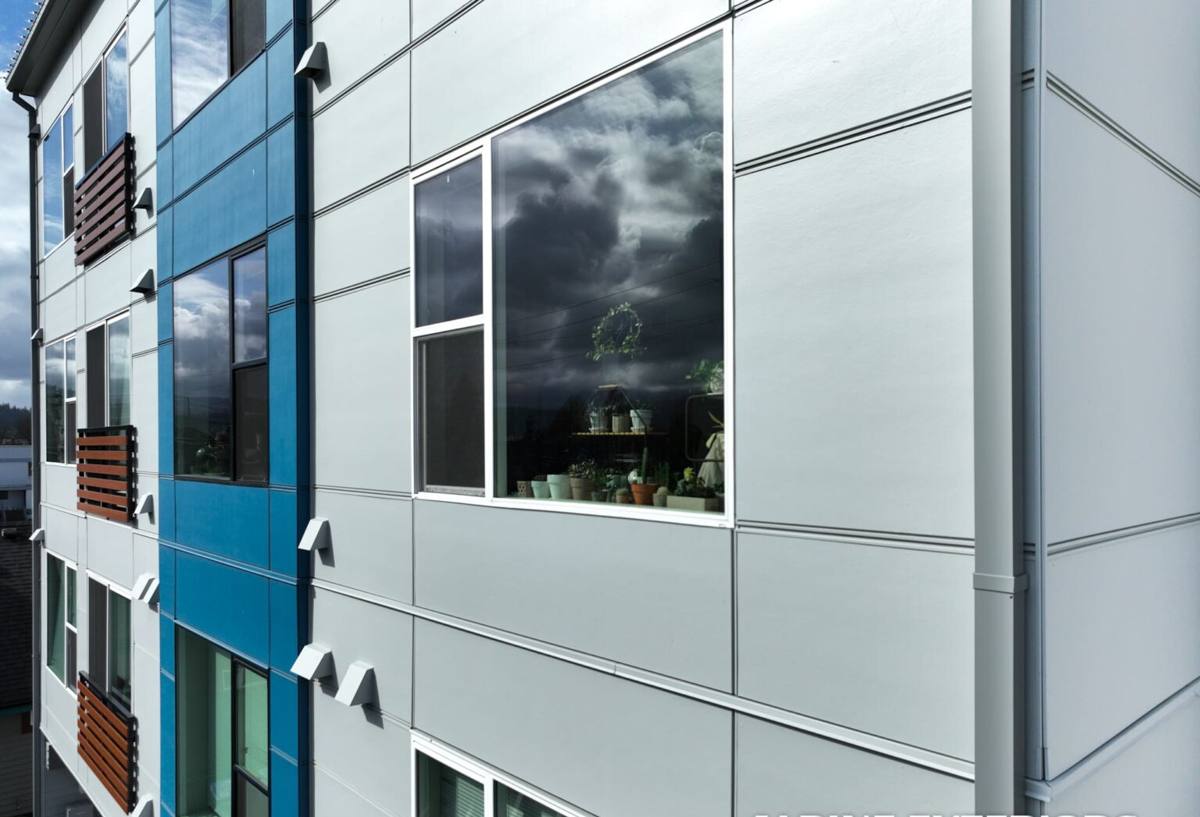
Why We Install Fiber Cement Here — and Only One Brand of It
Fiber cement is a mix of cellulose fiber, sand, and portland cement, pressed and cured into planks and panels. It doesn't feed moss the way wood does, it doesn't absorb water and swell the way engineered wood products can, and it's non-combustible, which matters more every wildfire season even on the wet side of the state. That's the category. Within that category, we install James Hardie products exclusively.
We made that call after years of installing and repairing multiple fiber cement and engineered wood brands. The differences between manufacturers aren't cosmetic — they show up in how consistently the product performs at year 10 and year 20, how the factory finish holds up to UV and salt exposure, and how the company backs the product when something does go wrong. Hardie's HZ5 product line is engineered specifically for climates like ours: freeze-thaw cycles, sustained moisture, and coastal exposure. That's not marketing language we're repeating — it's the reason we standardized on it instead of offering three or four competing brands and letting price decide.
We don't install vinyl, LP SmartSide, primed wood siding, or cedar. Each of those has a place in the market and each has real strengths. Our reasoning for standing behind Hardie instead, in this specific climate, comes down to moisture behavior over decades, finish durability in salt air, and a warranty structure that's actually transferable if the home sells — something we've had to explain to more than one Edmonds homeowner who inherited a warranty that didn't survive the sale.
What ColorPlus Finish Adds in a Coastal Neighborhood
Standard primed siding still needs field-painted topcoats, and paint applied on a job site is only as good as the weather conditions and prep work that day. Hardie's ColorPlus finish is baked on at the factory under controlled conditions, which gives it better fade resistance and a harder, more uniform surface — the kind of detail that matters more here than in a drier inland climate, because UV and salt both work faster on a weak coating.
What a Correct Fiber Cement Job Requires
Fiber cement siding fails almost exclusively for one of two reasons: it wasn't detailed to shed water correctly, or it was installed by a crew treating it like standard lap siding without accounting for its specific fastening, clearance, and flashing requirements. The board itself is not the weak point in a failed job — the installation almost always is.
- Correct fastener spacing and type, matched to exposure and substrate — not generic nails driven at whatever interval is fastest
- Proper starter strip and butt joint flashing, so water at horizontal seams is directed out, not absorbed inward
- A drainage plane (weather-resistant barrier plus rainscreen gap where conditions call for it) behind the siding, not just house wrap and boards
- Minimum clearance from grade, decks, and roof lines, so splashback and pooling water don't sit against the bottom course
- Caulking only where Hardie's own installation instructions call for it — over-caulking traps moisture instead of shedding it
- Trim and corner details sealed against wind-driven rain, which matters more on exposed and water-facing elevations
On a home with direct or partial exposure to the Sound, we pay particular attention to that drainage plane and to butt joint detailing, since those are the two places driving rain most often finds its way behind the cladding.
Fiber Cement vs. the Alternatives, in This Climate
| Material | Moisture behavior near the Sound | Moss/algae resistance | Typical service life here |
|---|---|---|---|
| James Hardie fiber cement | Doesn't absorb or swell; engineered HZ5 line for coastal PNW conditions | Resists moss growth on the surface itself; still needs periodic cleaning | 30+ years with correct install and basic maintenance |
| Engineered wood (e.g., LP-type products) | Wood-based core is vulnerable if the factory coating is compromised at cuts or fastener holes | More susceptible where coating is broken and moisture sits | Shorter under sustained wet exposure if edges aren't sealed and maintained |
| Vinyl | Doesn't absorb water, but seams and fastening flex more; can allow water intrusion behind panels | Moss/algae grow on the surface in shaded coastal exposures | Variable; UV and salt air degrade color and brittleness faster than inland |
| Cedar | Natural material; absorbs moisture and requires diligent finish maintenance | High — needs regular treatment to resist moss and rot in wet, shaded areas | Shortest without consistent upkeep in this climate |
This isn't a claim that the alternatives are poor products broadly — it's specific to what this climate does to them over time, and it's why our crews only carry one system on the truck.
Our Process for Edmonds Projects
1. On-Site Assessment
We look at more than the visible siding condition. Exposure direction, roofline drainage, grade slope near the foundation, existing moss patterns, and any signs of past moisture intrusion around windows and trim all factor into how we scope the job — not just how much siding needs replacing.
2. Water Management Plan
Before a single board goes up, we plan the drainage path: house wrap or weather-resistant barrier condition, flashing at every penetration and horizontal transition, and rainscreen where the elevation's exposure calls for it. This is the step that gets skipped on rushed jobs and is the one that determines whether the siding lasts 15 years or 35.
3. Installation to Manufacturer Spec
Hardie publishes detailed installation requirements for fastening, clearances, and joint treatment, and those specs are also what keeps the product warranty valid. We follow them as written, not as a rough guideline.
4. Final Detailing and Walkthrough
Trim, caulking, and touch-up work happen last, followed by a walkthrough where we show the homeowner what was done and what routine maintenance looks like going forward.
What Fiber Cement Siding Costs in This Area
| Cost factor | Why it moves the price |
|---|---|
| Home size and elevation count | More square footage and more corners/trim details mean more material and labor |
| Existing siding removal and substrate condition | Rotted sheathing or old moisture damage found during tear-off adds repair scope |
| Exposure level (waterfront vs. sheltered) | Homes with direct wind and rain exposure often warrant added drainage plane work |
| Trim complexity and siding profile | Custom trim, multiple reveals, or accent panels add labor time |
| Access and site conditions | Steep lots, tight setbacks, and staging constraints affect crew efficiency |
We don't publish blanket per-square-foot pricing because these factors genuinely change the number from one Edmonds property to the next — an on-site assessment is the only way to give an honest figure.
Living With Fiber Cement Siding in a Moss-Prone Climate
Correctly installed Hardie siding is low-maintenance, not no-maintenance. A few habits keep it performing the way it's designed to:
- Rinse shaded, north-facing sections once or twice a year to keep moss and algae from establishing
- Keep gutters clear so overflow doesn't run down the siding face repeatedly
- Trim back vegetation and tree cover that keeps sections of the wall damp and shaded
- Inspect caulking at trim and butt joints every couple of years and have any cracked sections resealed
- Address any paint or ColorPlus finish damage from impact promptly, since exposed edges are where moisture problems start
Why Local Experience in Edmonds Matters
A crew that mostly works drier, inland communities can install fiber cement correctly by the book and still miss the details that matter specifically near the Sound — how much rainscreen a particular exposure needs, where moss actually accumulates on a given lot, how salt air affects fastener choice over time. Crews who work Edmonds and the surrounding Snohomish County waterfront regularly build that judgment into the job before problems show up, not after a callback.
If you're weighing a siding replacement or new construction project in Edmonds, we're happy to walk the property, point out what your home's exposure actually calls for, and give you a straightforward, no-pressure estimate — no obligation, no pressure to sign anything on the spot.