 Everett
 Why Glenhaven Roofs Wear Differently Than Roofs Inland
Glenhaven sits close enough to Puget Sound and the broader Everett shoreline that homes here deal with a combination most inland Snohomish County neighborhoods don't: salt-laden air, near-constant winter rain, and enough shade and moisture to grow moss on almost anything that sits still long enough. None of these on their own is unusual for Western Washington. Together, over years, they change how an asphalt shingle roof ages, and they change what "correct installation" actually means for a house in this specific area.
A shingle roof built to a generic spec — the kind that would be perfectly fine in a dry inland climate — tends to underperform here. Metal fasteners corrode faster near salt air. Underlayment that's marginal on ventilation traps moisture instead of letting it escape. Shingles without algae-resistant granules go green and black years before they should. None of this means asphalt shingles are a poor choice for Glenhaven; it means the install has to account for the actual conditions the roof will live in, not the conditions on a spec sheet written for somewhere else.
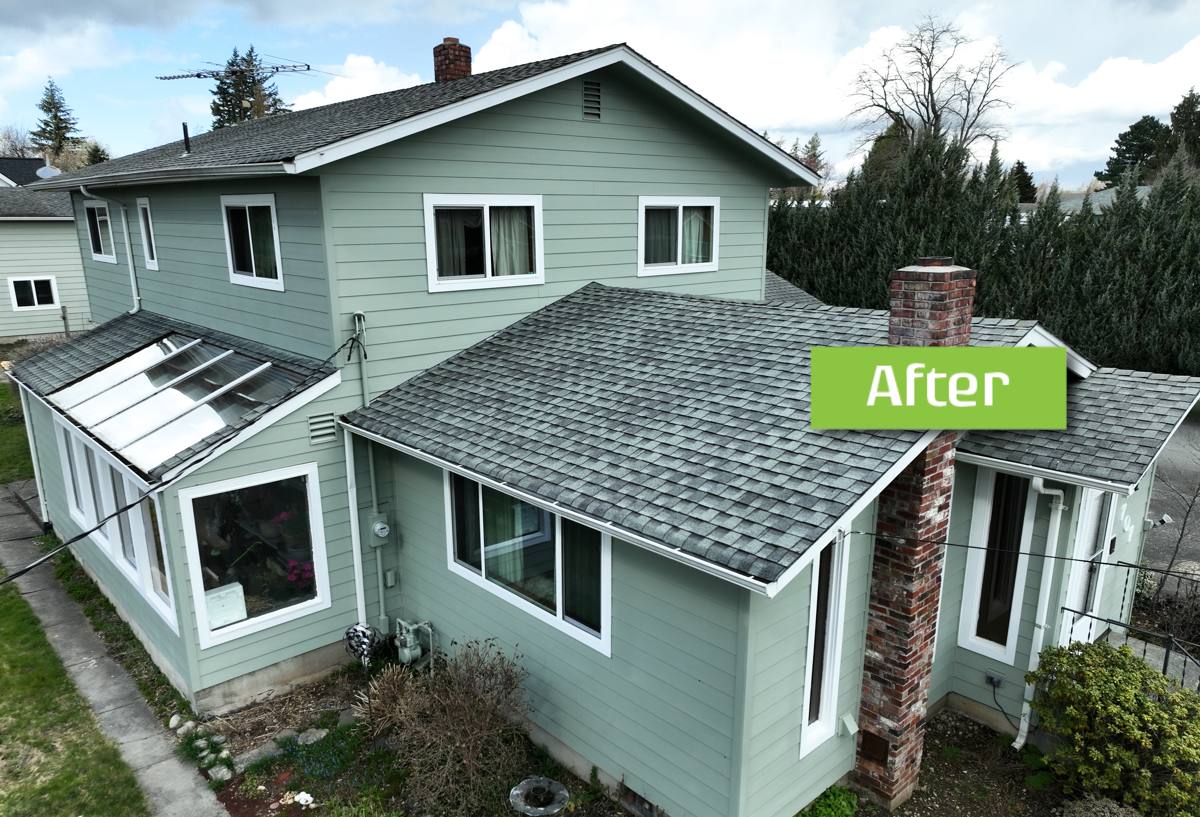
What a Correct Asphalt Shingle Roof Needs Here
A roof that's going to hold up in this part of Everett needs a few things dialed in that lower-cost installs often skip or shortcut. These aren't upgrades — they're the baseline for a roof that's actually built for the climate it's in.
Underlayment and Water Protection
With the volume of driving rain this area gets, especially in wind-driven storms off the Sound, felt paper alone is not enough of a margin. We use synthetic underlayment as the standard layer and add self-adhered ice-and-water membrane at eaves, valleys, and any low-slope transitions — the spots where wind-blown rain is most likely to work its way under the shingle course above it.
Ventilation That Actually Fights Moss
Moss doesn't just grow because a roof is shaded — it grows because a roof stays damp longer than it should. A roof deck that can't breathe holds onto moisture from the underside, which keeps the surface damp longer after every rain and gives moss and algae a head start. Balanced intake and exhaust ventilation shortens that damp window. It's a detail that's easy to get wrong on a re-roof if the existing vents aren't reassessed, and it's one of the biggest differences between a roof that stays clean for years and one that's green by its second winter.
Flashing at Every Transition
Chimneys, skylights, sidewalls, and roof-to-wall transitions are where the majority of leaks actually start — not in the open field of shingles. Step flashing, counter-flashing, and properly lapped valley metal, installed and sequenced correctly with the shingle courses (not just caulked over), are what keep those transitions dry through years of driving rain rather than just the first season.
Choosing the Right Shingle for This Climate
Not all asphalt shingles are built the same, and the differences matter more here than in a milder, drier climate. The table below covers the main categories we work with and how they hold up under Glenhaven's conditions.
| Shingle Type | Wind Resistance | Algae/Moss Resistance | Typical Lifespan | Best Fit |
|---|---|---|---|---|
| 3-Tab (standard) | Lower — rated for lighter wind exposure | Poor unless AR-rated | 15–20 years | Budget-focused projects, less wind-exposed lots |
| Architectural / Laminate | Higher — heavier, layered construction | Good with AR granules | 25–30+ years | Most Glenhaven homes; the standard we recommend |
| Impact-Resistant (Class 4) | High | Good with AR granules | 25–30+ years | Homes wanting added durability and possible insurance credit |
For nearly every home we look at in this neighborhood, we steer toward algae-resistant (AR) architectural shingles as the default. The copper- or zinc-infused granules slow moss and algae growth, and the heavier laminate construction handles wind gusts off the Sound better than a standard 3-tab. It costs somewhat more up front than the cheapest option, but it's the difference between a roof that needs moss treatment every year or two and one that stays cleaner with far less upkeep.
Our Installation Process for Glenhaven Homes
- Roof deck inspection. We check for soft spots, rot, or delamination before anything goes down — a common finding on older homes with marginal past ventilation.
- Tear-off and deck prep. Full removal of old material, deck repairs as needed, and a clean surface for the new system.
- Ice-and-water membrane. Installed at eaves, valleys, and vulnerable transitions before the underlayment goes on.
- Synthetic underlayment. Full coverage across the deck for a consistent water barrier under the shingles.
- Flashing. New step flashing, counter-flashing, and valley metal installed and properly integrated with the shingle courses — not just caulked over old metal.
- Shingle installation. Installed to manufacturer nailing patterns and exposure specs, which is what keeps wind and warranty ratings valid.
- Ventilation check and correction. Intake and exhaust balanced for the roof's actual size and attic volume.
- Final walkthrough. We go over the finished roof with the homeowner before calling the job done.
Living With a Shingle Roof in a Moss-Prone Neighborhood
Even a correctly installed, AR-rated roof will eventually see some moss activity in a neighborhood with this much tree cover and moisture — that's the reality of the local climate, not a sign something was done wrong. What changes with a correct install is how much moss grows and how fast, and how easy it is to manage.
A few habits go a long way between service visits:
- Keep overhanging branches trimmed back so shingles get more light and dry out faster after rain
- Clear gutters and valleys of needles and debris at least twice a year — clogged valleys hold water against shingles
- Have moss physically removed rather than power-washed off, which can strip granules and shorten shingle life
- Use zinc or copper strips near the ridge as a low-maintenance way to slow regrowth between cleanings
- Avoid bleach-heavy DIY treatments that can damage plants, gutters, and paint below the roofline
Signs Your Roof Needs a Closer Look
Because so much of a roof's condition isn't visible from the ground, homeowners often don't know there's a problem until it shows up as a stain on a ceiling. A few things worth checking or having inspected:
- Granules collecting in gutters or at the base of downspouts
- Shingles that look cupped, curled, or are missing entirely after a windstorm
- Dark streaking or moss patches concentrated on the shaded, north-facing sections
- Soft or spongy feeling decking near valleys or chimneys, if accessible
- Daylight visible through the roof deck from inside the attic
- A roof that's 20+ years old and has never had underlayment or flashing replaced
What Affects the Cost of a New Shingle Roof Here
Pricing depends on the specific home, but a few factors consistently move the number up or down. Roughly, homeowners in this area should expect somewhere in the range of $450–$650 per square (100 square feet) installed for a standard architectural asphalt shingle roof, with premium materials, complex rooflines, or extensive deck repair pushing that higher. A written, on-site estimate is the only way to get an accurate number for your specific home.
| Factor | Why It Matters |
|---|---|
| Roof pitch and access | Steeper or harder-to-access roofs take longer and require more safety setup |
| Number of layers being removed | Tear-off of multiple old layers adds labor and disposal cost |
| Deck condition | Rotted or soft decking found during tear-off requires repair before shingles go down |
| Shingle class chosen | Standard 3-tab, architectural, and impact-resistant shingles are priced differently |
| Valleys, chimneys, and skylights | Each transition needs custom flashing work, which adds time |
| Ventilation corrections | Adding or upgrading intake/exhaust vents is often needed on older homes |
Why a Crew That Already Works in Glenhaven Makes a Difference
A roofing crew that's worked this specific neighborhood already knows what tends to go wrong here — which lots hold moisture longer, which older homes tend to have undersized ventilation, and how much moss buildup is normal versus a sign of a deeper problem. That local pattern recognition matters as much as the actual installation skill, because it shapes decisions that don't show up on a basic estimate: how much ice-and-water membrane to use, whether existing vents need correcting, and which flashing details need extra attention on a given roof style.
It also means straightforward answers grounded in what actually holds up in Everett's climate specifically, not generic advice that happens to apply to Western Washington in general. Snohomish County has enough microclimates — closer to the water versus further inland, more or less tree cover — that experience with this particular area is worth something real when it comes to a roof that has to perform for 25-plus years.
If you're planning a new roof or need an honest read on the condition of your current one, we're happy to come take a look. The estimate is free, there's no pressure, and you'll get a straight answer about what your roof actually needs — just fill out the form below to get started.