 Everett
 Why Lake Stevens Decks Wear Out Faster Than Homeowners Expect
A deck in Lake Stevens does more work than a deck almost anywhere inland. Many homes here sit close to the water or on sloped lots with a view down to the lake, which means the deck is the outdoor room the whole household actually uses — for boat gear, for morning coffee looking at the water, for entertaining in the summer. That extra use comes on top of a climate that's already tough on exterior wood: long stretches of driving rain from fall through spring, humid air off the lake that keeps horizontal surfaces damp longer than a vertical wall ever stays wet, and a moss and algae season that can run from October well into May across Snohomish County. Add the salt-tinged marine air that moves inland off Puget Sound and settles into the region's overall weather pattern, and you've got a set of conditions that will find every weak point in a deck's construction — usually within a few wet seasons, not decades.
None of that means a deck can't last. It means the details that don't matter much in a dry climate — flashing, fastener choice, drainage, footing depth — matter enormously here. A deck built to a generic national spec, without those details, will show rot, corrosion, or slippery moss growth years before it should.
What a Deck Actually Needs to Survive Here
The Ledger Connection
Almost every deck failure we get called out to inspect starts at the same place: where the deck attaches to the house. That connection point — the ledger board — has to be flashed correctly so water sheds away from the house band board instead of running behind the siding or pooling against untreated wood. This is the single most important detail on any attached deck, and it's also the easiest one to get wrong or skip in a rush job, because once the decking is down, nobody can see it anymore. We flash every ledger connection properly before a single deck board goes on top, because fixing hidden rot at the house wall later is a far bigger job than doing it right the first time.
Fasteners and Hardware
In a climate with this much moisture and some salt exposure in the air, standard fasteners corrode faster than homeowners expect, and corroding fasteners are how a structurally sound deck becomes a wobbly one. We use stainless steel or coated fasteners rated for ground contact and exterior exposure, along with structural connectors (joist hangers, post bases, hurricane ties where called for) sized to match. It costs a little more up front. It's the difference between hardware that's still tight in fifteen years and hardware that's staining the wood brown and pulling loose in five.
Framing and Drainage
Joists, beams, and posts need to be sized for the actual span and load — not just "close enough" — and the framing needs airflow underneath so wood can dry out between rain events instead of staying damp. We also run joist tape over the tops of joists on framing that will be covered by decking, which keeps standing water off the top edge of the lumber where rot most often starts. On lower decks close to grade, we grade and drain the ground underneath so water doesn't just sit there feeding moss and mildew year-round.
Choosing a Decking Material for This Climate
There's no single "best" decking material — there's a best material for your budget, your maintenance appetite, and how the deck will actually be used. Here's how the common options actually perform once they've spent a few Snohomish County winters outside:
| Material | Upfront Cost | Maintenance | How It Handles Our Climate |
|---|---|---|---|
| Pressure-treated lumber | Lowest | Needs re-sealing every 1-2 years | Affordable and strong, but prone to graying, splintering, and moss growth without regular upkeep |
| Cedar | Moderate | Needs staining/sealing regularly | Naturally rot-resistant and attractive, but soft surface stains and absorbs moisture if not maintained |
| Composite decking | Higher | Occasional washing, no sealing | Resists rot and doesn't need staining, but can still grow surface moss/algae in shaded, damp spots and needs airflow underneath |
| PVC decking | Highest | Occasional washing | Fully moisture-resistant material, best long-term option for constantly damp, shaded, or lakeside conditions |
For lake-adjacent homes with shaded, humid microclimates near tree cover or the water itself, we lean toward recommending composite or PVC for anyone who doesn't want an annual sealing job. For homeowners who like the look and feel of real wood and are willing to maintain it, cedar or treated lumber built with the framing details above will still hold up fine — it just requires more attention from the owner over the life of the deck.
Sloped Lots and Elevated Decks Around the Lake
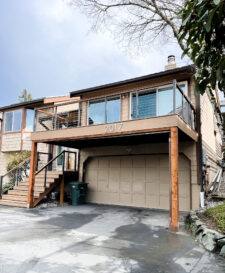
A lot of Lake Stevens properties sit on grades that drop toward the water, which means the deck often isn't a simple platform a foot off the ground — it's an elevated structure on tall posts, sometimes with a walkout level below. That changes the engineering. Taller posts need bracing against lateral movement (wind and foot traffic both push a deck sideways, not just down), footings need to be sized and set below the region's frost depth regardless of how deep that feels like overkill on a mild-winter day, and guardrails become a code requirement, not an aesthetic choice, once the walking surface is more than 30 inches above grade.
Footing Options for Sloped Ground
| Footing Type | Best For | Trade-Off |
|---|---|---|
| Poured concrete footings | Standard elevated decks on stable soil | Requires excavation and cure time before framing continues |
| Helical piers | Steep slopes or soil that's hard to excavate cleanly | Faster installation and less soil disturbance, but higher per-footing cost |
We evaluate the slope and soil on-site before recommending one over the other — there's no universal right answer, only the right answer for that particular lot.
Permits and Shoreline Rules Near the Water
Deck permitting in Snohomish County is straightforward for most inland lots, but properties on or near the Lake Stevens shoreline can fall under additional county shoreline and critical-area regulations that affect setbacks and what can be built how close to the water. This isn't something to guess at — if your lot is within the zone the county regulates, the permit process and allowable footprint can look different from a standard inland deck project. We check this before designing anything, so you're not surprised partway through with a redesign or a stop-work order. If your property doesn't fall in a regulated shoreline zone, permitting follows the normal residential building process: submitted plans, a structural review, and inspections at the framing and final stages.
Our Process, Start to Finish
- Site visit and design conversation. We look at your slope, sun/shade exposure, proximity to the lake, and how you actually want to use the space.
- Material and layout decisions. We walk through the decking material trade-offs above against your budget and maintenance preferences, and finalize size, stairs, and railing style.
- Permit and shoreline check. We confirm what's required for your specific lot before pulling permits, including any shoreline setback review if applicable.
- Footings and framing. Footings are set to code depth, framing is built to span and load requirements, and every ledger connection is flashed before decking goes on.
- Decking, railing, and stairs. Installed with corrosion-resistant fasteners and proper spacing for drainage and material expansion.
- Final inspection and walkthrough. We confirm everything passes inspection and walk you through basic care for whatever material you chose.
Keeping a Lake Stevens Deck Looking Good Season After Season
A well-built deck still needs some seasonal attention in this climate, particularly around moss and moisture. None of this is complicated, but skipping it for a few years is how a good deck starts looking neglected.
- Sweep leaves and debris off the deck surface regularly in fall — trapped organic matter is what feeds moss growth
- Rinse or lightly scrub shaded, damp areas where moss tends to establish first, especially under overhangs or tree cover
- Check that gaps between boards are clear so water drains through instead of pooling
- Inspect fasteners and railing connections once a year for looseness or corrosion staining
- Re-seal or re-stain wood decking on the schedule appropriate to that product — don't wait until it looks gray and dry
- Confirm the crawl space or ground under a low deck isn't holding standing water
Why It Matters That We Already Work in Lake Stevens
A contractor who mostly builds decks in drier parts of the state, or who treats every job with the same generic spec, can still build something that looks fine on day one. Whether it holds up depends on whether they've actually accounted for what this specific climate and this specific lake environment do to a structure over years, not months. Knowing which lots around Lake Stevens tend to have shoreline permitting considerations, which framing details actually matter in a wet marine climate, and which materials are worth the extra cost for a shaded, damp lot near the water isn't something you get from a manual — it's something you get from building decks in Snohomish County repeatedly and seeing what comes back needing repair five years later versus what doesn't.
If you're planning a new deck or replacing one that's showing its age, we're happy to come take a look at your property, talk through what makes sense for your lot and budget, and give you a straightforward, no-pressure estimate using the form below.