 Everett
 Why Decks Wear Out Faster in Marysville
Marysville sits close enough to Possession Sound and the broader Puget Sound corridor that salt-tinged air is a real factor in how outdoor structures age, not just a coastal-town cliché. Combine that with Snohomish County's long, wet fall-through-spring stretch of driving rain and the shaded, moss-friendly conditions that come with mature tree cover on many older lots, and you get a climate that is genuinely tough on decks. Fasteners corrode faster than they would in a dry inland climate. Wood fibers stay damp for days at a time instead of drying out between rain events. Moss and algae take hold on any surface that doesn't get direct sun or airflow, and once established they hold moisture against the decking and framing underneath.
None of this means every deck in Marysville is doomed early — it means the materials, fasteners, and construction details matter more here than they would in a drier region. A deck built without that in mind will often show real problems inside ten to fifteen years, well short of what the same design would last in a milder climate.
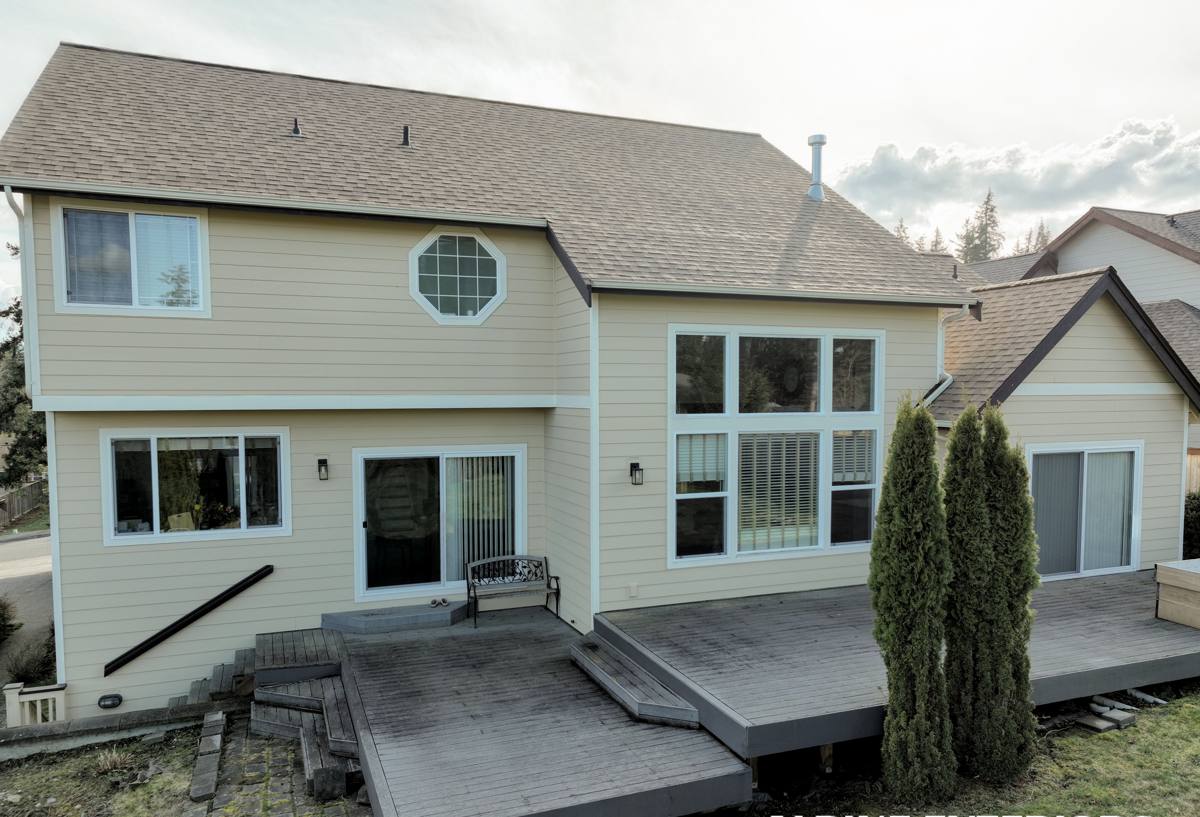
Signs Your Deck Needs Replacement, Not Just Repair
Homeowners often ask us to patch a board or two, and sometimes that's genuinely all that's needed. But there's a point where repair stops making sense and full replacement becomes the honest recommendation. A few boards on top of a sound frame is a repair. Soft framing, failing connections, or a structure that's simply undersized for how the deck is actually used is a replacement job.
- Joists or beams that feel spongy, spring underfoot, or show visible sagging between supports
- A ledger board pulling away from the house, or staining on the siding above it that suggests water has been getting behind it
- Deck posts or footings that have shifted, rotted at the base, or were never properly anchored to begin with
- Widespread surface checking, splintering, or soft spots you can press a screwdriver into
- Railings that wobble or don't meet a safe height and spacing for kids or pets
- Persistent moss or dark staining that comes back within weeks of cleaning, even after the surface has been treated
- A deck that's simply too small, too poorly laid out, or in the wrong spot for how the household actually wants to use the backyard
What a Correct Deck Replacement Actually Involves
It Starts Below the Surface
A deck replacement that's done right is mostly about what you don't see once it's finished. The framing — posts, beams, joists, and the ledger connection to the house — carries the load and determines how the deck ages. In our climate, joist spacing needs to account for the added weight decking holds when it's saturated, and footings need to be sized and set below frost depth so they don't heave or settle over time.
Fasteners and Hardware
Given the salt air and near-constant moisture exposure, we use fasteners and structural hardware rated for exterior, corrosion-prone environments — not general-purpose deck screws that are fine in a drier climate but will streak, weaken, or fail early here. Joist hangers, post bases, and structural screws all get matched to the wood or composite they're fastening, since mismatched metals can accelerate corrosion.
Water Management Details
The single biggest factor in how long a new deck lasts in this region is how well it sheds and drains water. That means proper flashing where the deck meets the house, correct slope across the decking surface, gapping between boards for drainage and airflow, and keeping ledger connections sealed so water can't wick into the house framing. These details rarely show up in a quick visual inspection, which is exactly why they get skipped on rushed jobs.
Choosing the Right Decking Material for This Climate
There's no single "best" decking material — there's a best fit for your budget, how much upkeep you want to do, and how much sun or shade the deck actually gets. Here's how the common options compare for a home in Marysville's climate specifically.
| Material | Moisture Behavior Here | Maintenance | Typical Lifespan |
|---|---|---|---|
| Pressure-treated wood | Absorbs and releases moisture readily; prone to checking and splintering with our wet-dry cycles | Annual cleaning and re-sealing recommended | 10-15 years before major issues |
| Cedar | Naturally rot- and insect-resistant, but still needs sealing to resist moss and graying | Sealing every 1-2 years | 15-20 years with upkeep |
| Capped composite | Doesn't absorb water into the core; resists moss staining much better than wood | Occasional washing, no sealing or staining | 25-30+ years |
| PVC decking | Fully synthetic, no organic material for moisture to affect or moss to feed on | Lowest maintenance of the group | 25-30+ years |
Wood costs less upfront and has a natural look plenty of homeowners still prefer, and that's a legitimate choice as long as you're realistic about the sealing schedule it needs in a climate this wet. Composite and PVC cost more initially but hold up better against moss, salt air, and the repeated soak-and-dry cycle that's normal here, which is why we see more homeowners choosing them for replacements rather than repeat repairs down the road.
What We Won't Do — And Why
We won't install decking directly over a frame that hasn't been inspected, and we won't mix incompatible fastener metals just to save a step. Both are common shortcuts that look fine on day one and cause callbacks — or worse, safety issues — a few years in. We'd rather explain the extra time or cost up front than hand over a deck that's going to fail early.
Our Deck Replacement Process
- On-site assessment. We check the existing framing, footings, and ledger connection before quoting anything, since what's underneath often changes the scope.
- Design and material selection. We walk through layout, railing style, and decking material trade-offs based on your budget and how you'll use the space.
- Permitting. Most deck replacements in Snohomish County require a permit, especially for anything attached to the house or above a certain height — we handle that paperwork rather than leaving it to you.
- Demolition and disposal. The old deck comes out, including any hidden rot in the framing that a surface inspection wouldn't have caught.
- Framing rebuild. Posts, footings, beams, and joists go in to current structural standards, sized for the actual load and span.
- Decking, railing, and stairs. Installed with correct spacing, fastening, and flashing details for long-term water management.
- Final walkthrough. We go over the finished deck with you, including any care the specific material you chose will need going forward.
Cost Factors Worth Understanding Before You Get Quotes
Deck replacement pricing varies more than most homeowners expect, and material is only part of it. Structural condition, size, and complexity often move the number as much as the decking surface itself.
| Factor | Why It Moves the Price |
|---|---|
| Framing condition | Rotted joists, beams, or footings found during demo add rebuild cost that a surface-only quote won't capture |
| Deck size and shape | Multi-level decks, curves, or built-in seating take more labor and material than a simple rectangle |
| Decking material | Wood costs less per square foot upfront; composite and PVC cost more but reduce future maintenance spending |
| Railing style | Cable, glass, or composite railing systems cost more than basic wood or metal balusters |
| Height and stairs | Taller decks and multiple stair runs add structural requirements and labor time |
| Access to the site | Backyards with limited equipment access can add labor hours for demo and material handling |
Permits and Code Considerations
Snohomish County and the City of Marysville both have permitting requirements that apply to most deck replacements, particularly when the deck attaches to the house or sits above a certain height off grade. Guardrail height, baluster spacing, and stair rise-and-run all have code minimums that exist for real safety reasons, not just paperwork. We pull permits as part of the job and build to current code rather than simply matching whatever the old deck happened to have, since older decks in this area were often built under different — and sometimes less strict — standards.
A Quick Pre-Project Checklist
- Confirm whether your deck attaches to the house or is freestanding — it affects both permitting and ledger inspection
- Note any moss, staining, or soft spots you've noticed, and where on the deck they show up
- Think through how you actually use the space — dining, grilling, lounging — so the new layout fits real life
- Decide roughly where you land on upfront cost versus long-term maintenance before comparing materials
- Ask whether disposal of the old decking and framing is included in the quote
Why Local Experience Matters for This Job
A deck replacement isn't a one-size-fits-all project, and a crew that mainly works drier inland regions can miss details that matter specifically in a place like Marysville. Knowing how far moss season extends into spring, how much shade a typical lot's tree cover creates, and how salt air factors into fastener and hardware choices all come from doing this work repeatedly in this specific area — not from a general how-to guide. It also means faster, more realistic scheduling around our wet season, since deck framing work goes much better in a dry stretch than in the middle of a heavy rain run.
If your deck is showing its age or you're planning a replacement, we're happy to take a look and give you a straight assessment — no pressure, no upsell, just an honest read on what your deck needs. Request a free estimate using the form below and we'll set up a time to come take a look.