 Everett
 Siding Replacement in Marysville: What Local Homes Are Up Against
Marysville sits close enough to the water and far enough into the Snohomish County drizzle belt that siding here has to do double duty. Homes take on salt-tinged air moving off the Sound, long stretches of driving rain from fall through spring, and a moss season that can run eight months or longer on north-facing walls and anything shaded by mature trees. None of that is dramatic on any given day. It's the accumulation that wrecks siding — moisture that never fully dries between storms, organic growth that holds water against the wall, and UV cycling in the brief sun breaks that dries out whatever the rain didn't already soften.
We work Marysville regularly as part of our Everett service area, and the failure patterns we see are consistent: siding that looked fine for a decade and then went soft at the bottom courses, paint that won't hold past a few years on the weather side of the house, and moss or algae staining that keeps coming back no matter how many times it's washed off. Replacement done right in this area isn't just swapping old boards for new ones — it's fixing the conditions that caused the failure in the first place.
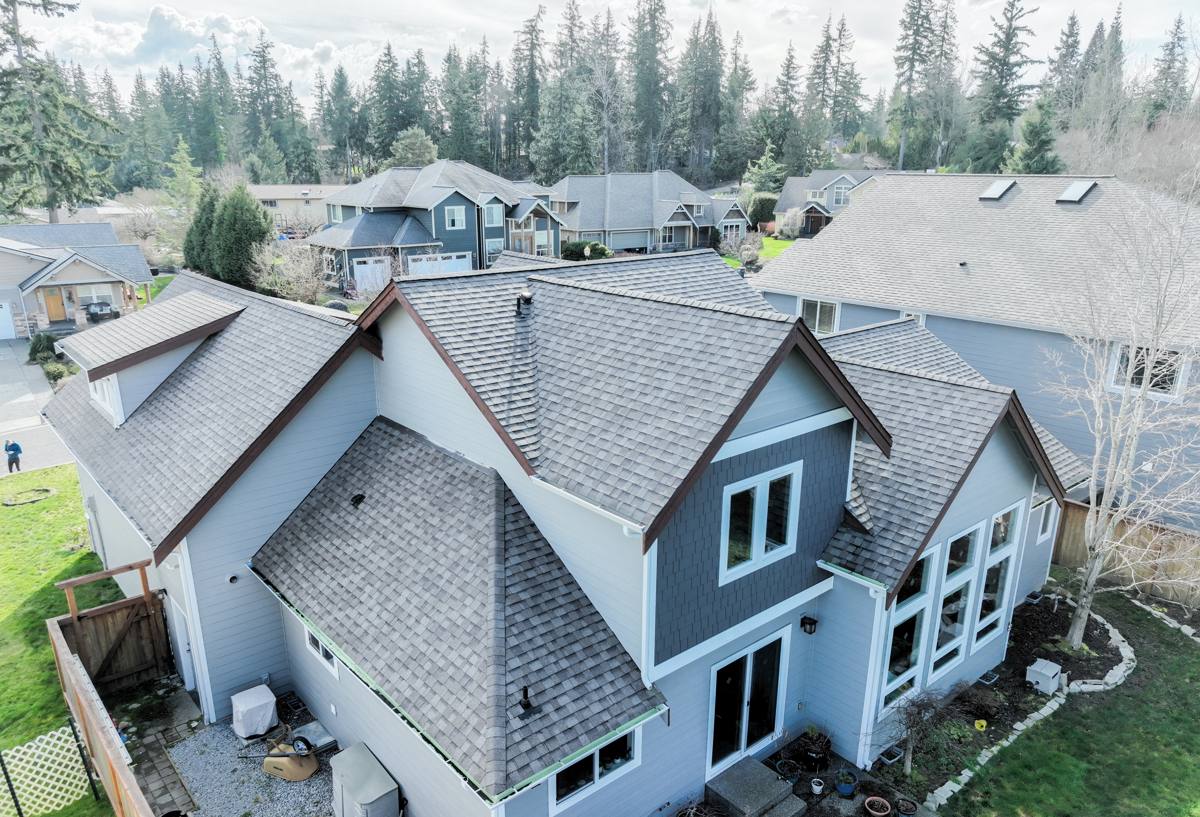
Why Marysville's Climate Is Harder on Siding Than It Looks
Moisture that doesn't fully dry
Snohomish County doesn't get the heavy downpours some regions do — it gets long, low-intensity rain that soaks in gradually and hangs around. Siding that traps or wicks moisture, rather than shedding it and drying quickly, stays wet longer with every storm cycle. Over years, that's what drives rot in wood-based products and paint failure across the board.
Salt air near the water
Marysville's proximity to Puget Sound means airborne salt is part of the environment, even a few miles inland on breezy days. Salt exposure accelerates corrosion on fasteners and trim hardware and adds to the wear on any painted or coated surface, which is one more reason factory-applied, baked-on finishes hold up better here than field-applied paint.
Moss, algae, and shade
Wooded lots and cul-de-sacs with mature landscaping are common in and around Marysville, and shaded, damp siding is exactly where moss and algae take hold. Growth on siding isn't just cosmetic — it holds moisture against the surface and can work into seams and butt joints over time.
What a Correct Siding Replacement Actually Involves
Tearing off old siding and nailing up new panels is the easy part. The work that actually determines how long a job lasts happens underneath, and it's the part homeowners often can't evaluate just by looking at the finished wall.
- Full tear-off and inspection — removing old siding down to the sheathing so we can see the actual condition of the wall, not guess at it
- Sheathing repair — replacing any rotted or water-damaged sheathing and framing found underneath before anything new goes up
- Correct weather-resistive barrier — a properly lapped and sealed house wrap or building paper system, since this is the layer that actually stops bulk water
- Flashing at every penetration — windows, doors, hose bibs, vents, and any trim intersection, since these are where most real-world leaks originate, not the field of the siding itself
- Proper fastening and clearances — correct nailing patterns and ground/roofline clearances so the new siding isn't set up to fail the same way the old one did
- Manufacturer-spec caulking and sealant — used only where the manufacturer calls for it, not as a substitute for proper flashing
Any one of these steps done poorly can undercut an otherwise good siding product. This is why we treat the tear-off and prep work as the real project, not a formality before the visible part begins.
Why We Install James Hardie Fiber Cement — and Only That
We don't install vinyl, LP SmartSide, primed wood, cedar, or other fiber cement brands. That's a deliberate standard, not a lack of options. In a climate like Marysville's, the material itself has to carry a lot of the burden, and we've built our process around one product line we can stand behind fully.
Non-combustible and dimensionally stable
James Hardie fiber cement doesn't expand and contract with moisture the way wood-based products do, which matters directly in a climate where the material is rarely fully dry. It's also non-combustible, which is a real consideration given wildfire smoke and ember exposure that has become more common across Western Washington in recent summers.
ColorPlus factory finish
Hardie's ColorPlus finish is baked on at the factory under controlled conditions, not brushed on at the jobsite. That finish is engineered to resist fading and hold up against UV and moisture cycling far longer than field-applied paint, which is one of the most common failure points we see on older siding in this area.
HZ5 product engineering
Hardie's HZ product lines are engineered for specific climate zones, and the HZ5 formulation is built for the wetter, cooler regions the Pacific Northwest falls into. That's an actual materials difference, not a marketing label.
A warranty that's transferable
Hardie backs its products with a long, transferable warranty, which matters both to homeowners planning to stay long-term and to anyone thinking about resale value down the road.
Siding Options Compared: Why We Standardized on One
| Material | Moisture Behavior in Wet Climates | Finish Durability | Fire Resistance |
|---|---|---|---|
| James Hardie Fiber Cement | Dimensionally stable, doesn't swell or rot | Factory-baked ColorPlus finish, long fade resistance | Non-combustible |
| Vinyl | Doesn't rot, but can warp and gap over time | Color molded in, fades over years; can't be repainted easily | Combustible, can melt/deform near heat sources |
| LP SmartSide / engineered wood | Treated to resist moisture, but wood-based core is still vulnerable if seals fail | Field or factory-primed, still needs maintenance | Combustible |
| Cedar / primed spruce | Natural material, absorbs and releases moisture readily | Requires regular refinishing to hold up | Combustible |
Every product on that list has legitimate uses somewhere. In Marysville's rain, salt air, and moss exposure, we've found the long-term trade-offs on the alternatives — maintenance burden, moisture sensitivity, or finish life — aren't worth it compared to what Hardie delivers when installed correctly.
Our Process for a Marysville Siding Replacement
- On-site assessment — we walk the exterior, check for moisture damage, evaluate shaded and north-facing walls where moss and rot tend to concentrate, and look at trim, flashing, and roofline details
- Straight-talk estimate — what needs replacing, what condition the sheathing is likely in, and what the full scope actually costs, without pressure
- Tear-off and structural check — removing old material and repairing any damaged sheathing or framing before moving forward
- Weather barrier and flashing installation — the layer that does the real waterproofing work, installed to manufacturer spec
- Hardie siding installation — panels, trim, and fasteners installed per James Hardie's published installation requirements, which is what keeps the warranty valid
- Final walkthrough — reviewing the finished work with the homeowner before we consider the job done
Why Hiring a Crew That Already Works Marysville Matters
Siding failures in this area tend to repeat themselves because the same climate conditions hit every house the same way. A crew that already works Marysville and greater Everett has seen where moss builds up fastest, which wall orientations take the worst weathering, and what flashing details tend to get skipped on older homes. That local pattern recognition shows up in fewer surprises during tear-off and a better outcome once the new siding is up.
It also matters for warranty support. James Hardie's system is only as good as its installation, and a local crew that stands behind its own work is easier to hold accountable than an out-of-area outfit that's moved on to the next region by the time an issue shows up.
Signs Your Marysville Home Needs Siding Replacement, Not Just a Repair
- Soft or spongy spots when you press on the siding, especially near the bottom courses or under windows
- Paint that's failing or bubbling within a few years of a repaint, rather than holding for a normal cycle
- Persistent moss or algae staining that returns quickly after cleaning
- Visible gaps, warping, or buckling panels, particularly on sun-exposed walls
- Rising utility bills alongside drafts or cold spots near exterior walls
- Siding that's original to a home built more than 20-25 years ago, especially wood-based products
If you're seeing one or two of these, a repair might genuinely be enough. If you're seeing several at once, that's usually a sign the underlying wall assembly needs the full attention a replacement provides rather than another patch.
What This Costs to Think About Honestly
Siding replacement pricing depends on the size of the home, how much sheathing repair is needed once the old siding comes off, trim complexity, and access. We won't quote a number without seeing the house, but we will tell you upfront what factors are likely to move the estimate up or down before we ever get on site.
If your Marysville home is showing signs of wear from the salt air, rain, or moss that this climate brings every year, we're happy to come take a look. The estimate is free, there's no pressure, and you'll get a straight answer about whether you need a full replacement or something less. Use the form below to get started.