 Everett
 Building a Deck That Actually Belongs in Mukilteo
Mukilteo sits right on the water, and that changes what a deck has to deal with compared to a deck built ten miles inland. Salt-laden air off the Sound accelerates corrosion on fasteners and hardware. Driving rain off Puget Sound doesn't fall straight down — it drives sideways into ledger boards, railings, and stair stringers that a standard deck detail never accounts for. And the long gray stretch of fall through spring means moss and algae get a real foothold on any surface that stays damp and shaded. A deck built to a generic spec sheet will show these problems within a few seasons: streaking hardware, soft spots at the house connection, slick green boards by February. A deck built for this specific location doesn't.
This page is about one thing: building and maintaining custom decks for homes in Mukilteo and the surrounding Everett area, with the material choices, structural details, and maintenance realities that this climate actually demands.
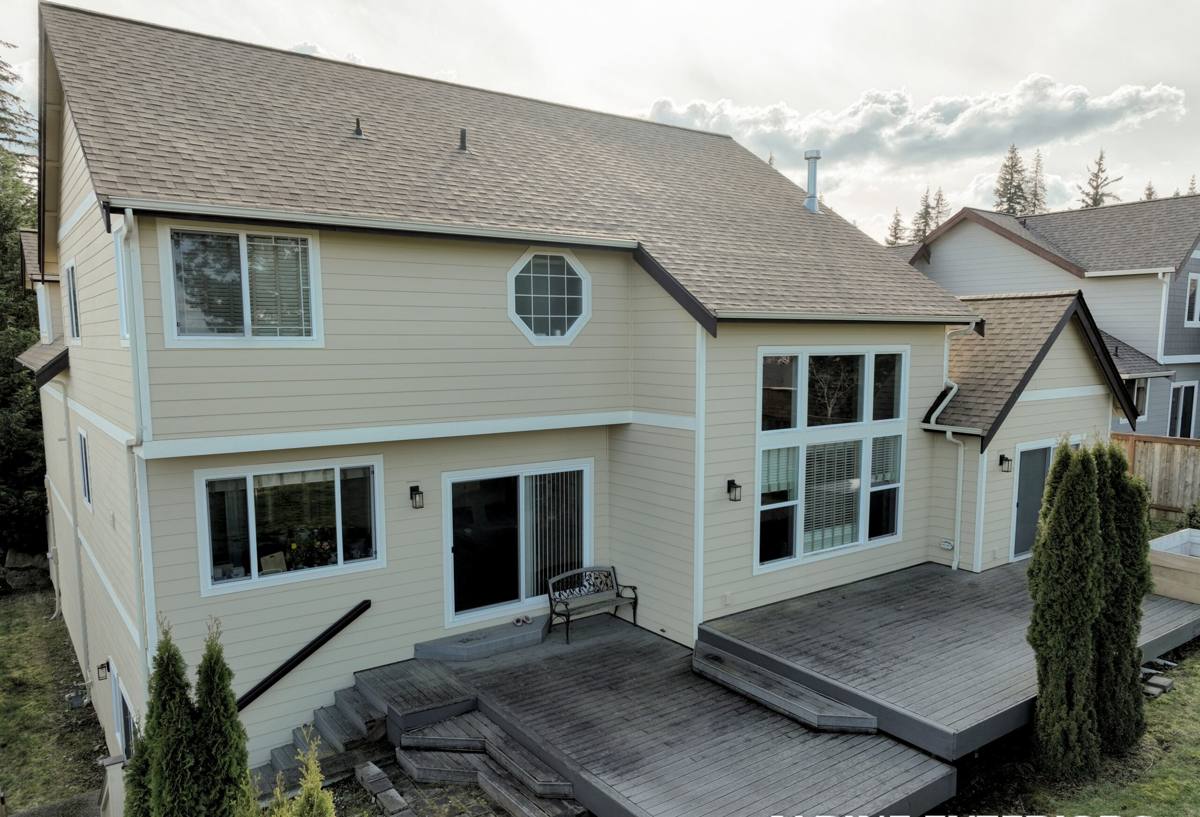
What Salt Air and Driving Rain Do to a Deck Over Time
Corrosion at the connections
The weakest point on most decks isn't the decking itself — it's the metal. Nails, screws, joist hangers, and structural screws that aren't rated for coastal exposure will start showing rust streaks and pitting years before the wood around them fails. Once a fastener corrodes, it loses holding strength quietly, with no visible warning until something moves.
Water intrusion at the house
Where the deck attaches to the house — the ledger board — is the single most important detail on the entire structure. Wind-driven rain pushes water sideways and upward into gaps that would never see moisture on a calmer site. Without proper flashing, that water tracks behind the siding and into the rim joist and framing, and by the time it's visible from inside, real damage has already been done.
Moss, mildew, and slip risk
Shaded, north-facing, or tree-covered decks in this area build up moss and algae fast, especially through the wet months. Beyond looking bad, a mossy deck surface is genuinely slippery — this is a safety issue on stairs and near entry doors, not just a cosmetic one.
Decking Material: What Actually Holds Up Here
There's no single "best" decking material — there's the right material for the site, the budget, and how much upkeep the homeowner actually wants to do. Here's how the common options compare for a Mukilteo-area deck specifically:
| Material | Moisture/Salt Air Behavior | Moss/Algae Resistance | Maintenance |
|---|---|---|---|
| Pressure-treated lumber | Good if fasteners and flashing are corrosion-rated; wood itself moves with moisture cycles | Needs regular cleaning; grain holds moisture and organic growth | Annual cleaning, periodic sealing |
| Cedar / natural wood | Naturally decay-resistant but still needs sealed end grain and good drainage | Similar to treated lumber; softer surface can trap grime | Sealing every 1-2 years to hold color and resist growth |
| Composite decking | Doesn't absorb water or rot; stable in salt air | Some early composite products were prone to surface mildew; modern capped composites resist this well | Occasional washing, no sealing or staining |
| PVC decking | Fully synthetic, no moisture absorption, handles direct wet exposure well | Smooth cap resists algae adhesion better than any wood option | Lowest — soap and water as needed |
For a deck that's shaded, close to the water, or gets minimal sun exposure, we generally steer homeowners toward capped composite or PVC — not because wood is a bad product, but because the honest trade-off is maintenance frequency. A wood deck in this exact setting needs more attentive upkeep to look and perform the same way over ten years. If a homeowner wants real wood for the look and is willing to keep up with cleaning and sealing, we'll build it right and tell them exactly what that upkeep schedule looks like.
Framing and Hardware: The Part You Don't See
Most of what determines whether a deck lasts 10 years or 30 happens below the decking boards, and it's the part homeowners rarely think to ask about.
- Corrosion-resistant structural screws and joist hangers rated for coastal/high-moisture exposure — not standard interior-grade hardware
- Proper ledger flashing with a water-shedding detail at the house connection, sealed against wind-driven rain
- Footings sized and set to current code for Snohomish County soil and frost conditions
- Joist spacing and blocking that account for the actual decking material's span rating — composite and PVC often have tighter span requirements than lumber
- Ventilation and drainage under the deck so trapped moisture doesn't sit against framing year-round
None of this is visible once the deck is finished, which is exactly why it's worth asking a contractor to walk through it before work starts, not after.
Design Considerations Specific to Mukilteo Properties
Water and view orientation
A lot of decks in this area are built to take advantage of water views, which often means more direct exposure to wind and driven rain than a deck tucked against a more sheltered side of the house. That orientation should inform railing style, decking material, and how aggressively we detail the ledger and flashing.
Slope and drainage
Many Mukilteo lots have real grade change, which affects footing depth, stair design, and how water is directed away from the structure once it's built. A deck that ignores existing drainage patterns just relocates a water problem instead of solving it.
Railings and code
Guard height, baluster spacing, and stair rail requirements are set by code, not preference — we build to current requirements regardless of the style chosen, and we'll explain why a particular railing design does or doesn't meet code before it's built, not after inspection.
How We Approach a Custom Deck Project
The process is straightforward, and we keep the homeowner informed at each stage rather than disappearing until the reveal:
- On-site assessment — we look at sun exposure, drainage, existing structure (if replacing a deck), and how the space will actually be used.
- Design and material selection — we walk through decking options honestly, including maintenance trade-offs, not just upfront cost.
- Permitting — decks over a certain size or height typically require a permit; we handle that process rather than leaving it to the homeowner.
- Framing and structural work — footings, ledger, joists, and hardware, all built to the coastal-exposure standards described above.
- Decking, railing, and finish work — installed to the manufacturer's fastening and spacing specs, which matters for both appearance and warranty validity.
- Final walkthrough — we go over care and maintenance specific to the material chosen, so there are no surprises a year in.
What a Realistic Budget Range Looks Like
Deck costs vary widely based on size, framing complexity (especially on sloped lots), decking material, and railing style. As a broad range, homeowners in this area typically see custom decks fall somewhere between $25 and $60+ per square foot installed, with composite and PVC decking sitting toward the higher end of material cost but the lower end of long-term maintenance spend. The only way to get a real number is a site visit — square footage alone doesn't capture what a slope, an existing structure tear-out, or a tricky ledger connection adds to the job.
Maintenance That Actually Fits This Climate
Whatever material is chosen, a little seasonal attention prevents most of the problems this climate causes:
- Sweep and rinse debris off the deck surface regularly through fall, when leaves and organic matter build up fastest
- Clean moss and algae with an appropriate deck cleaner before it gets established, rather than after it's slick and stained
- Check that gaps between boards stay clear so water and debris don't pool and hold moisture against the structure
- Inspect fasteners and hardware yearly for rust streaking or looseness, especially at the ledger connection
- Reseal wood decking on the schedule appropriate to the product — don't wait for it to look faded
- Confirm gutters and downspouts near the deck are directing water away, not onto the deck surface or framing below
Why a Crew That Works Mukilteo Regularly Matters
A contractor who builds decks across a wide, varied region tends to default to generic details because that's what works "everywhere." A crew that regularly works Mukilteo and the broader Everett and Snohomish County area already knows which hardware corrodes here, which orientations catch the worst of the wind-driven rain, and which shaded spots turn into moss problems within a year if they're not detailed for drainage from the start. That's not a marketing point — it's the difference between a deck we build once and one we get called back to fix.
If you're planning a new deck or replacing one that's showing its age, we're happy to take a look and put together a straightforward, no-pressure estimate — just fill out the form below.