 Everett
 Why Port Gardner Roofs Take a Beating
Port Gardner sits right above the bay it's named for, which means homes here deal with a combination most inland Snohomish County neighborhoods don't: salt-laden air off Puget Sound, wind-driven rain that comes in sideways during winter storms, and heavy tree cover that keeps roof surfaces shaded and damp for months at a time. Any one of those on its own is manageable. Together, they shorten the useful life of a roof that wasn't built or installed with this specific exposure in mind.
Salt air accelerates corrosion on exposed metal — fasteners, flashing, vent caps, gutter hardware. Driving rain finds its way into laps and seams that would stay dry in a calmer climate, which is why underlayment choice and flashing detail matter more here than in a lot of the country. And moss doesn't just look bad; it holds moisture against the roofing material and works its way under shingle tabs, lifting them over time. A roof installed to a generic national spec, without accounting for these three factors together, tends to show problems years before it should.
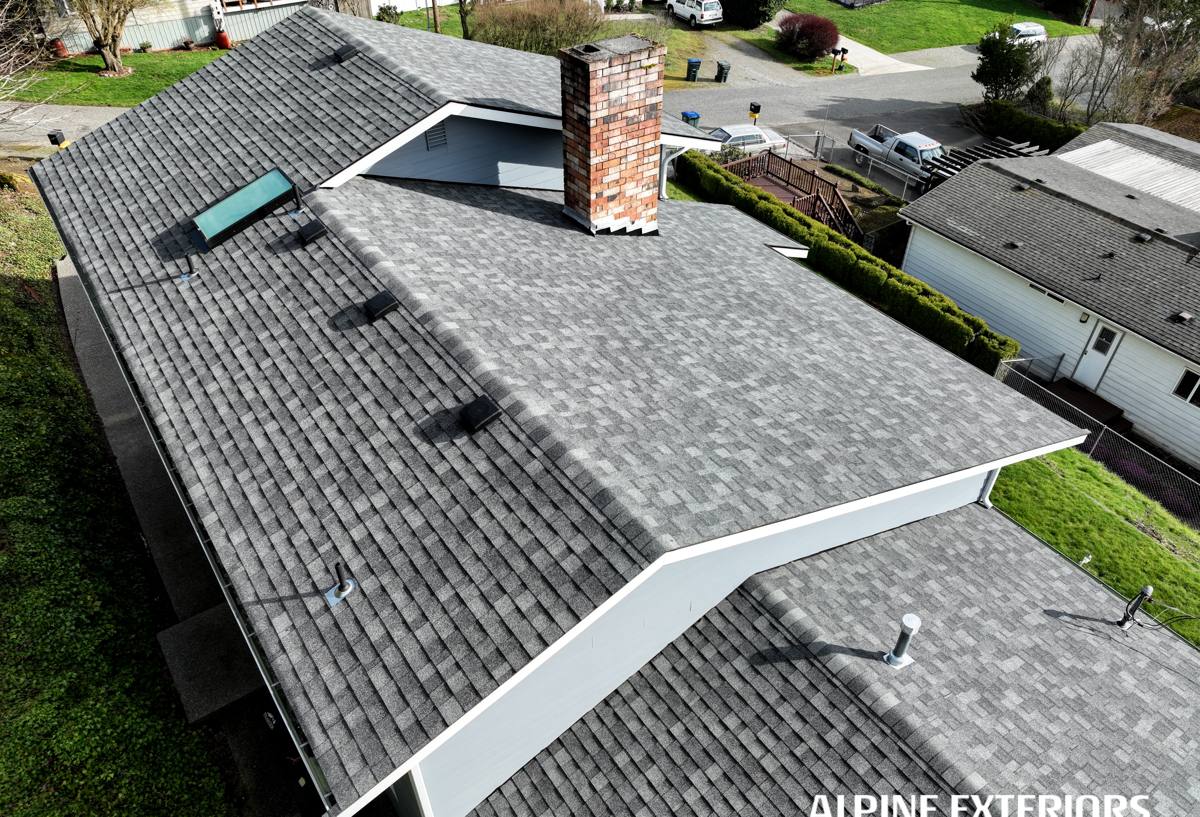
What a Correct New Roof Installation Actually Involves
A new roof is more than laying shingles or panels over the old ones. The parts of the job that don't show once it's finished are usually the parts that determine how long it lasts.
Tear-Off and Deck Inspection
We remove the old roofing down to the deck rather than layering over it. That's the only way to actually see the plywood or OSB underneath — soft spots, old water staining, or rot that's been hidden under the existing roof for years. In a marine climate, deck damage is common around chimneys, vent penetrations, and valleys, exactly the areas where water has had the most opportunity to find a way in over time. Any damaged sheathing gets replaced before anything new goes down.
Underlayment
This is where wind-driven rain gets stopped before it ever reaches the deck. We use a synthetic underlayment system with self-adhering membrane at the eaves, valleys, and any low-slope transitions — the spots where water is most likely to be pushed uphill by wind rather than simply running off. This matters more on a bluff-exposed property than it does a few miles inland.
Flashing
Flashing around chimneys, skylights, sidewalls, and roof-to-wall transitions is where most leaks actually start, not in the field of the roof. We install new metal flashing rather than reusing old pieces, and we use corrosion-resistant material given the salt exposure this close to the water.
Ventilation
Proper intake and exhaust ventilation keeps moisture from condensing inside the attic, which matters year-round in a climate this damp. It also keeps the roof deck at a more even temperature, which reduces moss growth and ice buildup risk during cold snaps.
Field Material
Shingles, panels, or whatever the chosen material is, installed to manufacturer spec with correct nailing pattern and exposure — this is the step people picture when they think "new roof," but it's the last of five, not the whole job.
Our Process, Start to Finish
- On-site assessment. We walk the roof (not just look from the ground), check the attic for existing moisture or ventilation issues, and look at how the home is oriented to wind and rain exposure.
- Written estimate. Materials, scope, and price laid out clearly — no vague allowances that turn into surprise add-ons later.
- Material selection. We walk through the honest trade-offs for this specific home and this specific exposure, not just what's cheapest or most popular.
- Scheduling around weather. Roofing in this region means working around rain windows. We plan installation days with enough buffer that a shortened forecast doesn't force a rushed, exposed roof deck overnight.
- Tear-off, deck repair, and dry-in. The roof gets weathertight the same day it's opened up whenever possible.
- Flashing, ventilation, and field installation. Completed to spec, with attention to the detail work that determines long-term performance.
- Final walkthrough. We go over the finished roof with the homeowner and cover basic maintenance expectations for this climate.
Material Comparison for This Climate
There's no single "best" roofing material — the right choice depends on budget, the home's roof pitch and style, and how much moss and moisture exposure the specific lot gets. Here's how the common options stack up for a Port Gardner property.
| Material | Moss/Moisture Resistance | Salt Air Durability | Typical Lifespan | Maintenance |
|---|---|---|---|---|
| Architectural asphalt shingle | Good with algae-resistant granules; still needs periodic moss removal in shaded areas | Good — minimal exposed metal in the field | 25–30 years | Moderate — gutter and moss upkeep |
| Standing seam metal | Excellent — sheds moisture, little surface for moss to grip | Good with coated/corrosion-resistant panels and fasteners | 40–50+ years | Low |
| Synthetic composite (shake-look) | Very good — doesn't absorb moisture like wood | Good | 30–50 years | Low |
| Cedar shake | Poor without diligent upkeep — absorbs moisture, prone to moss and rot in shade | Fair — needs regular treatment | 20–30 years with maintenance | High |
We're honest with clients about cedar shake specifically: it can look great, but in a shaded, damp, salt-air lot it demands a level of ongoing maintenance — cleaning, treating, replacing individual shakes — that most homeowners underestimate going in. If the goal is lowest long-term maintenance for this specific climate, asphalt, metal, or synthetic composite are usually the more practical call.
Ventilation and Moss: The Long Game
A lot of roofs in this part of Snohomish County fail early not because the shingles wore out, but because moss and trapped moisture undermined them from underneath. Moss holds water against the roof surface long after rain has stopped, and its root structure can lift shingle edges enough to let wind-driven rain work its way in. Combine that with an attic that isn't venting properly, and you get moisture pressure from both sides of the deck at once.
Correct ridge and soffit ventilation, sized to the attic volume, is a big part of the answer — it keeps air moving so surfaces dry out between storms instead of staying damp. Zinc or copper strips near the ridge can help suppress moss regrowth on shaded slopes, and keeping trees trimmed back from the roofline reduces both shade and debris buildup in valleys and gutters. None of these fixes the moss problem forever on their own, but together they meaningfully extend how long a new roof stays in good condition.
Signs a Roof Needs Replacement, Not Just Repair
- Granule loss heavy enough that you can see bare, shiny patches on asphalt shingles
- Shingles curling, cupping, or cracking across multiple slopes, not just one isolated spot
- Daylight visible through the roof deck from inside the attic
- Soft or spongy spots when walking the roof, indicating deck rot underneath
- Recurring leaks in different locations after repeated patch repairs
- Moss or algae staining that keeps returning within a season or two of cleaning
- Roof age past 20–25 years for asphalt, even if it "looks okay" from the ground
A single localized issue — a cracked pipe boot, a section of lifted shingles after a windstorm — is usually a repair, not a full replacement. The difference matters for budget, and a straightforward assessment should tell you honestly which situation you're in rather than defaulting to the bigger job.
What Drives the Cost
| Factor | Why It Matters |
|---|---|
| Roof size and number of slopes/valleys | More material and more flashing detail work at each transition |
| Existing deck condition | Rot or soft sheathing found during tear-off adds repair cost that can't always be quoted sight-unseen |
| Material choice | Metal and synthetic composite cost more up front than asphalt but need less long-term upkeep |
| Roof pitch and accessibility | Steeper or harder-to-access roofs take longer and require more safety equipment |
| Ventilation upgrades needed | Adding or correcting intake/exhaust venting is a smaller add-on during a full tear-off than as a separate project later |
Broadly, a full asphalt shingle replacement on an average-size home runs in the mid four figures to low five figures depending on the factors above; metal and synthetic composite run higher up front. Any of those numbers should come from an actual on-site look at the roof, not a phone estimate — deck condition especially can't be judged accurately from the ground or from photos.
What to Ask Before Hiring a Roofing Contractor
- Do you tear off down to the deck, or install over the existing roof?
- What underlayment and flashing materials do you use, and why those specifically for this location?
- Is the estimate itemized, or is it a single lump number with vague scope?
- Are you licensed and insured for roofing work in Washington, and can you provide proof?
- What's the manufacturer's warranty on materials, and what's your labor warranty separately?
- Have you worked on homes in this specific part of Everett, and do you understand the local exposure?
- How do you handle scheduling around rain, and what happens if weather interrupts a tear-off mid-project?
Why Local Experience in Port Gardner Matters
A roofing crew that mostly works drier, inland areas can still do competent general work — but they may not default to salt-resistant fasteners, self-adhering membrane at every low-slope transition, or ventilation sized for a shaded, moisture-heavy lot unless they're specifically thinking about it. A crew that's worked this waterfront-adjacent stretch of Everett repeatedly treats those choices as standard practice, not upgrades someone has to ask for. That's less about brand loyalty and more about which details a crew has learned, over repeated jobs in this exact climate, actually matter.
It also means fewer surprises during the estimate. We know what deck condition tends to look like under an older roof in this area, what moss buildup usually means once it's removed, and how exposure to wind off the bay tends to show up in flashing wear. That translates into estimates that hold up once tear-off actually starts, instead of ballooning with change orders.
If your roof is showing its age, or you just want a straight answer on repair versus replacement, we're happy to take a look. Request a free, no-pressure estimate using the form below — we'll walk the roof, tell you honestly what we find, and lay out the options in plain terms.