 Everett
 Lake Stevens Siding Has a Different Job to Do
Lake Stevens sits inland from Puget Sound, but the climate that governs it is still a Snohomish County climate: long wet winters, a marine air mass that carries salt-tinged moisture well past the shoreline, and tree cover around the lake that keeps siding shaded and damp longer than homes out in open sun. Add driving rain that comes in sideways during winter storms and a moss season that can run eight months or more in shaded, north-facing exposures, and you have a set of conditions that will find every weakness in a siding system — the seams, the fastener pattern, the flashing details, the paint.
None of that means Lake Stevens is unusually harsh. It means siding here has to be chosen and installed with those specific stresses in mind, not treated as an afterthought behind whatever's cheapest at the yard. That's the lens we bring to every siding replacement in this area.
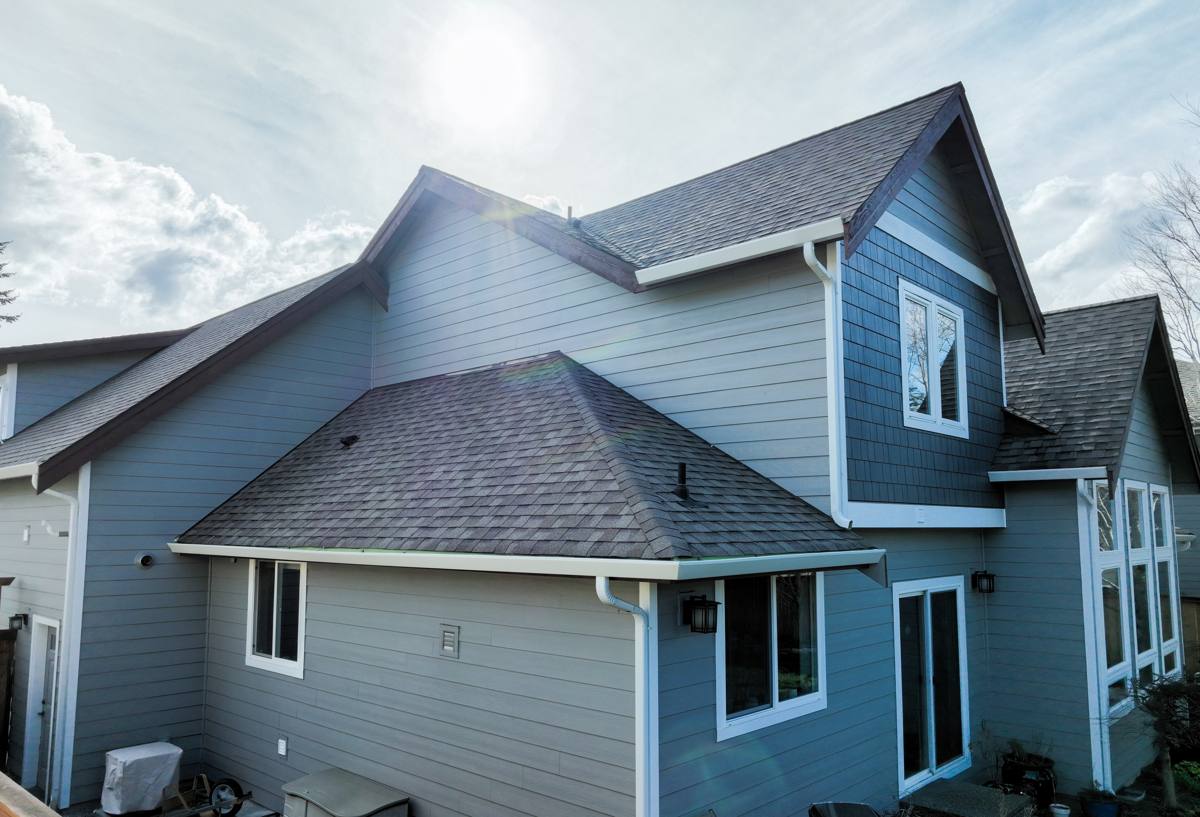
Signs a Lake Stevens Home Needs Replacement, Not Repair
Homeowners often call us assuming a patch job will fix a problem that's actually system-wide. A few signs point to replacement rather than repair:
- Soft or spongy siding when pressed, especially near the bottom courses and around window trim — a sign moisture has gotten behind the material
- Persistent moss or black streaking that returns within weeks of cleaning, even on siding that looks intact otherwise
- Visible cupping, warping, or delamination across multiple boards rather than one isolated spot
- Paint that's failing uniformly across a wall (versus one bad batch or one sun-exposed section)
- Siding installed more than 20-25 years ago on materials not engineered for this climate, even if it looks passable from the street
One or two of these in isolation might mean a repair. Several at once, especially combined with soft spots at multiple points on the wall, usually means the water-resistive barrier and flashing underneath have been compromised — and that's not something you patch over, it's something you rebuild correctly.
What a Correct Siding Replacement Actually Involves
Siding replacement is not a cosmetic swap. The visible boards are the last five percent of the job. What matters most happens underneath, and it's the part a homeowner can't easily inspect once the crew has moved on:
The Water-Resistive Barrier
A properly lapped, sealed weather-resistive barrier is what actually keeps bulk water out of the wall assembly. In a climate with as much sustained rain as Snohomish County sees, gaps or poor laps in this layer are where long-term rot starts — long before the siding itself shows a problem.
Flashing at Every Penetration
Windows, doors, hose bibs, light fixtures, deck ledgers — every point where something interrupts the wall plane needs flashing detailed to shed water outward and downward, never trap it. This is the single most common place we find prior work done wrong on homes we're re-siding.
Fastening and Ventilation
Fiber cement siding has a specific fastener schedule and clearance requirements — nailing patterns, minimum gaps at butt joints, and clearance off grade, decks, and roof lines. Skipping these details doesn't fail immediately; it fails in year eight or ten, which is exactly why cutting corners here is so common and so hard for a homeowner to catch at the time.
Why We Install Only James Hardie Fiber Cement
We get asked regularly why we don't offer vinyl, LP SmartSide, or cedar as options. It's a fair question, and the honest answer is that each of those products asks a homeowner to accept a trade-off we don't think holds up well in this climate over the long run.
| Material | The trade-off in a wet, mossy climate |
|---|---|
| Vinyl | Lightweight and inexpensive, but it expands and contracts significantly with temperature and can warp or crack over time; seams and panel movement create more opportunities for water intrusion |
| LP SmartSide (engineered wood) | Wood-based, so it depends entirely on an intact factory coating and correct field sealing of every cut edge to resist moisture; a missed cut edge in a climate this wet is a real long-term risk |
| Cedar / primed spruce | Attractive but high-maintenance — needs recoating on a regular cycle and is a natural food source for the moss and mildew this area is known for |
| James Hardie fiber cement | Non-combustible, dimensionally stable, engineered specifically for Pacific Northwest moisture conditions, factory-baked ColorPlus finish resists fading and doesn't require the same maintenance cycle |
We're not claiming the alternatives are junk — plenty of them are installed correctly and perform fine for a while. What we're saying is that after years of doing this work in Snohomish County's climate specifically, Hardie fiber cement is the one product line where the long-term maintenance burden and moisture performance line up with what we're willing to put our name on.
Choosing the Right Hardie Line for a Lake Stevens Home
James Hardie engineers its siding by climate zone, and homes here fall into the HZ5 category — the zone specification built for regions with sustained moisture and freeze-thaw cycling rather than dry heat. That's not a marketing distinction; it affects the composition of the board itself.
Beyond the HZ5 base, most Lake Stevens homeowners are choosing between a few common profiles:
- HardiePlank lap siding — the standard horizontal look, available in several exposure widths and textures (smooth or cedar-shake style)
- HardieShingle — for homes wanting a shingle or shake aesthetic without the maintenance burden of real wood shakes
- HardiePanel — vertical panel siding, often used as an accent on gables or in combination with lap siding
- HardieTrim — matching trim boards so the whole envelope, not just the field siding, gets the same moisture performance
ColorPlus factory finish is worth a specific mention for this climate: because the color is baked on at the factory rather than field-painted, it holds up better against the UV and moisture cycling that causes field-applied paint to chalk and fade faster here than in drier parts of the state.
Our Process for a Lake Stevens Siding Replacement
- On-site assessment. We inspect the existing siding, check for soft spots and moisture damage, and look at what's actually happening behind the wall wherever we can access it.
- Written scope and estimate. You get a clear breakdown of what's being replaced, which Hardie products and colors are being used, and what the underlying water management details will look like — no vague line items.
- Tear-off and structural check. Old siding comes off and we inspect the sheathing underneath for rot before anything new goes up. This is the point where hidden problems get caught, not covered.
- Water-resistive barrier and flashing installed to spec. Every penetration gets flashed and sealed before a single piece of siding goes on.
- Hardie siding installed to manufacturer fastening and clearance requirements. This includes proper clearance at grade, decks, and roofline, and correct gapping at all butt joints.
- Final walkthrough. We go over the finished job with you before calling it done.
What Drives Cost on a Lake Stevens Siding Job
Every home is different, and we won't quote a number without seeing the house, but these are the variables that typically move the price:
| Factor | Why it matters |
|---|---|
| Home size and wall complexity | More corners, gables, and dormers mean more cutting, flashing, and labor time |
| Extent of hidden damage | Rot found at tear-off may require sheathing repair before new siding can go on |
| Siding profile chosen | Lap, shingle, and panel styles have different material and labor costs |
| Trim and accessory scope | Full trim replacement adds cost but keeps moisture performance consistent across the whole envelope |
| Access and site conditions | Lake-adjacent lots with grade changes, mature trees, or tight access can add setup time |
Why It Matters That We Already Work in Lake Stevens
A crew that's worked this specific area knows things a generic siding company doesn't: which exposures on a lake-adjacent lot stay shaded and mossy nearly year-round, how tree cover changes the drainage and drying pattern on a wall, and what Snohomish County's permitting and inspection process actually requires before we ever tear off the old siding. That local familiarity shows up in small decisions — where we push for extra ventilation clearance, which walls need closer flashing attention — that a crew unfamiliar with the area might not think to make.
It also means we're not disappearing after the invoice clears. We're working this community on an ongoing basis, which is part of why we stand behind the installation, not just the material warranty.
After Replacement: Keeping Hardie Siding Performing Long-Term
Fiber cement is low-maintenance compared to wood or vinyl, but "low-maintenance" isn't "no-maintenance" in a climate like this one. A short annual routine keeps it performing the way it's designed to:
- Rinse siding annually, especially on shaded or north-facing walls where moss and algae take hold fastest
- Keep gutters clear so water isn't sheeting down the wall face during winter storms
- Trim back vegetation and tree cover that keeps a wall section damp and shaded longer than the rest of the house
- Check caulking at trim joints and penetrations every year or two and re-seal if it's cracking
- Address any impact damage (branches, equipment) promptly rather than letting a small crack become a water entry point
If you're seeing early signs of trouble on your current siding, or you're just ready to stop maintaining a product that isn't built for this climate, we'll come take a look and give you a straightforward, no-pressure estimate — no obligation, just an honest read on what your home actually needs.