 Everett
 Silver Lake's Siding Challenges Are Different From a New Subdivision Across Town
Silver Lake sits among mature trees and close to open water, and that combination creates a specific set of problems for exterior siding that a house on a bare, sun-exposed lot doesn't deal with in the same way. Homes here get more shade for more of the day, which means siding stays damp longer after every rain. Add Everett's long wet season and the salt-laden air that rolls in off Puget Sound, and you have an environment that's genuinely tough on exterior materials — not because any one factor is extreme, but because moisture, shade, and salt exposure stack on top of each other for months at a time.
We install and replace siding around Silver Lake regularly, and the pattern we see is consistent: north- and east-facing walls under tree cover develop moss and mildew staining years before the south side of the same house. Homes tucked closer to the lake itself hold humidity against the wall longer after storms. None of this means Silver Lake is a bad place to own a home — it just means the siding has to be chosen and installed with that reality in mind, not with a one-size-fits-all approach.
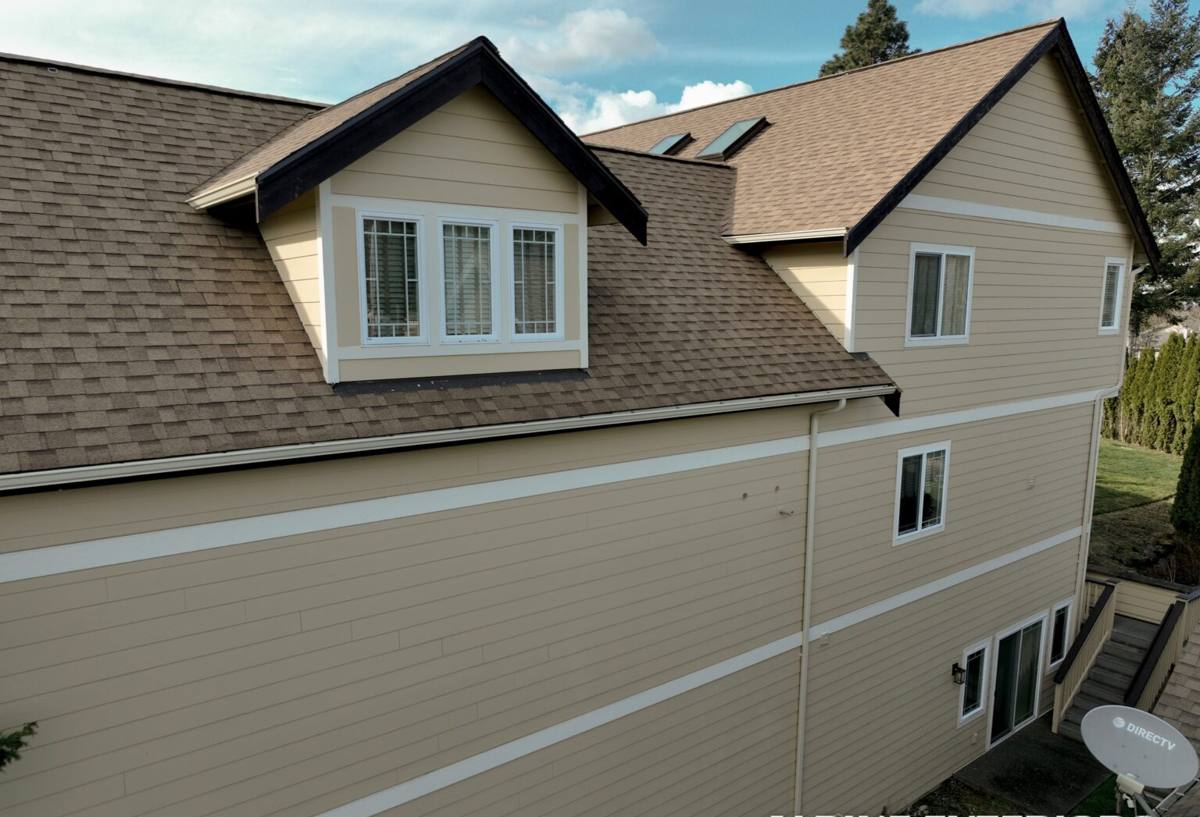
What Snohomish County's Climate Actually Does to Siding Over Time
Moss and Organic Growth
Moss doesn't just sit on the surface — its root structures work into seams, laps, and any place where two pieces of siding meet. On materials that swell or soften when wet, moss growth accelerates the damage. On a material that doesn't absorb water into its core, moss is still unsightly but it's a surface cleaning problem, not a structural one.
Driving Rain and Wind-Driven Moisture
Everett gets rain that comes in sideways during winter storms, which pushes water into laps, corners, and penetrations that a straight-down rain would never reach. This is where correct flashing and lap details matter more than the siding material itself — even the best product fails early if the water management behind it is done wrong.
Salt Air
Being close to Puget Sound means airborne salt settles on exterior surfaces over the year, accelerating corrosion on fasteners, trim, and any metal components. It also affects paint and coating performance on materials that rely on field-applied finishes, since salt residue breaks down some coatings faster than an inland home would ever experience.
Why We Install Only James Hardie Fiber Cement — Nothing Else
We made a deliberate decision years ago to install exclusively James Hardie fiber cement siding, and we turn down jobs where a homeowner wants vinyl, LP SmartSide, Cemplank, Allura, or bare cedar or primed spruce. That's not a marketing position — it's a standard we hold because of what we've seen happen to each of those materials in exactly the climate Silver Lake sits in.
Vinyl siding is inexpensive and low-maintenance in mild climates, but it expands and contracts with temperature swings, can warp or crack in sustained cold snaps, and its seams give moss and mildew plenty of places to take hold — with no way to properly seal those laps against wind-driven rain. LP SmartSide and other engineered wood products use a wood-strand core, and wood-based cores are vulnerable to moisture intrusion at cut edges, fastener holes, and joints; once moisture gets into that core, it doesn't dry out quickly under Silver Lake's tree cover and humidity, and swelling or delamination can follow. Cedar and primed spruce are real wood — they look great new, but they require an ongoing maintenance commitment (recoating, caulking, moss treatment) that most homeowners underestimate, and skipping even one cycle in a wet, shaded environment shortens the material's life considerably.
James Hardie fiber cement is cement, sand, and cellulose fiber — it doesn't have an organic core for moisture to break down, and it's non-combustible. Hardie's HZ5 product line is engineered specifically for climate zones like ours, with formulations built around moisture and freeze-thaw performance rather than a generic national spec. The factory-applied ColorPlus finish is baked on under controlled conditions, which gives it far better resistance to fading and to the salt-air degradation that hits field-applied paint. And Hardie backs the product with a real, transferable warranty — which matters to a lot of Silver Lake sellers and buyers when the house eventually changes hands.
Hardie vs. the Alternatives: A Straight Comparison for This Climate
| Material | Moisture behavior in shade/humidity | Moss/mildew resistance | Maintenance burden | Salt-air durability |
|---|---|---|---|---|
| James Hardie fiber cement | Non-organic core, doesn't swell or rot | Surface growth only, easy to clean | Occasional wash; factory finish holds up | Baked-on finish resists salt degradation |
| Vinyl siding | Doesn't absorb water, but seams trap moisture | Moss collects in laps and J-channels | Low, but color fades and panels can warp | Fasteners and trim corrode faster |
| LP SmartSide / engineered wood | Wood-strand core vulnerable at cuts/joints | Moderate; moisture speeds deterioration | Regular caulk/paint upkeep required | Coating breakdown accelerates near water |
| Cedar / primed spruce | Absorbs moisture, needs to breathe and dry | Requires active treatment to control | High — recoating and sealing on a cycle | Salt residue shortens coating life |
What a Correct Installation Actually Involves
The siding material is only part of the equation — most premature siding failures we're called to look at in Everett trace back to installation shortcuts, not the product itself. On a Silver Lake home, a correct job means:
- A continuous weather-resistive barrier installed with proper overlap and no gaps, taped and sealed at every seam and penetration
- Correct flashing at windows, doors, and any roof-to-wall transitions, sequenced so water is always directed outward and down
- Proper fastener placement and spacing per Hardie's installation spec — not just "close enough," since under-fastened or over-driven boards fail early
- Correct clearance between siding and grade, decks, and roof lines, so water and moss-prone debris don't sit against the bottom course
- Caulking only where Hardie's specifications call for it, using a sealant rated for the exposure — over-caulking traps moisture just as badly as under-caulking
- Field-cut edges properly primed and sealed, since raw fiber cement edges left exposed lose their factory protection
Every one of these steps matters more in a shaded, humid, salt-exposed environment than it would on a dry, sun-exposed lot across town. Skipping any of them shows up as a problem in years, not decades.
Our Process for a Silver Lake Siding Installation
- On-site assessment — we walk the property, checking sun/shade exposure on each elevation, existing moisture damage, and any trouble spots specific to the lot (tree cover, drainage, proximity to grade)
- Product and color selection — we help you choose the right Hardie plank profile and ColorPlus color, factoring in how each elevation's exposure will affect appearance over time
- Removal and inspection — old siding comes off and we inspect the sheathing underneath for hidden rot or moisture damage before anything new goes up
- Weather barrier and flashing — a new, continuous barrier and correct flashing details are installed before a single piece of siding is hung
- Installation to spec — Hardie boards installed per manufacturer fastening and clearance requirements, with attention to every lap, corner, and penetration
- Final walkthrough — we review the finished work with you and point out anything you should watch for as the house settles into the new siding
Signs Your Silver Lake Home's Siding Needs Attention
Because of the shade and humidity common around Silver Lake, siding problems often show up on specific elevations first rather than the whole house at once. Watch for dark staining or moss concentrated on north- or east-facing walls, soft spots or visible swelling near the bottom courses or around windows, paint or finish that's peeling unevenly by wall orientation, and any soft or spongy feel when you press on the siding near ground level or under gutters. Catching these signs early — especially on engineered wood or cedar siding — is the difference between a repair and a full replacement.
Why Local Experience in This Neighborhood Matters
A crew that's worked Silver Lake before already knows which elevations on a typical lot here get the least sun, how close the tree line usually sits to the house, and how the lake's humidity affects drying time between coats and between installation steps. That knowledge shapes real decisions — where to add extra attention to flashing, which color performs better under heavy shade over time, and how to sequence work around the wetter stretches of the year so materials aren't installed against manufacturer moisture guidelines. It's the kind of judgment that only comes from doing the work in this specific area repeatedly, not from a general contractor passing through the county once.
What This Costs and What Drives the Range
| Cost factor | Why it matters in Silver Lake |
|---|---|
| Home size and number of stories | More surface area and harder access on multi-story homes near trees |
| Existing sheathing condition | Hidden moisture damage under old siding is more common under heavy tree cover |
| Siding profile and finish selection | Plank width, texture, and ColorPlus color options affect material cost |
| Trim, soffit, and flashing detail work | Homes with more roof-to-wall transitions need more careful (and time-consuming) flashing |
| Site access and vegetation | Tree-lined lots often need extra care and time around landscaping |
Every Silver Lake home is a little different, and the honest answer on price only comes after we've actually looked at your walls, your framing, and your specific exposure conditions.
If you're weighing your options for a Silver Lake home, we're happy to come take a look, walk the property with you, and put together a straightforward, no-pressure estimate — no obligation, just an honest read on what your house actually needs.