 Everett
 Windows Built for South Everett's Weather, Not Just a Catalog Photo
South Everett sits close enough to Puget Sound that homes here deal with a specific mix of conditions most window sellers never account for: salt-laden air moving in off the water, wind-driven rain that hits window frames sideways instead of straight down, and a long stretch of the year — roughly fall through spring — where humidity stays high enough to grow moss on roofs and encourage condensation on glass. None of that is exotic or rare. It's just normal Snohomish County weather. But it means a window that performs fine in a dry, inland climate can still underperform here if it wasn't chosen or installed with this exposure in mind.
Energy efficiency in this climate isn't only about a lower heating bill, though that matters. It's also about the frame material holding up to years of damp cycling, the seals staying tight through repeated wind events, and the glass not fogging or streaming condensation on cold mornings because warm indoor air is meeting a cold surface with no thermal break. A window package that's genuinely right for South Everett addresses all of that together, not just the energy label on the sticker.
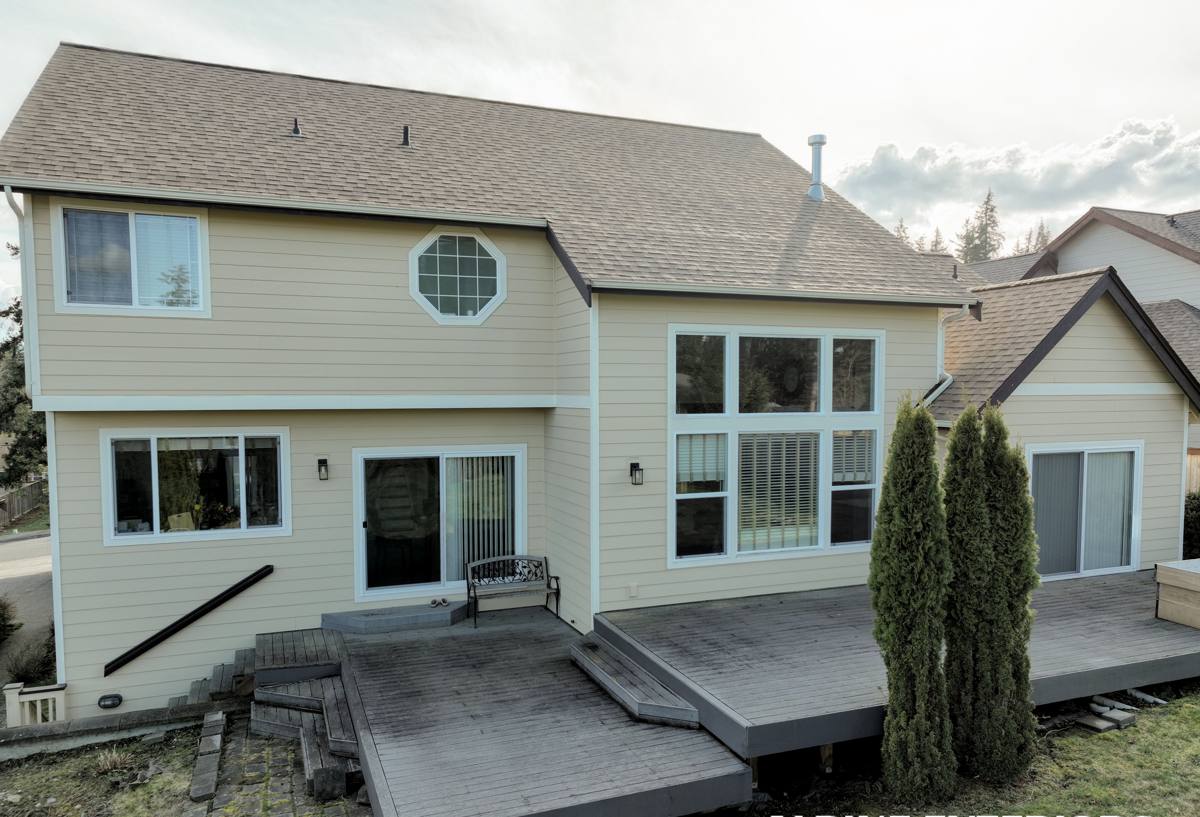
What "Energy Efficient" Actually Means Here
Every new window carries an NFRC (National Fenestration Rating Council) label with a few key numbers. Two matter most in western Washington:
- U-factor — how well the window resists heat loss. Lower is better. This is the number that matters most in our climate, because our heating season is long and our cooling season is short and mild.
- SHGC (Solar Heat Gain Coefficient) — how much solar heat passes through the glass. In hot, sun-heavy climates this is the priority number. Here, it's secondary — we're rarely trying to keep heat out, we're trying to keep it in.
That distinction is worth knowing because some window packages are optimized for the wrong problem. A window heavily engineered to block solar heat gain (common in southern-climate marketing) can trade away some of the U-factor performance that actually matters for a South Everett winter. We spec glass and frame combinations based on the U-factor first, then confirm the SHGC is reasonable — not the other way around.
Double-Pane vs. Triple-Pane
A quality double-pane window with a low-E coating and argon gas fill performs well in this climate and is the right call for most South Everett homes on a normal budget. Triple-pane glass improves U-factor further and adds sound dampening, which some homeowners want if they're near busier roads, but it adds cost and weight, and the marginal energy savings over a good double-pane unit are usually modest here. We'll walk through both honestly rather than upsell the triple-pane option by default.
Frame Material: What Holds Up to Salt Air and Moisture
| Frame Material | How It Handles Salt Air & Moisture | Maintenance |
|---|---|---|
| Vinyl | Doesn't rust or corrode; good baseline performance for the price | Low — occasional cleaning, no painting |
| Fiberglass | Very stable dimensionally, handles damp cycling and temperature swings well | Low — can be painted if desired, rarely needs it |
| Wood-clad | Attractive interior wood look, but the exterior cladding and any exposed joints need to stay sealed against driving rain and salt-laden moisture | Moderate to higher — watch caulk lines and touch-up cladding damage promptly |
| Aluminum | Conducts heat and cold readily unless thermally broken; can be prone to condensation on the frame in our humidity without that thermal break | Low, but not our default recommendation for efficiency-focused replacements |
Our standard recommendation for most South Everett homes is vinyl or fiberglass, specifically because they don't give salt air or a wet winter anything to corrode or swell. Wood-clad windows can look great and we'll install them if that's the look a homeowner wants, but we're upfront that the exterior seals need more attention over the years in this exposure.
Where Window Jobs Actually Go Wrong (It's Rarely the Glass)
Most window failures we get called out to inspect aren't glass failures — they're installation failures. The glass unit itself can be excellent and still let water in if the frame wasn't integrated correctly with the wall behind it. This is the part of the job that separates a correct install from a fast one, and it's where our siding background actually helps:
Sill Pans and Flashing
Every replacement window opening should have a sloped sill pan that directs any water that gets past the frame back outside, not into the wall cavity. Flashing tape needs to integrate with the house wrap or weather-resistive barrier in the correct shingle-lap order — top piece over the side pieces, side pieces over the sill pan — so water always sheds down and out. Skipping or rushing this step is the single most common cause of hidden rot behind "new" windows, and it's invisible until there's a problem years later.
Sealant Selection and Placement
Wind-driven rain off the Sound pushes water sideways and even slightly upward against a wall during a real storm. That means sealant has to be applied at the right joints — not just a bead around the exterior trim — and needs to be a product rated for continued flexibility through our wet-to-dry seasonal cycling. A sealant that hardens or shrinks after a couple of winters isn't doing its job anymore even if it looks fine from the ground.
Interior Condensation Control
During the long moss-season stretch of high humidity, condensation on interior glass or frames is usually a sign of one of three things: an older single-pane or failed double-pane seal, a poorly insulated frame, or a ventilation/humidity issue inside the home unrelated to the window itself. Part of a proper assessment is telling you honestly which one it is before you spend money assuming new glass alone will fix it.
Our Process for a South Everett Window Replacement
- On-site assessment — we look at each opening individually: current frame condition, signs of past water intrusion, sun/wind exposure per elevation, and how the window ties into the existing siding or trim.
- Product selection — we go over frame material, glass package, and grid/style options against your budget and the home's exposure, with the U-factor priority explained above.
- Ordering and lead time — custom-sized windows typically take several weeks to arrive; we plan install dates around both that lead time and a realistic weather window, since flashing and sealant work needs a dry install day to cure properly.
- Removal and opening prep — old units come out, the opening is inspected for hidden damage before anything new goes in, and any rot or compromised sheathing is addressed rather than covered over.
- Sill pan, flashing, and window set — installed in the correct sequence described above, then the new unit is shimmed, leveled, and fastened per manufacturer specs.
- Sealant, trim, and cleanup — exterior sealant, trim work to match the existing siding line, interior finish work, and full cleanup of the work area.
- Walkthrough — we operate every window with you before we call the job done and go over warranty coverage on both the product and our labor.
Signs Your Current Windows Are Working Against You
- Visible condensation or fogging between the panes (a sign the seal has failed, not something that can be cleaned away)
- Drafts you can feel near the frame even when the window is fully latched
- Wood trim or sill discoloration, softness, or paint failure near a window — often an early flashing or sealant issue
- Difficulty opening, closing, or latching, especially after a wet stretch of weather
- Noticeably colder rooms in winter near windows compared to interior rooms
- Rising heating bills without a clear other explanation
- Moss or persistent green growth on the sill or surrounding trim, indicating standing moisture
What Drives Window Project Cost
| Factor | Why It Matters |
|---|---|
| Number and size of openings | Larger and more numerous windows increase material and labor directly |
| Frame material chosen | Vinyl, fiberglass, and wood-clad sit at different price points before install labor |
| Full-frame vs. insert replacement | Full-frame (removing down to the rough opening) costs more but is often the correct choice when there's any sign of hidden water damage |
| Extent of flashing/sheathing repair needed | Hidden rot found during removal adds work, but it's work you want done rather than covered up |
| Glass package | Double-pane low-E/argon vs. triple-pane, plus any grid or specialty glass options |
Whole-house window replacement projects for a typical South Everett home generally fall in a broad mid-four to low-five-figure range depending on the factors above; single or partial replacements are proportionally less. We give firm numbers only after seeing the actual openings — quoting sight-unseen tends to undersell hidden repair work that comes up during removal.
Why a Crew That Already Works South Everett Matters
Window installation done right depends on understanding how a specific house handles water, not just how to hang glass in an opening. A crew that regularly works South Everett homes has already seen how the local wind and rain patterns tend to hit different elevations, knows what condition to expect behind older siding when an opening is cut into it, and isn't guessing at permit requirements with the City of Everett or Snohomish County for a given scope of work. That familiarity shows up as fewer surprises mid-project and a longer-lasting result, not just a faster one.
If you're weighing new windows for a South Everett home, we're happy to come take a look, walk you through what your specific openings actually need, and give you a straight answer — including telling you if a repair or partial replacement makes more sense than doing the whole house at once. Reach out for a free, no-pressure estimate using the form below.