 Everett
 Why Marysville Siding Takes More Punishment Than People Expect
Marysville sits close enough to Port Susan and the greater Puget Sound corridor that salt-laden air is a real factor for exterior materials here, not a coastal-town exaggeration. Add Snohomish County's long wet season, driving rain that comes in sideways off frontal systems, and shaded north-facing walls that barely dry out from October through April, and you have a climate that's genuinely tough on siding. Homes here don't fail because owners neglect them. They fail because the wrong material was asked to do a job it was never built for.
Salt air accelerates corrosion on fasteners and trim hardware. Driving rain finds every gap in flashing and caulk that a calmer climate would never expose. And moss and algae, given eight or nine months of damp shade, will colonize almost any siding surface that holds moisture or has a rough, absorbent face. None of that is unique to Marysville, but the combination is more persistent here than in drier parts of the state, which is exactly why the siding choice and the installation quality matter more than the brand name on the invoice.
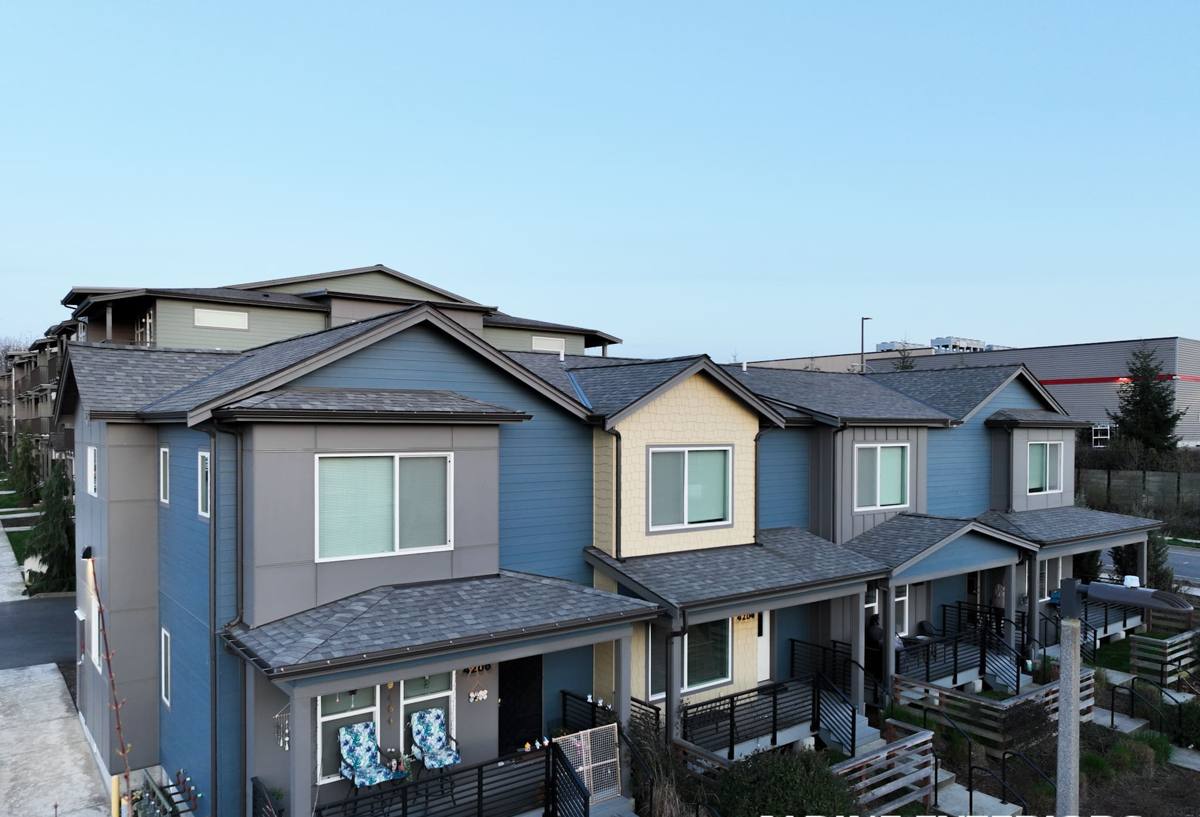
What Fiber Cement Actually Solves for This Neighborhood
Fiber cement siding is a mix of Portland cement, sand, and cellulose fiber, engineered to be dimensionally stable, non-combustible, and resistant to moisture-driven rot. That matters directly for Marysville conditions:
- It doesn't swell, cup, or delaminate the way engineered wood products can when repeatedly wetted along cut edges and seams.
- It holds a factory finish far longer than field-painted wood or primed siding, which matters when driving rain and UV cycle a wall through wet-dry stress constantly.
- It's non-combustible, which is a genuine benefit anywhere in Western Washington's wildfire-adjacent seasons, not just east of the mountains.
- Its harder, denser surface resists moss and algae adhesion better than porous or textured wood-fiber substrates, though nothing prevents organic growth entirely in this climate.
We install James Hardie exclusively — not because every other product on the market is bad, but because we've made a professional call about what holds up best, longest, with the least callback risk, in exactly the conditions Marysville throws at a house. Hardie's HZ5 product line is engineered specifically for climates like ours: freeze-thaw cycling, sustained moisture exposure, and coastal-influenced humidity.
ColorPlus Finish and Why It Matters in Driving Rain
James Hardie's ColorPlus finish is baked on in a controlled factory environment, through multiple coats, rather than sprayed or brushed on-site after installation. In a climate where field-applied paint has to cure through unpredictable rain windows, a factory finish removes that variable entirely. It also resists the chalking and fading that field paint shows first, and touch-up product is formulated to match rather than approximated on-site.
How Fiber Cement Compares to the Alternatives Homeowners Consider
| Factor | James Hardie Fiber Cement | Vinyl Siding | Engineered Wood (LP SmartSide) | Cedar / Primed Wood |
|---|---|---|---|---|
| Moisture behavior in driving rain | Stable; won't swell or rot | Doesn't absorb, but seams and J-channels trap water behind panels | Vulnerable at cut edges and fastener points if seal fails | Absorbs; needs consistent maintenance to stay sealed |
| Salt air / coastal exposure | Engineered for it (HZ5 line) | Can become brittle and discolor over time | No specific coastal engineering | No inherent resistance |
| Moss and algae resistance | Dense surface resists adhesion | Smooth but seams collect debris | Textured grain holds moisture and organics | Porous grain, high moss risk |
| Fire resistance | Non-combustible | Melts/deforms under heat | Combustible | Combustible |
| Finish longevity | Factory ColorPlus, 15-year finish warranty typical | Color molded in, fades over time, cannot be repainted easily | Field or factory finish, shorter repaint cycle | Field-painted, repaint every few years |
| Long-term maintenance | Occasional wash, caulk checks | Low, but seams degrade and can't be spot-repaired well | Moderate to high, edge sealing critical | High, regular sealing/painting |
This isn't a claim that every alternative is unusable — vinyl and engineered wood both have a place in the market. It's why, as a company, we standardized on one product system we can install to spec and stand behind, rather than stocking five products and hoping each holds up.
What a Correct Fiber Cement Installation Actually Involves
The material is only half the equation. Most fiber cement failures we're called to look at trace back to installation shortcuts, not the product itself — and in a climate that drives rain sideways into walls, those shortcuts show up faster than they would somewhere drier.
Weather-Resistive Barrier and Flashing First
Before a single plank goes up, the wall needs a properly lapped weather-resistive barrier and correctly integrated flashing at every window, door, and penetration. In Marysville's rain patterns, flashing that's reversed, missing, or improperly lapped is the single most common source of hidden water intrusion — and it's invisible once siding covers it.
Gaps, Clearances, and Fastening
James Hardie's own installation instructions specify minimum clearances from grade, roof lines, and decks, plus specific gap and caulking requirements at butt joints and trim. Fasteners need to be corrosion-resistant and driven to the correct depth — overdriven nails crack the board's edge and create a moisture entry point that's easy to miss on a walk-through but shows up as staining within a year or two.
Caulk and Sealant Selection
Not every sealant on the shelf is rated for the movement and exposure fiber cement trim sees here. Using the wrong caulk, or skipping it at transitions where two material types meet, is a common shortcut that fails quietly until a homeowner sees a dark stain bleeding through paint.
- Weather-resistive barrier lapped correctly, shingle-style, top to bottom
- Flashing integrated — not just caulked — at every window and door
- Minimum clearance maintained from grade, roofing, and decking per manufacturer spec
- Fasteners corrosion-resistant and set to correct depth, not overdriven
- Butt joints and trim sealed with a sealant rated for the exposure
- Field-cut edges sealed or back-primed before installation, not left raw
Our Process on a Marysville Job
We start with an on-site walk of the exterior, checking not just the visible siding but what's likely happening behind it — soft spots, staining patterns near grade, and window flashing condition. From there we scope the job as a full tear-off and re-wrap rather than siding over existing material, because covering up a compromised weather barrier just delays a bigger repair later.
Once materials are ordered, installation follows Hardie's fastening and clearance specs, with attention to the details that matter most in this climate: flashing integration, gap sealing, and correct clearance at grade and roofline transitions. We walk the finished job with the homeowner before calling it done, and we register the manufacturer warranty properly so it actually transfers if the home sells.
Living With Fiber Cement Siding in a Marysville Climate
Fiber cement is low-maintenance compared to wood, but "low" isn't "none." A periodic gentle wash — garden hose pressure, not a pressure washer aimed directly at seams — keeps moss and algae from establishing on north-facing and shaded walls. Caulking at trim and butt joints should get a visual check every year or two, since UV and freeze-thaw cycling eventually age any sealant, and catching a failed bead early is a five-minute fix instead of a moisture problem behind the wall. Gutters and downspouts that dump water directly against a wall are worth correcting regardless of siding material, since concentrated runoff is one of the more common causes of localized staining and moss growth we see on Marysville homes.
Why Hiring a Crew That Already Works This Area Matters
Snohomish County's coastal-influenced microclimates aren't uniform — a wall facing Port Susan handles different salt exposure than a shaded lot a mile inland, and a crew that only installs siding occasionally in this specific area won't necessarily know which details to prioritize. A local crew that's already doing this work in Marysville and around Everett knows which walls need extra attention to flashing, which lots run damp longer into spring, and how local permitting and inspection expectations run. That local pattern recognition is part of what keeps a job from becoming a callback.
Ready for a Straight Answer on Your Siding
If your current siding is showing staining, soft spots, persistent moss, or peeling paint, it's worth getting an honest look before deciding what to do next. We offer free, no-pressure estimates for Marysville homeowners — walk the exterior with us, ask about the James Hardie product line, and get a clear scope of what correct installation looks like for your specific home. Use the form below to get started.