 Everett
 Decks in South Everett Take More Punishment Than People Expect
South Everett sits close enough to Puget Sound and the Snohomish River lowlands that homes here deal with a specific combination of moisture problems: salt-tinged air drifting in off the water, long stretches of driving rain through fall and winter, and a moss season that can run eight months or more on shaded lots. A deck built the same way you'd build one in a dry inland climate will show problems here within a few years — soft spots at the ledger, rusting fasteners, and a slick green film that never fully goes away between power washings.
None of that means you can't have a good deck in South Everett. It means the details that don't matter much in other climates — flashing, fastener grade, drainage, and material choice — matter a lot here. This page covers what a deck actually needs to hold up in this specific area, and what our process looks like when we build one.
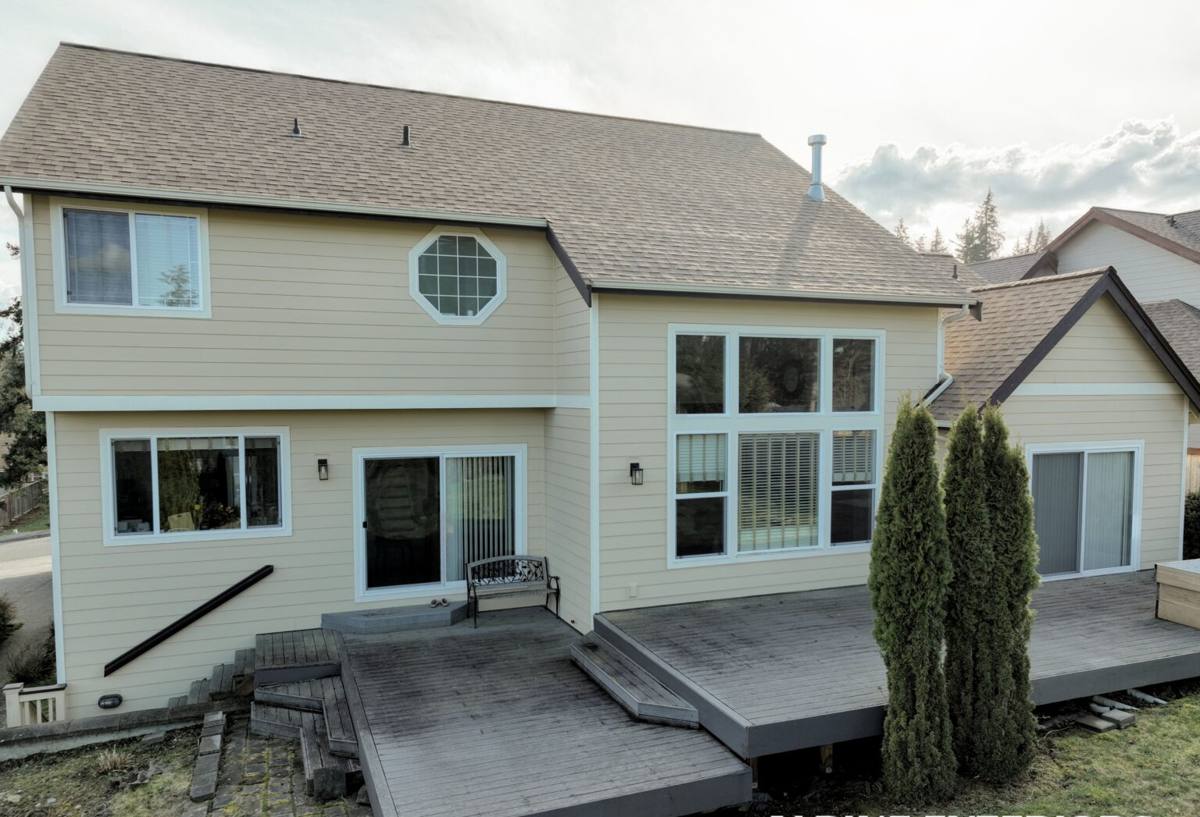
The Two Places Where Everett Decks Actually Fail
Ledger Board Flashing
Most attached decks fail where they meet the house, not out in the field of the deck. The ledger board — the piece bolted to your house that the joists hang from — sits directly against your home's sheathing and framing. If water gets behind it, it doesn't dry out quickly in our climate; it sits there and rots the ledger, the rim joist, and sometimes the framing behind your siding. Correct flashing (a proper metal flashing cap plus a water-resistant barrier between the ledger and the house, with the housewrap or siding integrated over the top of it, not just caulked) is the single most important detail on an attached deck in this area. It's also the detail that's easiest to shortcut, because it's invisible once the deck is built.
Fastener Corrosion
Standard galvanized fasteners hold up fine in a lot of the country. Closer to Puget Sound, the combination of salt air and near-constant moisture accelerates corrosion on lower-grade hardware, especially at joist hangers, ledger bolts, and any exposed screw heads. We build with stainless steel or high-grade coated fasteners and hardware rated for coastal exposure, because replacing a handful of rusted screws is easy — replacing a joist hanger that's failed is not.
Choosing the Right Decking Material for This Climate
There's no single "best" decking material — there's a best material for your budget, your maintenance appetite, and how shaded your lot is. Here's how the common options actually perform in a wet, moss-prone climate like Everett's:
| Material | Moisture/Rot Behavior | Moss & Algae Resistance | Maintenance | Typical Lifespan |
|---|---|---|---|---|
| Pressure-treated lumber | Good if properly sealed; end cuts and fastener holes are vulnerable points | Low — porous surface holds moisture and organic buildup | Re-seal every 1-2 years; annual cleaning | 15-20 years with upkeep |
| Cedar | Naturally rot-resistant but still needs sealing in this climate | Moderate — better than PT but still needs regular cleaning | Sealing every 1-2 years; more sensitive to neglect | 15-20 years with upkeep |
| Composite / capped composite | Excellent — non-porous, doesn't absorb water | Good — smooth cap resists moss rooting, though surface film can still form in deep shade | Periodic washing; no sealing or staining | 25-30+ years |
| PVC decking | Excellent — fully synthetic, no organic material to rot | Good, same caveat as composite in heavy shade | Periodic washing | 25-30+ years |
On heavily shaded South Everett lots — the kind with mature fir or cedar cover — we lean homeowners toward composite or PVC decking more often than we would on an open, sunny site, simply because wood surfaces in constant shade stay damp longer and grow moss faster no matter how well they're sealed. That said, plenty of homeowners want the look and feel of real wood and are fine with the maintenance schedule — that's a legitimate choice too, as long as it's made with eyes open.
Framing, Footings, and Drainage
What's under the decking matters as much as the decking itself. A few specifics we build to on every project:
- Footings dug and poured to the depth required by local code, not just "deep enough" by eye
- Joist framing with proper hanger hardware at every connection — no toe-nailed joists
- Grading and drainage planned so water sheds away from the house and footings instead of pooling underneath the deck
- Ventilation gaps maintained under low decks so the framing can actually dry out between rain events
- Any structural wood in ground contact or close to grade rated for that exposure, not standard PT lumber
A deck that looks finished on top but was framed with shortcuts underneath is the kind of project that causes problems five or ten years down the road — after the person who built it is long gone. We frame decks assuming they need to survive Snohomish County winters for decades, not just pass a walkthrough.
Guardrails, Stairs, and Permits
Any deck above a certain height needs a code-compliant guardrail, and stairs need proper rise/run and handrail specs — these aren't optional details, they're safety code and they get checked at inspection. Everett and Snohomish County permitting requires a permit for most new decks and significant deck rebuilds, along with inspections at key stages of construction. Skipping the permit might save a little time up front, but it creates real problems later: at resale, with insurance claims if something fails, and with liability if someone gets hurt on an unpermitted structure. We pull the necessary permits and build to the code that applies to your property, and we coordinate the inspections so you don't have to chase that down yourself.
Living With Moss and Algae in South Everett
Even a well-built, well-sealed deck in this area will see some moss and algae growth eventually — it's a function of the climate, not a sign something was done wrong. What makes the difference is how much and how fast:
- Trim back overhanging branches where possible to let more light and air reach the deck surface
- Sweep debris off regularly — wet leaves and needles trap moisture and feed moss growth
- Clean and reseal wood decking on schedule rather than waiting until it looks bad
- Wash composite or PVC decking periodically even though it doesn't need sealing — surface film still builds up in shaded areas
- Avoid pressure washing wood decking at high pressure, which can strip fibers and actually roughen the surface, giving moss more to grip
None of this is complicated, but it's easy to let slide, and once moss establishes itself it's a lot more work to remove than to prevent.
Our Process for a South Everett Deck Project
- On-site assessment — we look at sun exposure, tree cover, drainage patterns, and how the deck will attach to your home before recommending a material or layout
- Design and material selection — sized, priced, and specified based on your budget and how much maintenance you actually want to do long-term
- Permitting — we handle the permit application and coordinate required inspections through the city or county
- Build — footings, framing, flashing, decking, and railing, built in that order with attention to the details covered above
- Final walkthrough — we go over the finished deck with you, including basic care and maintenance for whatever material you chose
Why Hiring a Crew That Already Works in South Everett Matters
A contractor who mostly builds in drier parts of the state may not default to coastal-grade fasteners, may not think twice about ledger flashing in a climate that punishes mistakes slowly and invisibly, and may not have a feel for which lots in this area need extra drainage planning versus which don't. A crew that regularly works South Everett has already seen what five- and ten-year-old decks in this climate look like when they were built right — and when they weren't.
A short checklist worth using when you're vetting any deck contractor in this area:
- Do they specify stainless or coastal-rated fasteners and hardware, or just "standard galvanized"?
- Can they explain their ledger flashing method in plain terms, without hand-waving?
- Are they pulling the permit and scheduling inspections, or asking you to skip that step?
- Do they give you honest maintenance expectations for the material you're choosing, not just a sales pitch?
- Are they licensed and insured, and willing to put that in writing?
If a contractor can't answer the flashing and fastener questions clearly, that's worth noting before you sign anything.
Get a Free, No-Pressure Estimate
If you're planning a new deck or replacing an aging one in South Everett, we're glad to come take a look, walk you through material options for your specific lot, and give you a straightforward estimate — no pressure, no sales tactics. Use the form below to get started.